

DianNei Tech and Collaborators Publish Groundbreaking Study in Cancer Research: 3D Deep Learning Model Outperforms Radiologists in Predicting Early Tumor Invasiveness from Subcentimeter Pulmonary Adenocarcinoma CT Scans
Recently, VCBeat (WeChat ID: vcbeat) learned that the joint research team, comprising Diannei Technology, the “Zhang Guozhen Center for Diagnosis and Treatment of Tiny Pulmonary Nodules” at Huadong Hospital Affiliated to Fudan University, and the “SJTU-UCLA Joint Research Center for Machine Perception and Reasoning” at Shanghai Jiao Tong University, published their collaborative research findings titled “3D Deep Learning from CT Scans Predicts Tumor Invasiveness of Subcentimeter Pulmonary Adenocarcinomas” in Cancer Research, the journal of the American Association for Cancer Research (AACR). The journal had an impact factor of 9.13 in 2017.
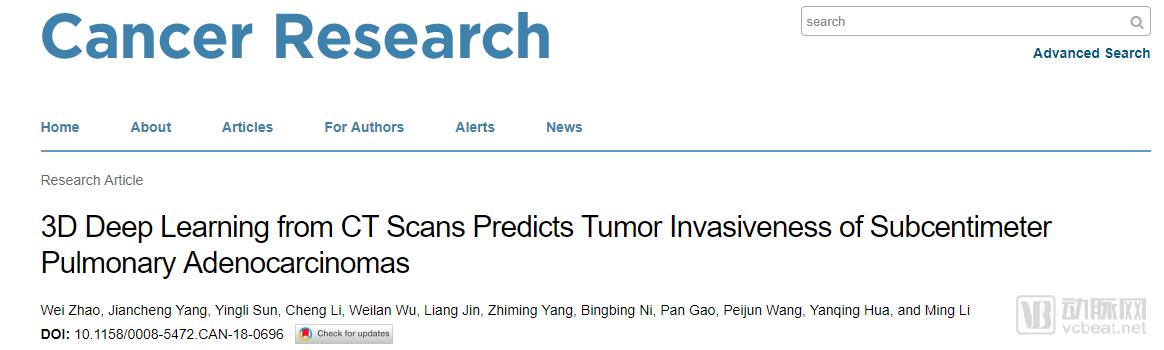
Paper Screenshot
This article was published online on October 2, 2018. It employed deep learning methods to train on CT data of sub-centimeter lung adenocarcinomas with pixel-level annotations and their corresponding clinical outcome labels. By leveraging a multi-task convolutional neural network, the study achieved automatic preoperative prediction of the invasion risk for sub-centimeter lung adenocarcinomas. Furthermore, it established a task spectrum in medical imaging to reduce the model’s learning difficulty, thereby enhancing its transfer generalization capability, stability, and reliability. This research can assist physicians in selecting treatment strategies for early-stage lung cancer and will effectively promote the development of precision medicine.
CT Imaging Predicts Early Tumor Invasion, Precisely Addressing Challenges in Lung Cancer Screening
Professor Li Ming from Huadong Hospital of Fudan University discussed the current status of lung cancer: “China is a country with a high incidence of lung cancer, where the five-year survival rate is below 20%, and the mortality rate ranks first among all cancers. This situation stems from the lack of early screening awareness among patients in China; by the time lung cancer is detected, it has often progressed to an intermediate or advanced stage, making treatment challenging even with current medical capabilities. Meanwhile, the high cost of medical care not only places financial strain on patients’ families but also imposes a significant burden on the national healthcare insurance system. Therefore, China has introduced multiple policies aimed at decentralizing patient care to primary healthcare institutions, a process that requires artificial intelligence assistance.”
However, while there are numerous companies in China specializing in pulmonary nodule analysis with comparable accuracy in image recognition, the overall quality of their diagnostic workflows varies significantly. To stand out in this industry, Diannei Technology has adopted a multi-class classification approach to categorize pulmonary nodules into four subtypes: atypical adenomatous hyperplasia (AAH), adenocarcinoma in situ (AIS), minimally invasive adenocarcinoma (MIA), and invasive adenocarcinoma (IA). This method provides recommendations on the extent of early invasion, enabling a more in-depth assessment of patients’ pulmonary nodules.
On a test set of 128 cases, the multi-task deep learning model outperformed four radiologists (two senior and two junior). The model achieved an AUC of 78.8% for binary classification of invasive versus non-invasive lesions, an AUC of 88.0% for binary classification of IAC versus non-IAC (Stage 0/Stage I), and an F1 score of 63.3% for three-class classification of AAH-AIS/MIA/IAC.
The subcentimeter pulmonary nodule data used in this study consisted predominantly of ground-glass nodules (GGNs). For this type of nodule, particularly subcentimeter GGNs, diagnosis is highly challenging due to the infrequent presence of traditional malignant features on CT images and the significant overlap in imaging manifestations between pre-invasive and invasive lesions. In three-class classification, the diagnostic accuracy of senior radiologists was only 56.6%, whereas the deep learning model achieved an accuracy of 63.3%. These findings highlight the advantages and promising potential of deep learning in addressing such diagnostic challenges.
From conception to publication, this work underwent data collection, pixel-level annotation, data processing, model development and training, model testing, application for access to public datasets, downloading, annotation, testing, manuscript drafting, revision, peer review, and resubmission. The joint research team within the institution completed the algorithm development, testing, and paper publication in less than nine months.
About Diannei Technology
Diannei Technology is an innovative high-tech enterprise established in April 2016, with its headquarters located in Shanghai, China. The company’s core management team hails from senior positions at Fortune 500 pharmaceutical and medical device companies, including members of the American Association for the Advancement of Science (AAAS).
In the 2017 “Tianchi Medical AI Competition – Intelligent Diagnosis of Pulmonary Nodules,” Diannei Technology outperformed 2,886 competing teams from around the world to secure first place. In August of the same year, Diannei Biotechnology received tens of millions of RMB in investment from Xinyi Investment.
In terms of AI product approval, Diannei Technology has long maintained a position on par with leading AI healthcare companies. On June 10 this year, following the completion of on-site calibration for lung nodule images in the standard test dataset for pulmonary imaging, the AI Group of the Optics, Mechanics, and Electronics Division at the National Institutes for Food and Drug Control (NIFDC) issued a notice on June 15 soliciting feedback on the testing protocol for AI products targeting lung nodules, aiming to expedite entry into the testing phase. The first batch of 11 companies submitted their products to the NIFDC for evaluation, with Diannei Technology prominently included among them.
On August 8, 2018, Diannao Technology became one of the first enterprises to obtain a Class II Medical Device Registration Certificate from the China Food and Drug Administration (CFDA). By that time, Diannao Biology had completed AI training on nearly 50,000 cases of lung CT data in collaboration with specialized pulmonary hospitals and large Grade A tertiary hospitals across China, closely integrating artificial intelligence technology with big data.
Looking to the future, the founder of Diannei Technology told VCBeat, “Diannei Technology is committed to achieving excellence in the management of pulmonary nodules. This goes beyond mere detection and resection (pathological analysis); we aim to elucidate their genetic associations while providing physicians with an optimal user experience. The publication of this paper underscores our scientific research capabilities. We will continue to collaborate with top-tier talent to ensure that Diannei Technology remains at the global forefront.”