

How Internet Healthcare Is Reshaping Patient Behavior and Transforming Pharmaceutical Distribution
“We want to understand what changes have actually taken place in patients’ healthcare-seeking and medication-purchasing behaviors under the trend of internet-based healthcare, and what we should do to respond to these changes and achieve growth.” This is the question that the head of the OTC division at a multinational pharmaceutical company hoped VCBeat could answer after the introduction of the “New Regulations on Internet Healthcare.”
The concerns raised by this executive actually reflect the “anxiety” within the pharmaceutical industry regarding the development of internet healthcare. Internet healthcare has fundamentally transformed the ways and habits of seeking medical care and purchasing medications. For relatively “traditional” pharmaceutical companies, it is not easy to clearly understand the trends in internet healthcare, often leaving them with no choice but to respond passively.
In the “Internet + Healthcare” ecosystem, the two sectors most closely tied to pharmaceutical companies are internet hospitals and online pharmaceutical e-commerce platforms. The former enables online follow-up consultations for common and chronic diseases, thereby unlocking sustained and substantial medication demand; the latter, after years of development, has become a major channel for over-the-counter (OTC) drugs. Moreover, the converging trend between internet hospitals and online pharmaceutical e-commerce points to the vast market potential for online sales of prescription drugs.
What impact will the development of “Internet + Healthcare” have on pharmaceutical distribution and retail? What are the characteristics of internet marketing models and pharmaceutical e-commerce channels? How can pharmaceutical companies leverage innovative marketing strategies to achieve growth, and where do the lucrative opportunities lie?
In this article, VCBeat (WeChat: vcbeat) will take the OTC drug market as its entry point to analyze industry changes.
Due to the regulatory “red line” prohibiting online sales of prescription drugs, over-the-counter (OTC) medications sustained the core business of pharmaceutical e-commerce for an extended period. OTC drugs accounted for more than 80% of product categories in pharmaceutical e-commerce and contributed over half of its revenue.
To understand why over-the-counter (OTC) drugs have achieved such “strong” performance in pharmaceutical e-commerce channels, it is essential to recognize the differences between prescription and non-prescription medications. Drug regulation in China has generally evolved through three phases: prior to 1996, there was no strict distinction between prescription and OTC drugs; beginning in 1996, China started exploring a classified management system for prescription and OTC drugs; and in 2000, China officially implemented the drug classification management system.
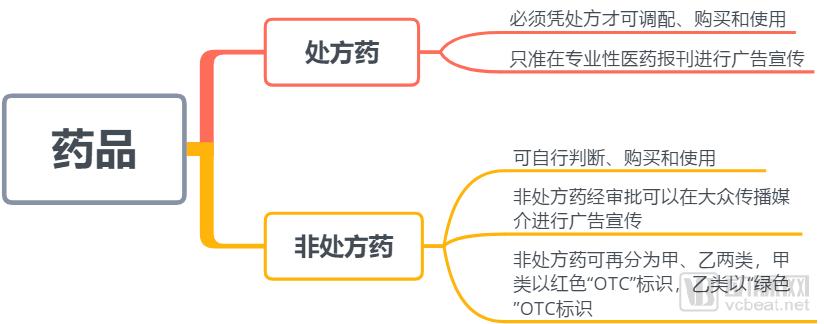
According to regulations, prescription drugs must be dispensed, purchased, and used only with a prescription from a licensed physician or licensed assistant physician; over-the-counter (OTC) drugs may be self-assessed, purchased, and used without such a prescription.
Prescription drugs are permitted to advertise only in professional medical and pharmaceutical publications, whereas over-the-counter (OTC) drugs may advertise in mass media upon approval, thereby providing greater scope for marketing innovation for OTC products.
One Chart to Understand the Differences Between Prescription and Over-the-Counter Drugs
Under the traditional model, prescription drug sales channels are dominated by medical institutions, with market access achieved through tendering and procurement processes. In contrast, over-the-counter (OTC) products are primarily sold through retail pharmacies, utilizing three main distribution models: agency distribution, brand-controlled sales, and mass distribution. The primary distinctions among these three models lie in the level of channel control and brand strength. Companies choose different sales strategies based on their resource management capabilities and brand promotion strengths; for instance, firms with strong retail teams, significant brand investment, and robust channel control typically opt for the brand-controlled sales model.
Top-Selling OTC Categories
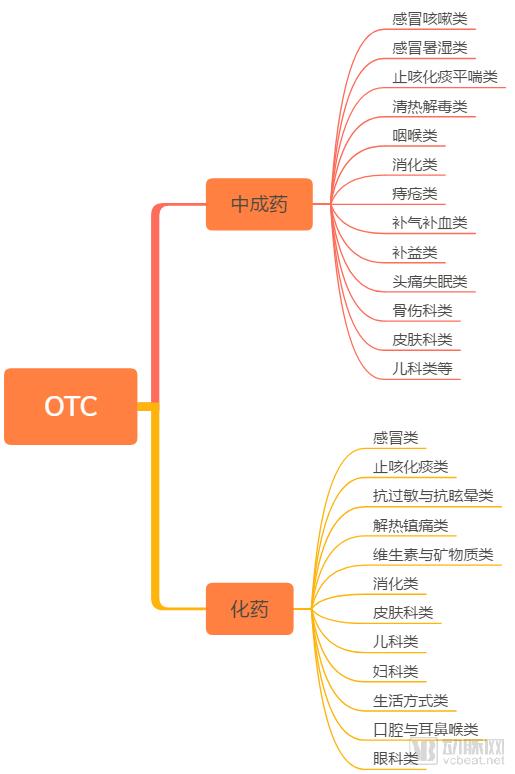
Source: China Nonprescription Medication Association, VCBeat
Xiao Lingfei, founder of Yaofei Technology, has long been engaged in innovation in pharmaceutical marketing and channel development. He told VCBeat that for OTC products, how to leverage innovative marketing strategies and harness the power of internet-based marketing have long been thorny issues for many manufacturing enterprises. In the past, marketing approaches adopted by these manufacturers were often crude; most companies paid insufficient attention to market dynamics and brand building, with some lacking even a formally structured brand and marketing department.
“In the past, many industrial enterprises devoted the vast majority of their efforts to channel development and point-of-sale interception, largely neglecting communication with consumers. Coupled with lax regulatory oversight of pharmaceutical advertising, this enabled a cohort of manufacturers—exemplified by those relying on intensive television ad blitzes—to seize market growth opportunities,” said Xiao Lingfei. He noted that this model of market growth essentially overdraws on opportunities for brand building, is unsustainable, and would precipitate significant crises once national policies tighten.
Therefore, for OTC manufacturers, the development of the “Internet + Healthcare” ecosystem and internet marketing have created new opportunities for OTC brand building. Embracing internet marketing and channel innovation will give rise to a new wave of brands.
Xiao Lingfei stated that for OTC manufacturers engaging in internet marketing, two key elements must be mastered: scenario and content. A scenario serves as a trigger to help consumers recognize their pain points; scenario-based marketing enables consumers to empathize with these issues, thereby stimulating demand for the product.
Especially for pharmaceuticals, demand is often sporadic and sudden, making scenario-based marketing even more critical to enhance consumers’ understanding of and connection with the product. For instance, the advertising campaign for 999 Ganmaoling (a popular cold remedy) exemplifies effective scenario-based marketing. Coupled with its tagline—“Warm and comforting”—it instantly evokes a sense of warmth and well-being.
Content serves as the vehicle through which consumers understand products. Mere slogan-driven or repetitive advertising no longer resonates with audiences. Young consumers are not averse to advertisements; in fact, they are even willing to proactively share them, provided the ads are sufficiently compelling.
Internet marketing for pharmaceutical products demands higher standards and greater precision in advertising formats compared to traditional marketing approaches. By leveraging accumulated data and specialized tools, internet marketing achieves higher efficiency and facilitates more accurate identification of target users.
However, driven by shifts in online consumption patterns and demands, the internet user base differs significantly from traditional retail customers. Internet users tend to be younger, have higher expectations for content, and are more difficult to engage. This is because, with greater digital literacy, their ability to evaluate products far exceeds that of traditional consumers. Meanwhile, the environment of information overload has raised the threshold for what captures their interest. Content can no longer serve merely as simple notification; it must be more engaging, substantive, and precisely targeted.
Many OTC drug manufacturers have begun to experiment with internet marketing, including pre-roll video ads, title sponsorships of online variety shows, and product placement. Some manufacturers even deeply participate in the production of online content, customizing it based on brand positioning and usage scenarios—such as in-show advertisements and Easter eggs in web series. This approach has not only achieved strong dissemination effects but also contributed to brand building.
In terms of the pharmaceutical e-commerce channel, the consumer base is becoming increasingly younger. Data shows that post-80s and post-90s generations now account for over 70% of online shoppers, with the post-90s cohort alone comprising more than 40%. This implies that OTC manufacturers must adjust their product positioning and sales strategies to align with the preferences of younger consumers.
Secondly, e-commerce platforms offer lower selection costs, making it easier for consumers to compare and choose among different products. This requires manufacturers to invest more effort in product operations and promotion, ensuring robust brand development. Thirdly, e-commerce sales are largely passive, with many consumers placing orders silently without guidance from sales personnel. This places exceptionally high demands on product brand building, as well as on the clear articulation of benefits and selling points in product descriptions.
Xiao Lingfei believes that in today’s market environment, the position of e-commerce as one of the pillars of retail channels is indisputable. Although its current share is relatively small due to policy influences, the trend toward e-commerce adoption in retail is irreversible. Any attempt to resist e-commerce by closing off, rejecting, or controlling distribution channels is both laughable and unwise. This is akin to automobiles replacing horse-drawn carriages or touchscreens replacing physical buttons—it represents not only a technological transformation but also an upgrade in consumer demand.
Especially for the post-90s user demographic, as digital natives, they have a natural affinity for e-commerce and are accustomed to having every aspect of their lives integrated with the internet; they will become the primary consumer base for pharmaceutical e-commerce in the future.
“Therefore, the opportunities that e-commerce presents for OTC products are self-evident. A brand-new channel, a new cohort of consumers, and an entirely novel sales model—this signifies market reshuffling, a narrowing of gaps, and the opportunity to overtake competitors on the bend,” said Xiao Lingfei.
Of course, opportunities and challenges coexist. For OTC manufacturers to embrace e-commerce channels, they must master e-commerce strategies, accumulate relevant resources, and, most importantly, shift their mindset. They should not view e-commerce merely as cannibalizing existing customer traffic or shifting sales from one channel to another. Instead, they must recognize that e-commerce represents a broader transformation in societal consumption habits. OTC manufacturers should therefore embrace and accept this trend, adapting to the e-commerce evolution through self-reform and continuous improvement.
The aforementioned changes primarily pertain to the OTC drug market; in fact, with the introduction of the “New Policies on Internet Healthcare,” the scope of impact will extend to the prescription drug sector.
The “Measures for the Administration of Internet-Based Diagnosis and Treatment” stipulate that, after reviewing patients’ medical records, physicians may issue online prescriptions for certain common and chronic diseases. Online prescriptions must bear the physician’s electronic signature; upon verification by a pharmacist, medical institutions and pharmaceutical distributors may entrust qualified third-party agencies to handle delivery.
From the patient’s perspective, obtaining prescription refills for chronic conditions previously required returning to the hospital to queue and register anew, which was time-consuming and strained physician resources. The adoption of online consultations combined with electronic prescriptions eliminates the need for hospital registration, thereby enhancing the efficiency of medical resource utilization. Furthermore, medications can be accessed through multiple channels—including pharmaceutical e-commerce platforms, retail pharmacies, and online-to-offline (O2O) services—not only ensuring regulatory compliance but also providing tangible convenience to patients.
Currently, the “Internet Hospital + Electronic Prescription” model has been rolled out across China. In terms of implementation channels, it primarily involves online pharmaceutical e-commerce platforms and offline retail pharmacies. Not only have enterprises made extensive attempts in this area, but government departments such as those overseeing medical insurance and drug regulation have also provided substantial support.
For instance, WeDoctor’s “Internet Hospital + Pharmacy” collaboration initiative enables partner pharmacies to provide members with precise appointment scheduling, remote consultations, and electronic prescriptions by logging into the Wuzhen Internet Hospital Pharmacy System, thereby directly upgrading the pharmacies into virtual clinics. Currently, WeDoctor’s Medical-Pharmacy Platform has integrated more than 20,000 pharmacies, serving nearly 50,000 patients on a daily basis.
What is even more attractive is the “Medical Care + Pharmaceuticals” model, which integrates internet hospitals with pharmaceutical e-commerce. Several rapidly growing internet hospitals, such as WeDoctor, Haodf, and Chunyu Doctors, are actively strengthening their pharmaceutical services. Meanwhile, pharmaceutical e-commerce platforms are entering the internet healthcare sector through self-establishment or partnerships. For instance, Jianke has acquired and built its own hospitals and obtained an internet hospital license, while 1 Drug Network (1 Yao Wang) and Qilekang also operate their own internet hospitals.
E-commerce giants Alibaba and JD.com have also made strategic moves in the “Internet + Healthcare” sector. Alibaba operates Ali Health as its “flagship platform,” engaging in businesses such as pharmaceutical e-commerce and smart healthcare. JD.com, on the other hand, has established operations including JD Pharmacy, JD Internet Hospital, and JD Pharmaceutical Logistics. Ping An Good Doctor, which was the first to list on the Hong Kong Stock Exchange, also adopts a “pharmaceuticals + medical services” integrated model, featuring both a self-built team of thousands of physicians and a pharmaceutical e-commerce business.
In fact, whether it is platform-based enterprises such as Alibaba, JD.com, and Ping An Good Doctor, or e-commerce-centric companies like 111.com, Jianke, and Qilekang, it is evident that they are striving to build a business “closed loop.” Once this “closed loop” is established, it will have a profound impact on traditional medical services and pharmaceutical distribution.
Pharmaceutical companies have also adopted a positive stance toward the incremental market opportunities brought by internet healthcare. As a typical representative of this sector, Alibaba Health has established partnerships with multiple leading global pharmaceutical firms, including Pfizer, Merck & Co., Sanofi, GlaxoSmithKline, and AstraZeneca. These collaborations focus on “Internet + Healthcare,” leveraging Alibaba’s vast traffic and data resources to build brand equity and drive growth. Such arrangements are advantageous both in terms of short-term gains and long-term strategic considerations.
From a macro perspective, the separation of prescribing and dispensing is inevitable. The traditional hospital-dominated pharmaceutical distribution channel will be disrupted, with sales shifting to retail pharmacies, Direct-to-Patient (DTP) pharmacies, pharmaceutical e-commerce platforms, and Online-to-Offline (O2O) channels. The development of internet healthcare will accelerate this process.
Another emerging trend is the rise of pharmaceutical services in primary healthcare, exemplified by companies such as Hangzhou Zhuojian, Mingyi Zhonghe, Akang Health, and Yaoshibang. These entities have penetrated the vast primary care market through information services, resource matchmaking, and e-commerce transactions, thereby achieving deep integration of “Internet + Pharmaceutical” services.
Overall, before and after the new policies on internet-based healthcare were implemented, “Internet + Healthcare” services have become integrated, enabling the provision of “closed-loop” services to users. For pharmaceutical companies, this incremental market is impossible to ignore, whether for over-the-counter (OTC) products or prescription drugs.
From the perspective of pharmaceutical companies seeking opportunities in the “Internet + Healthcare” sector, the prospects are undoubtedly promising. First, the “Internet + Healthcare” model aligns with national conditions, helping to address the scarcity and uneven distribution of high-quality medical resources, and enjoys policy support. Second, after years of incubation and anticipation, the service models of “Internet + Healthcare” have largely matured, laying a solid foundation for large-scale implementation and application.
The core competitiveness of pharmaceutical companies lies in discovering drugs and successfully bringing them to patients. In the era of “patient-centricity,” the latter capability may be even more critical. Against the backdrop of the booming internet healthcare sector, pharmaceutical companies’ ability to leverage the internet for marketing and channel innovation has become increasingly important.
From exploring marketing innovations for early OTC drugs to seizing opportunities in online prescription drug sales driven by the “new internet healthcare policies,” pharmaceutical companies, as value creators in the pharmaceutical industry chain, have not only supported the industry’s early growth but also provided numerous lucrative opportunities for subsequent expansion.