

"Pocket Ultrasound + AI" Emerges as a New Frontier: Butterfly Raises $250M to Join Unicorn Ranks, Chinese Firms Follow Closely
On September 28, U.S. handheld ultrasound device manufacturer Butterfly Network announced the completion of a $250 million Series D financing round, bringing its post-money valuation to $1.25 billion and propelling it into unicorn status in the digital health sector.
Who is Butterfly? Why are investors so bullish on it? What is the current state of the handheld ultrasound market? Are there any Chinese companies that can rival Butterfly? VCBeat attempts to answer these questions one by one through an in-depth analysis of the industry...
Butterfly, founded in 2011, is one of the world’s leading developers of handheld ultrasound imaging devices. It is committed to driving the decentralization of medical imaging through the research, development, and application of “pocket-sized ultrasound + AI.” Its flagship product, the Butterfly iQ ultrasound system,It is the world’s first personal ultrasound device to receive FDA approval for market launch, and also the world’s first ultrasound imaging system with a single probe suitable for whole-body use.
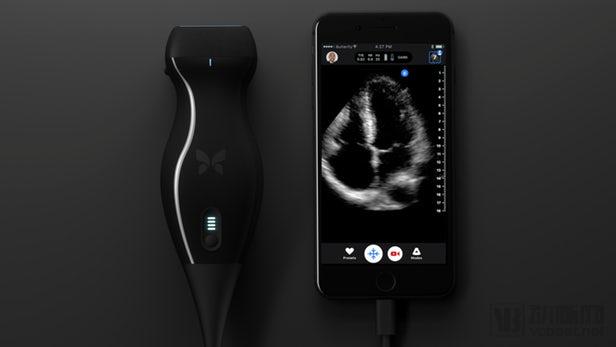
Image source: New Atlas
Butterfly iQ leverages an ultrasound transducer system integrated onto a single chip, enabling direct connectivity with smartphones. By combining cloud technology, artificial intelligence, and deep learning, this single handheld ultrasound probe supports multiple examination modes to address diverse clinical application needs across various body regions. Reportedly, Butterfly iQ covers 13 indications, including abdominal, cardiovascular, obstetric, gynecological, urological, and musculoskeletal applications.
Meanwhile, leveraging smartphone applications and internet technology, the Butterfly iQ effectively enables features such as remote collaboration, facilitating seamless, real-time communication and cooperation between general users and industry experts, as well as between primary healthcare institutions and large hospitals.
Dr. Jonathan M. Rothberg, the founder of Butterfly, believes that Butterfly iQ represents “"The Birth of a New Industry", it is transforming the existing healthcare model with ultrasound-on-chip technology.
Is Handheld Ultrasound a Challenge to Traditional Ultrasound?
This new industry is precisely“Handheld Ultrasound + AI”this subsector.
Handheld Ultrasound, also known as Pocket Ultrasound, is a smartphone-sized ultrasound device capable of performing examinations that typically require large hospital-based B-mode ultrasound systems.Compared to traditional large-scale instruments, this compact handheld ultrasound device offers numerous unique advantages:
Traditional large-scale ultrasound devices suffer from drawbacks such as bulky size, heaviness, lack of portability, and high cost. For hospitals, procuring such equipment involves significant expenditure and requires training for specialized physicians. For patients, usage scenarios are limited; examinations must be conducted in dedicated departments, typically requiring advance appointments or waiting in queues, resulting in relatively cumbersome procedures.
Portable ultrasound devices are well-positioned to address these limitations. First, the portability and ease of use of handheld ultrasound systems significantly improve diagnostic efficiency, facilitating their integration into clinical departments and deployment at primary care levels. Second, handheld ultrasound devices offer a substantial cost advantage.
Dr. Zhou Jianqiao, Deputy Director at Ruijin Hospital, stated, “Large-scale ultrasound systems cost over RMB 1 million, whereas handheld ultrasound devices have extremely low costs, facilitating their widespread adoption in primary care settings and clinical departments. In the future, they could become as indispensable to physicians as stethoscopes. Meanwhile, handheld ultrasound units can be deployed in large quantities; while top-tier tertiary hospitals typically possess only around 20 large-scale ultrasound machines, each team-leading physician in clinical departments of smaller facilities can be equipped with a handheld device. For primary healthcare institutions that cannot afford high-end equipment, handheld ultrasound can fulfill the purpose of population-based ultrasound screening. These devices can also be taken into communities and rural areas, offering broad application scenarios. Furthermore, handheld ultrasound is highly valuable in the military domain, where there is significant demand for use in field combat operations.”
Widely Applied
Specifically, there are three main application scenarios for handheld ultrasound: hospital clinical departments (including bedside examinations and ICU emergency care), the primary healthcare market, and out-of-hospital disaster emergency response. These represent incremental markets that are difficult for traditional large-scale ultrasound systems to reach.
First, with the miniaturization of ultrasound equipment, ultrasound technology has moved beyond the radiology department into clinical wards, assisting clinicians in performing point-of-care testing, and even extending to emergency departments and ICUs to save lives. For instance, during preoperative anesthesia administration, physicians can perform precise needle insertion under ultrasound guidance, thereby reducing the number of needle attempts required for anesthesia.
SecondWith the decentralization of medical resources, primary healthcare is gradually rising. There is enormous demand for ultrasound examinations in China’s vast primary healthcare market. However, the widespread adoption of ultrasound is currently limited by primary care physicians’ lack of proficiency in operating ultrasound equipment and interpreting the images. To enable broader use of ultrasound among primary care physicians, “handheld ultrasound + AI” will play a significant role. By integrating artificial intelligence systems, ultrasound devices can provide automated prompts, such as indicating whether a lesion is potentially malignant, thereby significantly alleviating the workload of primary care physicians.
3., at disaster relief sites, particularly in remote mountainous areas, portable handheld ultrasound devices are especially useful. They enable physicians to perform accurate on-site assessments of patients' injuries, facilitate the timely formulation of treatment plans, and determine which patients require immediate emergency care on site and which need urgent transfer.
Furthermore, handheld ultrasound has another application scenario in home healthcare. With the aging population, family doctors and nurses can perform routine vital sign checks for patients. Currently, handheld ultrasound is relatively widespread among family physicians in the United States.
Low Price
In terms of price, handheld ultrasound devices are also significantly more affordable than traditional large-scale ultrasound systems.
According to Cost Owl, most new ultrasound devices are priced between $20,000 and $75,000. GE’s high-end ultrasound systems even cost over six figures. In contrast, the Butterfly iQ ultrasound device is priced at just $2,000, more than ten times lower.
Butterfly’s Chief Medical Officer, John Martin, even stated that once the company scales up production, the price of the device could drop further, to as low as $500. Butterfly hopes that handheld ultrasound devices can be as“Stethoscope”Generally, it has become a standard tool for physicians.
Wu Yifang, President and Chief Executive Officer of Fosun Pharma, commented, “Butterfly has brought about a revolution in medical imaging, making ultrasound technology more accessible, convenient, and affordable.”
As for whether the further proliferation of handheld ultrasound will shake the position of traditional ultrasound equipment, or even replace it, remains uncertain. However, it can be predicted thatHandheld ultrasound will undoubtedly become the strongest growth driver in the ultrasound market.Perhaps,Handheld ultrasound is not a replacement for traditional ultrasound, but rather a complement.
High Demand for Handheld Ultrasound Devices Drives a Massive Market Size
We live in a world where medical resources and technology are unevenly distributed, in thisApproximately two-thirds of the global population lacks access to medical imaging services. Even in developed countries, high costs and a shortage of expertise hinder the widespread adoption of medical imaging.
Butterfly has been striving to democratize ultrasound imaging by leveraging advanced technology to eliminate cost barriers and meet the ultrasound examination needs of 4.7 billion people worldwide.There are 9.2 million physicians worldwide, along with twice as many nurses, midwives, and other healthcare providers. Consequently, the market for efficient, portable, and affordable handheld ultrasound devices is substantial.
According to research by Probes Capital and Signify Research, the global market size for ultrasound imaging equipment was $7.5 billion in 2015 and is projected to reach $10.5 billion in 2021, representing a compound annual growth rate (CAGR) of 7%. Within this market, the portable ultrasound segment saw a 40% increase in size from 2016 to 2017. Driven by improvements in performance and usability, this segment is expected to grow at an annual rate of 20% from 2017 to 2022.
Simon Harris, Chief Analyst at Signify Research, stated: “The latest handheld ultrasound devices have seen significant improvements in performance, including image quality, power management, and usability. They have gained widespread acceptance for point-of-care diagnostics and are also being adopted to a lesser extent in more traditional departments such as radiology, urology, cardiology, and women’s health.”
Blue Ocean Market, Technology Reigns Supreme
So, is the handheld ultrasound market a red ocean or a blue ocean?VCBeat’s inventory reveals that despite being such a lucrative market, there are only 14 global players, with just six companies in China. This indicates that the handheld ultrasound market remains a blue ocean, with substantial room for future growth.
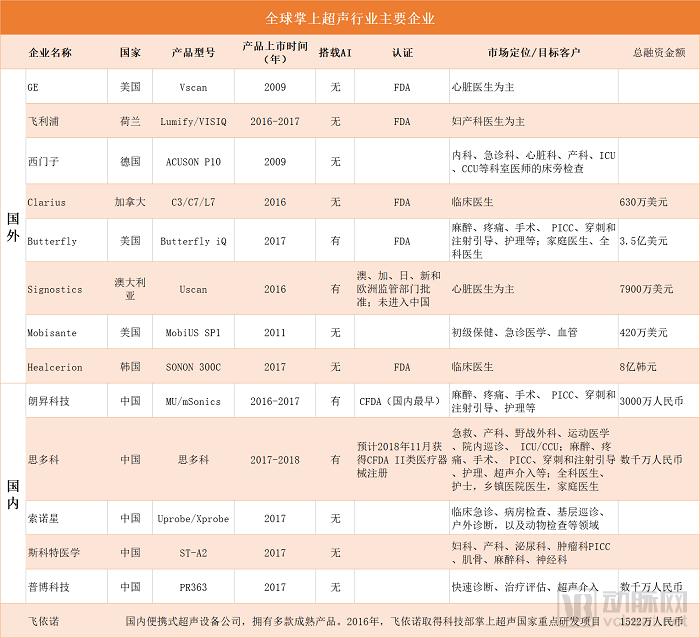
Data sources: Huayi Capital, Crunchbase; compiled by VCBeat
Globally, traditional medical device giants led by GPS have been at the forefront of the handheld ultrasound market, with strategic deployments dating back to 2009. The launch of GE’s first-generation handheld ultrasound system, Vscan 1.0, in the United States created a significant stir, earning recognition as one of “The 50 Best Inventions of 2009” by Time magazine and one of “The 100 Best Technological Achievements of 2010” by the renowned popular science magazine Popular Science.
However,The vast majority of handheld ultrasound manufacturers worldwide are startups. Chinese companies have largely kept pace with their foreign counterparts, with most obtaining their first handheld ultrasound certification between 2016 and 2017.Currently, GE, Philips, Clarius, Healcerion, and Butterfly from abroad have all obtained FDA certification. The Australian company Signostics has received approvals from regulatory authorities in Australia, Canada, Japan, Singapore, and Europe, but has not yet entered the Chinese market. In China, Langsheng was the first company to obtain CFDA certification, followed closely by Sonostar and Suzhou Scott. VCBeat has learned that Sidoco is also expected to receive certification from the National Medical Products Administration this year.
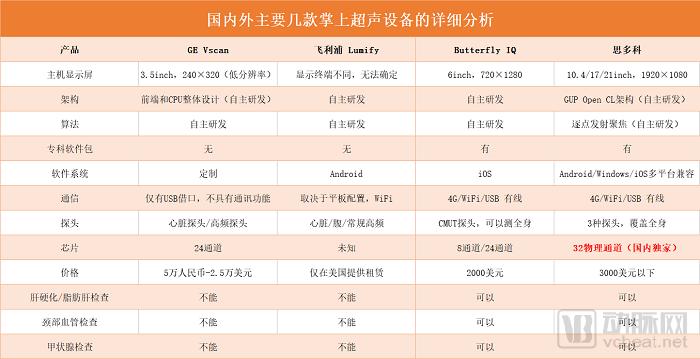
Data Source: Probe Capital; Compiled by VCBeat
Furthermore, from a technical perspective, there are also some differences between domestic and international enterprises.The imaging quality of ultrasound equipment is closely related to two aspects: one is the number of physical channels in the hardware, and the other is the implementation level of algorithm chips. The former can be likened to the body of ultrasound performance, while the latter can be understood as the soul of ultrasound performance.
In terms of the number of physical channels, generally speaking, the greater the number of physical channels, the more signal data is collected, and the higher the image resolution obtained through computation.Currently, most major manufacturers of handheld ultrasound devices offer systems with either 8 or 24 channels. In contrast, Sdtek’s handheld devices start with 32 physical channels right out of the gate. The company has announced that its next step is to introduce 128 physical channels, a specification that matches the number of physical channels currently used in large-scale color Doppler ultrasound systems in China’s mid-to-low-end market.
In terms of algorithm chips, superior core ultrasound algorithms and chip implementations can enable ultrasound devices to achieve performance levels far exceeding the capabilities of their existing hardware. Currently, many well-known domestic ultrasound brands have fully matched imported brands in terms of hardware specifications; however, there remains a significant gap between them and imported brands in the research, development, and accumulation of algorithm and chip technologies.
Butterfly Network in the United States is the first company to reimagine ultrasound from the ground up. Its Butterfly iQ ultrasound device is not merely a miniaturized version of traditional ultrasound systems; rather, it fundamentally transforms the design philosophy behind ultrasound technology.
Traditional ultrasound devices rely on the vibration of quartz crystal transducers to send pulses into the human body, after which electronic components convert the returning pulses into images. In contrast, the Butterfly iQ replaces these crystals with an ASIC chip embedded with 9,000 metallic transducers, each smaller than the tip of a human hair.Compared with general-purpose chips such as GPUs and CPUs, ASICs offer greater computing power at a lower cost. Furthermore, they can integrate AI algorithms, consolidating all ultrasound detection functions at the front end, which significantly improves data collection efficiency and enhances overall computational performance.
VCBeat has found that there are only four manufacturers of handheld ultrasound devices with AI-enabled products globally: Australia’s Signostics, the US-based Butterfly Network, and China’s Langsheng Technology and Siduoke.Sito is currently the only ultrasound equipment manufacturer in China capable of encapsulating underlying platform algorithms and artificial intelligence algorithms into ASIC chips.Currently, the demand for such AI assistance is primarily focused on delineating organ structures and lesions.
In China, Domestic Handheld Ultrasound Companies Have a Competitive Edge
Focusing on the domestic market, China's ultrasound diagnostic equipment market reached RMB 6.9 billion in 2014, and is projected to exceed RMB 9.1 billion by 2019, with a compound annual growth rate (CAGR) of 5.7%.
In the niche segment of handheld ultrasound, as China’s medical technology R&D capabilities have improved, a growing number of domestic companies capable of rivaling Butterfly Network have emerged, such as Langsheng Technology and Siduoke. As local enterprises, they are reaping the dividends brought by technological advancements, supportive policies, and favorable market conditions.
First,, with technological advancements and cost reductions driven by economies of scale, handheld ultrasound devices are poised to replace the stethoscope—the most widely used clinical diagnostic instrument currently—in applications such as point-of-care testing, thereby offering substantial market prospects.
Across the entire ultrasound imaging sector, handheld ultrasound devices are gaining increasing acceptance among clinicians in various departments due to their broad applicability and operational portability. These devices are entering clinical settings and gradually penetrating primary healthcare facilities, positioning them as the most potent driver of growth in the ultrasound imaging market.
According to research, there is substantial demand for it in departments such as emergency medicine, anesthesiology, obstetrics and gynecology, cardiology, and endocrinology at China’s Grade A tertiary hospitals, with a future addressable market of approximately $27 billion.
Secondly,As primary healthcare continues to rise, hospital outpatient services are increasingly shifting toward the primary care level, making primary care settings one of the main application scenarios for small, non-invasive diagnostic devices.
Finally,National Policies Favor the Development of the Domestic Handheld Ultrasound Industry. In recent years, the state has introduced a series of policies to encourage innovation in medical devices.
For example, in 2017, the "Opinions on Deepening the Reform of the Review and Approval System to Encourage Innovation in Drugs and Medical Devices" was issued to encourage innovation in domestically produced medical devices; in 2016, handheld ultrasound equipment was included in the National Key R&D Program of the 13th Five-Year Plan released by the Ministry of Science and Technology; government-led grassroots healthcare initiatives such as "Doctors on Horseback" have been implemented, procuring small non-invasive diagnostic devices and driving increased demand.
This combination of policy and market factors has given Chinese domestic handheld ultrasound manufacturers, such as Sdco, a competitive advantage in the Chinese market over foreign competitors like GE, Philips, and Butterfly.Moreover, as it stands, there are no foreign wireless portable ultrasound devices available in the Chinese market. Siemens’ wireless devices are sold overseas but have not been introduced to China due to their prohibitively high prices; Philips offers only wired devices, which are also not marketed in China; and GE’s handheld, smartphone-style devices are primarily targeted at clinical departments in large hospitals.
Therefore, this presents a significant opportunity for the development of China’s domestically produced handheld ultrasound industry.
The Rise of Domestic Brands: Who Will Be the First to Overtake on the Bend?
Thus, in such a favorable environment, companies with strong independent R&D capabilities are most likely to overtake competitors and be the first to commercialize handheld ultrasound devices.
VCBeat has observed that among the domestic handheld ultrasound device companies, Sduo Tech is the most likely to become the leading enterprise in China's handheld ultrasound sector.
First, a team with a strong technical background sets Siduoke apart from other companies in the ultrasound sector. Siduoke’s core team possesses profound technical expertise and extensive experience in the research, production, and sales of ultrasound products. Dr. Yu Bo of Ziniu Fund, the angel investor in Siduoke, once commented on the founding team as follows:They are among the few teams in China capable of integrated hardware and software design and development for underlying technology platforms.
The company also possesses its own proprietary imaging platform, along with several key technologies such as proprietary elastography and 3D Doppler spectral imaging. Siduoke’s proprietary ultrasound imaging platform not only employs 32 physical channels (whereas comparable systems typically feature 8 or 24 channels) but also utilizes a self-developed GPU OpenCL architecture for image data processing. It is worth noting that GPU-based image processing technology is generally found only in the new high-end ultrasound products of leading international manufacturers, such as GE, Siemens, and Supersonic Imagine. In contrast, large-scale domestic medical ultrasound products mostly rely on CPU-based computation, lagging behind GPU-based algorithms.
According to Zhang Zhuo, CEO of Siduoke, the company has launched multiple compact, non-invasive diagnostic products based on ultrasound technology. These devices are applicable in various clinical scenarios, including intraoperative monitoring, anesthesia, and needle aspiration, and can be used for liver disease diagnosis as well as screening of cervical vessels and the thyroid gland. In the future, image fusion navigation will also be leveraged to provide guidance for interventional surgeries.
In the handheld ultrasound sector, we have seen Butterfly emerge as an industry unicorn, driven by its disruptive technological prowess. It is poised to improve the quality of healthcare for half of the global population, while also delivering substantial returns to its investors in the process.
Like Butterfly, Sdtek also integrates its underlying platform algorithms and artificial intelligence algorithms into ASIC chips. Leveraging the built-in intelligent diagnostic module, it moves routine ultrasound applications out of standalone imaging departments and into various clinical specialties, significantly expanding usage scenarios and market size. This approach enhances diagnostic precision while minimizing reliance on high-level expert experience, thereby facilitating adoption at primary care levels.
Therefore, with its robust technical capabilities, could Stork become China’s Butterfly? Even more, by leveraging the advantages of domestic enterprises and driven by national policies and market forces, might it achieve a leapfrog development to lead the entire handheld ultrasound industry? Time will tell.
The Future Is Promising
As an old saying goes, “Sell to the rich, live with the poor; sell to the poor, live with the rich.” From a perceptual standpoint, selling to the poor appears more advantageous. In other words, technologies and products that improve the quality of life for the underprivileged are more likely to achieve sustainable development. Handheld ultrasound devices, by meeting the healthcare needs of a broader population at a lower cost, align perfectly with this philosophy, promising strong future prospects.
Now, an increasing number of physicians are recognizing the potential of handheld ultrasound. In the next five to ten years, a large number of clinicians, general practitioners, and other healthcare professionals will have personal ultrasound devices that can fit in their pockets. Handheld ultrasound may become the next stethoscope.
References:
1、http://www.telemedmag.com/article/the-butterfly-effect/
2、https://www.nanalyze.com/2018/10/handheld-ultrasound-device-smartphone/
3、http://www.telemedmag.com/article/the-butterfly-effect/
4、https://vcbeat.top/MTMwZDhjMDhjZTZhYmI4MmJmOTAzNGEyZWZiOTVkYjc=