

MiaoZhi Tech Files IPO Prospectus: Pioneering AI-Powered Surgical Guidance Platform in Digital Orthopedics
In the digital orthopedics market, Miaozhi Technology has developed a patient medical imaging-based surgical guidance platform to improve physician efficiency and reduce patient costs.
VCBeat (WeChat ID: vcbeat) has learned that Miaozhi Technology (Shenzhen) Co., Ltd., which recently turned three years old, won the First Prize in the Pharmaceutical and Biological Industry category and the Third Prize in the Grand Final of the 10th China Shenzhen Innovation and Entrepreneurship Competition (hereinafter referred to as the “Shenzhen Innovation Competition”) with its intelligent surgical system for spinal surgery.

Xie Zhiheng (left), founder of Miaozhi Technology, accepts the first prize in the biopharmaceutical industry at the Shenzhen Innovation and Entrepreneurship Competition.
The Shenzhen Innovation and Entrepreneurship Competition, hosted by the Shenzhen Municipal People’s Government, is one of the city’s most prestigious startup competitions. Over the years, it has nurtured six publicly listed companies, four unicorns, 85 companies listed on the National Equities Exchange and Quotations (NEEQ), and 434 national high-tech enterprises. Notably, DJI, the global leader in the consumer drone market, was an award winner at the second edition of the competition in 2010.
The current session of the Shenzhen Innovation and Entrepreneurship Competition spanned 196 days. After fierce competition in the preliminary rounds, semifinals, and industry-specific finals, a total of 24 elite teams emerged from 5,766 projects to advance to the grand finals. Amid such intense rivalry, how did Miaozhi Technology’s surgical guidance platform break through and achieve outstanding results?
R&D of a Surgical Guidance Platform Based on Patient Medical Imaging
It has been reported that Miaozhi Technology was established in September 2015, holds 15 software copyrights and invention patents, and has secured two rounds of financing totaling tens of millions of yuan. Amid the recent wave of mass entrepreneurship, Miaozhi Technology has maintained a low profile, focusing on building a solid foundation. Its founder, Xie Zhiheng, is from Hong Kong, China. He is currently a Ph.D. candidate in the Department of Physics at The Chinese University of Hong Kong (CUHK), where he also completed his undergraduate studies in physics. He later earned dual master’s degrees in Electronics and Biomedical Engineering and brings many years of experience in the research and development of medical imaging systems, having already been granted three invention patents.
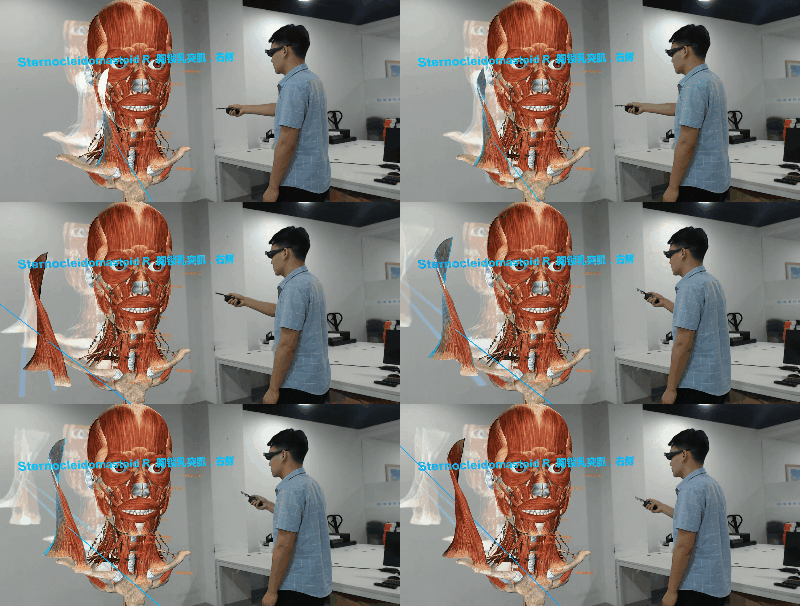
mAnatomy Holographic Projection Anatomy System, supporting up to 50 viewers simultaneously
Xie Zhiheng told reporters that the past decade has been a "golden decade" for medical imaging in China, with a surge in both the quantity and quality of imaging equipment. The next phase in medical imaging focuses on post-processing, which involves extracting critical information from vast amounts of imaging data to support clinicians’ decision-making. In response, Miaozhi Technology has developed an AI-powered surgical guidance platform based on patient medical imaging, specifically targeting surgery—a field highly dependent on medical imaging. By leveraging artificial intelligence algorithms and virtual reality visualization, the platform enables physicians to conduct intuitive preoperative planning, intraoperative navigation, and robot-assisted surgeries.
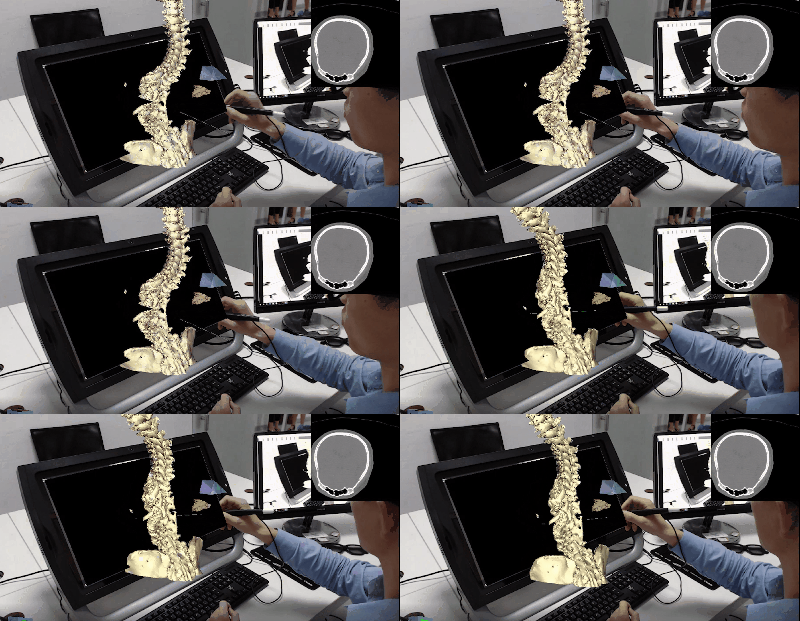
mVR Virtual Reality Surgical Planning System for Clinical Cases of the Spine
After three years of dedicated development, Miaozhi Technology has delivered impressive results. Its mVR surgical planning product automates the 3D visualization of traditional medical imaging data (including DICOM images such as CT and MRI scans) and outputs them into virtual reality scenarios, enabling physicians to efficiently conduct preoperative planning and simulate procedures such as bone reduction. By leveraging artificial intelligence for reconstructing the surgical target area, the system reduces the time required to generate a surgical plan from one hour to under ten minutes. With the mVR preoperative planning system, localization time for minimally invasive surgeries is reduced by 50%, and the number of intraoperative X-rays is decreased by two-thirds.
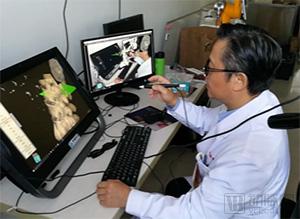
Professor Zhou Yue of Xinqiao Hospital Uses the mVR System
Additionally, the latest joint surgery planning feature of mVR can reconstruct a model of the patient’s femoral head, enabling clear visualization of the location and extent of osteonecrosis. This allows surgeons to precisely calculate the optimal angle for rotational osteotomy of the femoral neck while preserving blood supply to the femoral head, thereby customizing the most appropriate treatment plan for each patient.
Currently, mVR has obtained a Class II registration certificate from the China Food and Drug Administration (CFDA) and has been implemented in nearly 20 hospitals, including renowned institutions such as the Guangzhou General Hospital of the PLA, the Second Affiliated Hospital of Sun Yat-sen University, Nanfang Hospital, and the First Affiliated Hospital of the PLA General Hospital (304). The system has processed medical imaging sequences for over 1,000 patients. Recently, at the Jiangsu Province Hospital of Traditional Chinese Medicine, an expert team utilized mVR for surgical planning, successfully preserving the hip joint of a young patient with femoral head collapse. This approach avoided the need for expensive artificial joint implants, thereby reducing costs.
Building a Complete Digital Surgery Ecosystem
Xie Zhiheng, founder of Miaozhi Technology, stated that the clinical implementation of mVR marks the first step in the team’s establishment of a comprehensive digital surgery ecosystem. Building upon preoperative planning, Miaozhi Technology has completed the development of the mNAVIGATION VR intraoperative navigation system, which provides real-time guidance to surgeons during procedures and significantly reduces the number of X-ray fluoroscopy exposures. mNAVIGATION achieves millimeter-level real-time localization and registration of surgical instruments. Furthermore, the surgical robot currently under development at Miaozhi Technology can directly assist physicians in performing high-precision punctures along pre-planned trajectories, with an error margin of less than 1 millimeter. This extends the entire digital workflow to the therapeutic phase, substantially enhancing surgical accuracy.
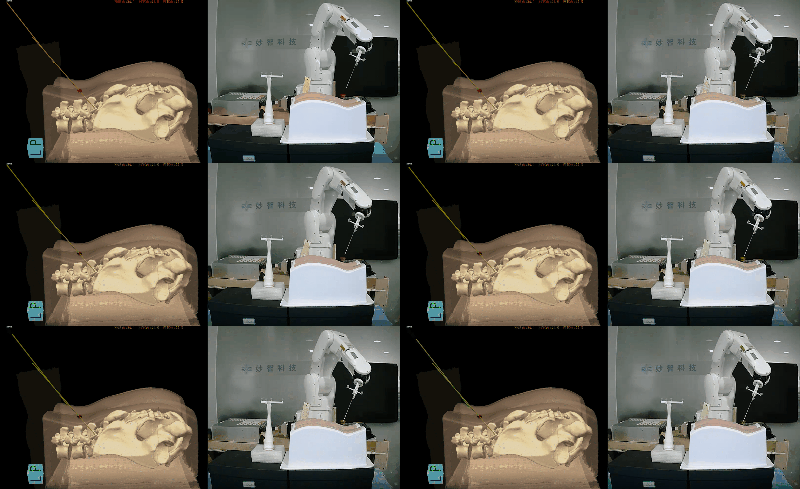
Miaozhi Technology's Surgical Assistance Robot, in Conjunction with Preoperative Planning and Navigation, Achieves High-Precision Surgical Positioning
Furthermore, Miaozhi Technology has simultaneously embarked on building a cloud-based case database. By leveraging data and products, it provides clinicians with comprehensive clinical solutions. Hospitals, in turn, contribute cases to the database, allowing clinical data to accumulate progressively. This process gradually forms a massive database that further drives technological and product upgrades. Within this complete surgical data ecosystem, surgeries become highly efficient and precise, minimizing human variability and enabling less experienced surgeons to perform high-quality procedures. This aligns closely with Miaozhi Technology’s vision: to reduce nationwide disparities in healthcare quality, shorten the training cycle for physicians, standardize medical processes, and ensure equitable access to healthcare for patients.
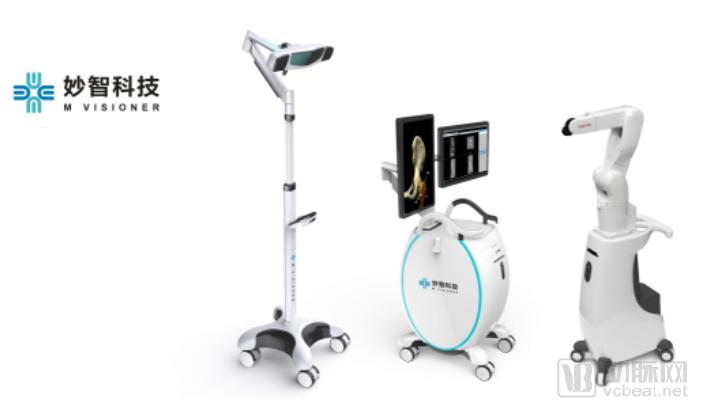
MiaoZhi Technology's Surgical Navigation System and Surgical Assistance Robot
Currently, the domestic digital orthopedics and surgical navigation market is largely monopolized by foreign manufacturers such as STRYKER, BRAINLAB, and MEDTRONIC, with Chinese manufacturers holding only a 5% market share. However, this situation is changing. The National 13th Five-Year Plan explicitly highlights “precision medicine” and “accelerating the translation of medical research achievements,” and the market demand for surgical guidance is poised for rapid growth.
Since 2016, the government has successively issued dozens of policy documents, elevating artificial intelligence (AI) to the level of national strategy and setting forth specific requirements for AI development in the healthcare sector. Under the preferential guidance of national policies, domestically produced medical devices are gradually replacing the market share held by foreign manufacturers, a trend that is particularly irreversible in the digital orthopedics market.
Regarding future development, Xie Zhiheng, founder of MiaoZhi Technology, believes that there is still significant room for innovation in the integration of electronics and healthcare. He is confident that life sciences will experience explosive growth over the next 10 to 30 years, bringing endless possibilities to the advancement of medical care.