

ErBao Tech Files IPO Prospectus: Empowering Over 90 Hospitals with Medically-Centric Child Health Management System
The “Healthy China” strategy begins with child health. The health of every child is the prerequisite and foundation for family happiness, and it is crucial to the future of the nation. Full-cycle health services start with pediatric health services. With the implementation of the universal two-child policy and the acceleration of urbanization, the number of newborns has surged. The severe imbalance in the distribution of pediatric medical resources needs to be addressed, and the level of maternal and child healthcare services urgently requires improvement.
With the growing public awareness of health, the state has placed increasing emphasis on child healthcare. Health policies have shifted from a treatment-oriented approach to one focused on prevention and control, making child healthcare an increasingly vital component of pediatrics. The scope of child healthcare services covers areas such as growth and development, psychological and behavioral health, pediatric rehabilitation, early childhood development, and nutrition and feeding.
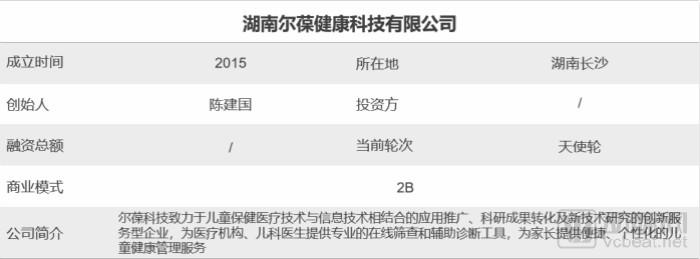
Erbao Technology is an innovative service-oriented enterprise dedicated to the application promotion, transformation of scientific research achievements, and research on new technologies that integrate child healthcare medical technology with information technology. The company provides professional online screening and auxiliary diagnostic tools for medical institutions and pediatricians, and offers convenient, personalized child health management services for parents.
From a business needs perspective, pediatric healthcare services in medical institutions face the following challenges: First, existing pediatric healthcare resources are unevenly distributed, and primary care physicians often have limited technical expertise. Second, even tertiary hospitals lack professional intelligent auxiliary screening and diagnostic system tools; the quality of currently available tools varies significantly, with unclear or even erroneous reference sources. Third, some auxiliary screening and diagnostic technologies previously introduced from abroad are outdated, and their parameters have changed, necessitating revision. Fourth, pediatricians seek timely access to the latest academic trends in the field and desire a one-stop platform for learning new technologies. Fifth, pediatricians aim to comprehensively understand children’s health status, enabling immediate access to complete historical health records and facilitating follow-up tracking.
Hunan Erbao Health Technology Co., Ltd. has launched the “Internet + Child Health Management System,” which transforms child health management from manual, basic, and fragmented services into intelligent system-based services, and even personalized internet-enabled extended services. This system effectively addresses the gap in child health services outside of clinical medical care, thereby establishing a new model for child health management that integrates “assessment + online consultation + big data applications + smart healthcare + artificial intelligence.” It achieves connectivity among hospitals, physicians, and families, providing comprehensive informatization services covering health education, health assessment, online consultation, and post-diagnosis management throughout the entire childhood period. Currently, the “Internet + Child Health Management System” has served more than 90 hospital clients.
When discussing the original motivation behind starting the business, Chen Jianguo, CEO of Erbao Technology, stated, “My spouse is a senior pediatric healthcare physician. During her long-term practice, she identified numerous issues within the overall management of child health care, including inconsistent levels of clinical expertise among physicians and outdated knowledge in pediatric healthcare. Diagnosis and intervention in child health care still rely heavily on a scarce pool of experienced doctors, resulting in a severe imbalance in the distribution of medical resources.”
In addition to the uneven distribution of medical resources, the shortage of pediatricians has become a long-standing issue. With the implementation of the “universal two-child” policy, the imbalance between supply and demand is expected to worsen further. In 2016, the National Health and Family Planning Commission issued the “Opinions on Strengthening the Reform and Development of Children’s Medical and Health Services,” which suggested transitioning adult internal medicine physicians into pediatrics. However, the clinical knowledge and skills required for pediatrics differ significantly from those for adult care. Moreover, since children are often unable to articulate their symptoms and have lower levels of self-awareness than adults, diagnosing pediatric conditions demands a high degree of professional expertise from physicians, while also requiring parents to effectively monitor their children’s health status.
Erbao Technology currently offers intelligent medical technology services to B-side healthcare institutions. However, Chen Jianguo believes that the company’s competitiveness does not lie in its information technology capabilities. Rather, its true competitive barriers are derived from its translation of innovative research findings and knowledge in child healthcare into practical applications, the establishment of new technical standards for child healthcare through big data analytics, and the gradually developed system for providing medical training to pediatric healthcare providers in collaboration with authoritative domestic medical institutions and experts.
Erbao Technology has currently launched 49 functional modules across 14 major categories commonly used in child growth and development, including physical growth assessment, children's intellectual development assessment, children's behavioral evaluation, as well as guidance on motor skills, language, and nutritional feeding. A medical technology team composed of professional pediatricians ensures the quality and rigor of its medical technologies. Erbao Technology strengthens and enriches its product content and data through multiple channels: first, by adapting advanced foreign child healthcare medical technologies; second, by collaborating with domestic experts to integrate existing child healthcare technologies; and third, by continuously establishing new diagnostic and intervention models based on data during product promotion and updates.
For physicians, Erbao Technology’s intelligent system facilitates online assisted screening and diagnosis, establishes child health records, and tracks pediatric health histories. It supports cross-departmental and inter-hospital collaboration, enabling information sharing among pediatric healthcare departments at hospitals of all levels—including community health service centers—as well as among secondary pediatric specialties within the same hospital.
Meanwhile, the intelligent system can provide highly structured outpatient medical records and support the upload of unstructured records, assisting healthcare institutions and physicians in extending in-hospital services. This improves the management efficiency and follow-up rates of child healthcare, providing a closed-loop data service for children’s health management across pre-consultation, intra-consultation, and post-consultation stages. Additionally, Erbao Technology offers several smart tools; for instance, parents can scan a QR code to enter their child’s information, which is then automatically synchronized with the system, thereby enhancing the work efficiency of medical staff.
For healthcare institutions, Erbao Technology’s intelligent system can also facilitate collaboration between tertiary hospitals and primary care facilities. Under this model, diagnoses for certain cases are made at tertiary hospitals, where specialists formulate rehabilitation plans, while the actual rehabilitation is carried out at primary care institutions. By leveraging their respective strengths, tertiary and primary care hospitals effectively achieve patient triage, saving parents considerable time and expenses.
On the parent-facing side, parents can use the “Zhangshang Erbao” WeChat Official Account of Erbao Technology to view their children’s health examination records at any time, schedule appointments with doctors, and consult online. Parents can directly share the assessment reports generated by the client application when consulting physicians. Following diagnosis by specialists at tertiary hospitals (Grade III A), parents may opt for rehabilitation interventions at secondary hospitals, thereby eliminating the need to shuttle back and forth with extensive medical documentation.
Chen Jianguo stated to VCBeat, “Our core technology lies in the extensive portfolio of specialized pediatric healthcare technologies embedded within our system. Leveraging this, Hunan Erbao Health Technology Co., Ltd. can assist medical institutions in establishing specialized pediatric healthcare departments and address the need for clinical training among pediatric healthcare providers. In the future, we aim to provide advanced intelligent auxiliary screening and diagnostic technologies in pediatric healthcare, both domestic and international, to medical institutions free of charge, contributing our efforts to the healthy development of children in China!”
Currently, the company is seeking financing to support the commercialization of research achievements, product development, and team expansion; previously, it secured angel-round funding, with the amount undisclosed.