

Korui Bio Advances TCR-T Platform to Enable Large-Scale Clinical Application in Solid Tumor Immunotherapy
In China, research into cellular immunotherapy has a history spanning more than a decade. However, it is only in the past two years that enthusiasm and attention from both the industry and the public have surged dramatically. Every technological or commercial milestone achieved by CAR-T-based therapies has drawn significant attention. Kerui Bio is a participant in this wave, yet it has chosen not to pursue non-CAR-T approaches as its primary focus; instead, it is dedicated to the development of its TCR-T research platform.
Xie Xingwang, founder of Kerui Bio, told VCBeat (WeChat ID: VCbeat) that the company’s choice to pursue TCR-T therapy reflects its unique industry insights and steadfast commitment to technological innovation. TCR-T cell immunotherapy is a cutting-edge biologic treatment that engineers T cells to express T-cell receptors (TCRs) capable of specifically recognizing tumor cells, thereby enabling targeted tumor destruction and therapy.
In completed clinical trials, TCR-T therapy has demonstrated favorable therapeutic outcomes in various fatal malignancies, including melanoma, synovial sarcoma, and multiple myeloma. Consequently, a consensus has been reached within the industry that TCR-T tumor immunotherapy holds broad prospects and serves as a cornerstone of cellular immunotherapy for solid tumors.
Kerui Biologics, founded in 2015 and headquartered at the PKU Healthcare Innovation Valley in Changping, Beijing, focuses on universal TCR-T (UTCR-T) as its core product. The company has completed the establishment of its key technology platform and early-stage products, and has begun planning and filing core patents. It is reported that Kerui Biologics has established a relatively comprehensive R&D technical system for TCR-T, covering technology platforms such as screening and identification of specific tumor antigens, identification of T-cell immune epitopes, cloning of epitope-specific TCRs, optimization of TCR affinity, and preclinical validation of TCRs. The company plans to initiate clinical trials of TCR-T therapy for lung cancer by the end of 2019.
In 2006, Xie Xingwang, the founder of Kerui Biologics, enrolled at Peking University Health Science Center. The research group he joined was among the earliest institutions in China to conduct research on cellular immunotherapy and tumor immunotherapy. Regrettably, studies on cellular immunotherapy and tumor immunotherapy during this period failed to yield satisfactory experimental results.

Dr. Xie Xingwang, Founder of Kerui Bio | Photo provided by the interviewee
By around 2012, gene-editing technologies had broken through bottlenecks, knowledge of tumor immunology was expanding exponentially, and PD-1/PD-L1 antibodies had emerged as a breakthrough. This rekindled hope among researchers in cellular immunotherapy. At that time, Xie Xingwang, who had previously shifted away from research on the molecular mechanisms of tumors, returned to the field of tumor immunology. “Tumor immunotherapy was the first R&D direction I engaged with; it left the deepest impression on me and earned my highest level of personal endorsement.”
Xie Xingwang decided to start a business, and the first person who came to his mind was Jiang Dong, a senior member of his research group at Peking University. Jiang Dong is a typical technology enthusiast with over 20 years of uninterrupted experience in biomedical research.
When Xie Xingwang first learned of Jiang Dong, the latter had already become a technical benchmark within Peking University’s biotechnology circle. At that time, Jiang was conducting postdoctoral research in the United States, where he achieved substantial results. “He has profound expertise in technology, and I have been following in his footsteps for many years.” Persuading Jiang Dong to join Kerui Bio as Chief Technology Officer greatly boosted Xie Xingwang’s confidence.
Currently, the team at Kerui Bio consists of 16 members, including five partners and seven technical staff. Among the partners, Xie Xingwang and Jiang Dong are responsible for the top-level technical design, while Wang Xueyan and Du Wei lead the technical team in implementing solutions. Zheng Lanbin is in charge of recruiting senior technical talent for the company. Wang Xueyan, the R&D Director of Immunotherapy, earned her Ph.D. from the Chinese Center for Disease Control and Prevention and conducted oncology research at Peking University for over a decade; she was part of the same research group as Xie Xingwang and Jiang Dong. Du Wei, the R&D Director of the Viral Vector Platform, received his Ph.D. from the Health Science Center of Peking University and completed his postdoctoral fellowship at the University of Florida. The gene therapy projects he previously participated in have received FDA approval for clinical trials.
When discussing cellular immunotherapy, CAR-T is an indispensable topic. The principle of CAR-T involves transferring a chimeric antigen receptor (CAR)—comprising the antibody-derived antigen-recognition domain (single-chain variable fragment, scFv) and the intracellular signaling domain—into T cells, thereby enhancing their cytotoxic activity against tumor cells.
It has been vividly likened that CAR-T therapy equips T cells, which originally “walked” in pursuit of tumor cells, with wheels, enabling them to “drive” and eradicate tumor cells, leaving the tumors nowhere to hide. With the market launch of Keytruda and Opdivo, expectations for CAR-T therapy have grown increasingly high.
In fact, CAR technology is relatively mature, allowing many biopharmaceutical companies to leverage their existing technical capabilities to participate, accelerate market approval within a short timeframe, and achieve significant social benefits. However, fundamentally, CAR-T therapy can only target antigens specifically expressed on the surface of tumor cell membranes. Consequently, the number of target antigens susceptible to CAR-T attack is limited, making it difficult to identify suitable targets for most solid tumors.
In contrast, TCRs can recognize virtually all types of cellular antigens, including those located intracellularly, enabling effective treatment of most solid tumors using TCR-T technology. Unlike CAR-T therapy, which involves extensive modification of the T cell’s antigen recognition receptor and signaling pathways, TCR-T therapy preserves the T cell’s native receptor structure and signaling processes.
TCR-T technology involves precise modification and optimization of the antigen-recognition region of the T-cell receptor (TCR) to enhance its ability to recognize tumor antigens. However, while engineering the TCR, it is essential to preserve its recognition capacity for normal antigens and eliminate off-target effects.
TCR-T technology has a high barrier to entry, with very few companies capable of conducting research in this field. Furthermore, currently available therapeutic-grade TCRs are extremely scarce.
Kery Biotech Bullish on the Application Prospects of TCR-T
Xie Xingwang told VCBeat that there are two technical bottlenecks constraining the development of TCR-T therapy. First, it is challenging to obtain clinically viable TCRs; achieving large-scale clinical application requires establishing a more efficient affinity optimization system to secure sufficient quantities of clinical-grade TCRs. Second, affinity-enhanced TCRs carry a high risk of off-target attacks.
In traditional TCR affinity optimization workflows, researchers must employ labor-intensive strategies such as mutagenesis library construction, phage display, and affinity chromatography to optimize TCR affinity. It may take dozens of researchers several years to complete the entire technical process for optimizing the affinity of a single TCR.
However, the risk of off-target attacks following affinity enhancement raises serious concerns about the safety of TCRs in clinical therapy. Xie Xingwang explained that refining T-cell receptors actually alters key parameters of the human immune system. While this modification enhances the ability of T cells to attack tumor cells, it may also impair their capacity to recognize and spare normal cells, leading to nonspecific attacks.
When nonspecific attacks occur in critical cells, such as neurons, patients may develop cerebral edema and even die.
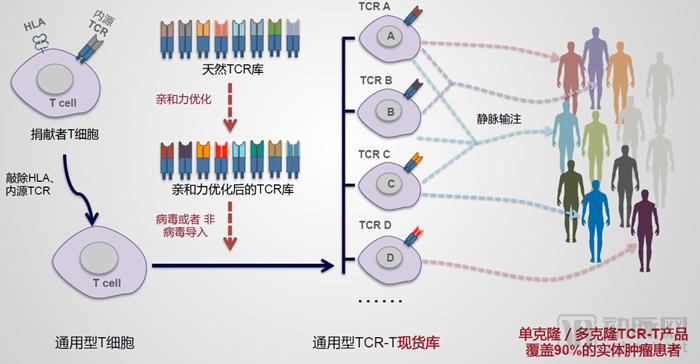
Corri Biotech’s Process. Photo provided by the interviewee
In response, Kere Biologics has established a core technology system comprising a precise target antigen localization system, a TCR affinity optimization system, a high-efficiency clinical-grade lentiviral production system, and a mature gene-editing platform. The company is also planning to create a patent pool containing 8–10 patents to provide comprehensive protection for this technology system.
Through in-depth mining of big data on tumor genomics and large-scale experimental validation using clinical tumor samples, after confirming tumor antigens with restricted expression in tumor cells, Kere Biologics further utilized its precise T-cell immune epitope mapping system to identify epitope peptide sequences that can be presented by HLA molecules and targeted by TCRs. This precise epitope mapping system covers all peptide sequences of the tumor antigens and evaluates the ability of these epitope peptides to bind and be presented by all types of HLA molecules.
More importantly, KeRui Bio’s TCR affinity optimization system adopts a streamlined, closed-loop design. It leverages an intracellular DNA site-directed high-frequency somatic mutation system to automatically generate high-capacity mutant TCR libraries, and employs an affinity maturation technology analogous to thymic positive selection to preferentially select mutant TCR sequences with moderate affinity. Finally, through a non-specific TCR exclusion system akin to thymic negative selection, all TCRs that recognize off-target epitopes are eliminated.
Furthermore, Kere Biotech has established a high-efficiency, clinical-grade lentiviral production platform. By stably integrating inducible packaging proteins and scaling up culture processes, the company has transitioned its production system to bioreactors for quantitative manufacturing. Meanwhile, Kere Biotech’s gene editing platform, built on CRISPR technology, enables operations such as knockout, knock-in, sequence editing, epigenetic editing, and high-throughput library screening at specific genomic loci, thereby achieving highly efficient gene knockout and knock-in in T cells.
According to Xie Xingwang, Kerui Bio’s R&D journey has not been smooth sailing; the technical complexity and workload far exceeded expectations, delaying the R&D progress. “We originally planned to have a TCR ready for clinical trials by the end of 2018 at the earliest, but it now appears that this milestone may be delayed by six months,” said Xie. However, he believes this situation is a mixed blessing: “We sacrificed efficiency in exchange for a superior technology platform.”
From the perspective of VCBeat, this enhancement in the technological framework is reflected in the two strategic shifts undertaken by Kery Biologics to adapt to TCR-T therapy. The first strategic shift involved transitioning from personalized TCRs to universal (off-the-shelf) TCRs. Kery Biologics’ initial technical approach was based on developing patient-specific TCR-T therapies. However, after a period of time, the technical team discovered that personalized TCR-T therapy was severely constrained by patients’ physical conditions, often resulting in an inability to harvest sufficient T cells or sudden deterioration of the patient’s health to a state unsuitable for TCR-T treatment.
Consequently, Kerui Bio chose to leverage gene-editing technology to engineer T cells into universal T cells, thereby enhancing product commercialization and enabling off-the-shelf availability for patients.
The second strategic shift involved transitioning from a standalone TCR affinity optimization system to an integrated upstream platform for TCR-T technology. Xie Xingwang used the term “integrated upstream platform for TCR-T technology” to summarize the “four-in-one” technical framework of Kera Biotech mentioned earlier. However, in his initial vision, neither the precise target antigen localization system nor the high-efficiency, clinical-grade lentiviral production system existed.
“At the time, we underestimated the importance of supporting processes.” Therefore, the entire team decided to slow down and refine the technical platform before moving forward. The establishment of a comprehensive platform for TCR-T technology will undoubtedly enhance Kere’s standing in the industry.
For a technology that has yet to yield a mature product, focusing solely on achievements is insufficient for long-term success. Therefore, VCBeat specifically asked Xie Xingwang about KeRui Bio’s current weaknesses. Xie has a clear understanding of his team’s shortcomings and has made early preparations to address them. “As R&D deepens, certain niche areas where our technical capabilities are weak have begun to emerge,” Xie pointed out. “Therefore, we recently finalized the hiring of three senior technical experts, who have already started providing technical support for KeRui Bio’s R&D efforts.”
Coray Biotechnology is set to onboard technical talent on a project basis through its Series A round, providing senior technical support in clinical drug research, immunological antibody research, and biological product research. Xie Xingwang did not disclose the names of these three individuals to VCBeat; all have been immersed in the biopharmaceutical field for many years and have been deeply involved in numerous cutting-edge projects. Furthermore, beneath this tier of high-end technical talent, Coray Biotechnology has established a larger R&D platform and accelerated the accumulation of junior technical staff through deep incubation by Peking University Healthcare Group.
As the interview drew to a close, VCBeat asked Xie Xingwang about the introduction of investors. Xie Xingwang believes that although Cori Biosciences' competitive advantages in its sector have attracted significant capital attention, most investors do not understand the technical characteristics of TCR-T therapy and are unable to accept the long capital payback period associated with cell immunotherapy projects. Therefore, for Cori Biosciences, alignment with investors on perspectives such as industry prospects and development pace is the primary consideration.
Xie Xingwang added in his final remarks to VCBeat that, in the face of lengthy technology development cycles, Kerui Biotech is leveraging the industrial application and development of gene-editing technologies to balance its cash flow. “We believe that gene editing will generate substantial cash revenue within the next one to two years,” said an optimistic Xie Xingwang.
Currently, Kerui Bio is seeking financing in the tens of millions, which will be primarily used to refine its TCR-T technology platform and conduct preclinical validation for select product candidates.