

7+1 Medical Center Files IPO Prospectus: Pioneering Standardized Glycemic Control via JADE Program and Interactive Insurance Model with 95% Efficacy Rate
The long disease course, poor patient compliance, uneven management standards, and the passive diagnosis and treatment model of physicians have always been the “stubborn ailments” in diabetes management.
After the “Hundred Glucose Apps War” emerged during the 2015 mobile health boom, the market for diabetes apps aimed at patient self-management underwent a significant shakeout. This process led to a sobering realization: for diabetes, a condition requiring continuous monitoring and management, virtually no product on the market effectively addressed adherence to self-management regimens.
Unlike the trajectory of most diabetes apps, which acquire users online and then expand into offline services, founder Xu Jianqun conducted market research in core first- and second-tier cities before establishing 7+1. He gained insights into market demand, clearly identified the strengths and weaknesses of blood glucose management apps and the shortcomings of the current healthcare system, and analyzed patients’ self-management behaviors and psychology. In 2016, he founded the 7+1 Medical Center, adopting a “trust-based” model that began with the establishment of offline diabetes care centers.

Actual View of 7+1 Medical Center, Photo Provided by the Interviewee
Two Major Pain Points in the Diabetes Market: Systematic Management and Patient Awareness of Disease Control
Long-term diabetes carries a significant risk of complications. Among these, more than half of deaths are attributed to cardiovascular disease, 10% to kidney disease, and the rate of amputation in diabetic patients is 10–20 times higher than in non-diabetic individuals. According to statistics from the World Health Organization, there are over 100 types of diabetes-related complications, making it the disease with the highest number of known complications. Therefore, blood glucose control is the foundation and core of diabetes management.
The challenges in blood glucose management for China’s 114 million people with diabetes lie in two aspects: the lack of systematic management protocols and insufficient patient awareness of self-management.
In the market, patients seeking blood glucose management are generally served by two types of institutions or enterprises: one is service-oriented, such as hospitals and community health service centers; the other is product-oriented for self-management, such as smart hardware and apps for diabetes management.
Hospitals primarily focus on diagnosis and treatment. Chronic diseases typically require long-term, continuous glucose monitoring and personalized management, rather than one-size-fits-all conventional therapies. While hospitals possess authority and professional expertise, they lack the capacity for refined, individualized management, thereby making it difficult to achieve optimal glucose control outcomes.
Xu Jianqun, founder and CEO of 7+1 Medical Center, stated, “Whether it is hospitals, community health centers, pharmacies, or smart hardware companies, they are all providing point-based services that lack systematicity and comprehensiveness.”

Xu Jianqun, Founder and CEO of 7+1 Medical Center
Diabetes self-management apps typically adopt a light consultation model, making it difficult to ensure patient adherence and treatment continuity. Their profitability largely relies on e-commerce features embedded within the app, thereby deviating from the core medical track.
For patients with diabetes, cost is a challenge, but not the greatest one. Although long-term expenditures on medications and services have driven up the costs of chronic disease management, the root cause lies in the lack of awareness about the condition and the urgency of its control. Market education plays a critical role in this context.
“Most patients harbor a sense of luck, believing that the absence of current complications indicates safety; in reality, this reflects poor health literacy and a lack of perceived urgency. Consequently, this poses additional challenges for market operations in the diabetes care sector.”
Xu Jianqun has a professional background in management, with over 12 years of experience in IPOs and management consulting. He previously served as the CFO of Weidian Biology, a publicly listed company.
Among his team is another heavyweight partner. Yan Pingyi, Co-founder and Advisor, was previously the founder of three medical companies—Mindray Bio-Medical Electronics, Rayto Life Science, and Weidian Biotechnology—and brings over 20 years of experience in the medical and diagnostic equipment sectors.
After identifying the pain points and gaps in the diabetes market, Xu Jianqun first conducted an eight-month market research study to verify the authenticity of the demands within this sector. “We began exploring these issues at the end of 2014. I also incorporated some market conditions from Weidian Bio at that time, communicated extensively with many diabetes patients, and gradually developed the ‘7+1’ model.”

7+1 Medical Center: Actual Photos (Provided by Interviewee)
Differentiated Development of Blood Glucose Control in Physical Institutions: A "Combo Punch" Strategy Combining High- and Low-Frequency Services
Addressing the pain point of lacking a systematic management protocol for diabetes care, Xu Jianqun identified JADE (Joint Asia Diabetes Evaluation Program), a research achievement with over 30 years of development by The Chinese University of Hong Kong in the Asian region.NoteIt has been successfully validated in over 150,000 individuals with diabetes across Asia, whereas there is currently no comprehensive diabetes management system available in China.
Based on this, 7+1 has localized “JADE” and established a standardized assessment system based on JADE for application at 7+1 Medical Center, to help more patients with diabetes.
As the sole authorized entity in mainland China for this standardized assessment protocol, 7+1, with the support of ADF, introduces a series of validated and effective diabetes risk control models to individuals with diabetes and those at high risk. In contrast to approaches that rely solely on monitoring and intervention for glycemic control, the JADE model emphasizes comprehensive diabetes management. It provides personalized risk assessments, nursing plans, and treatment recommendations, while offering practical guidance to encourage self-management and facilitate shared decision-making between patients and healthcare providers.
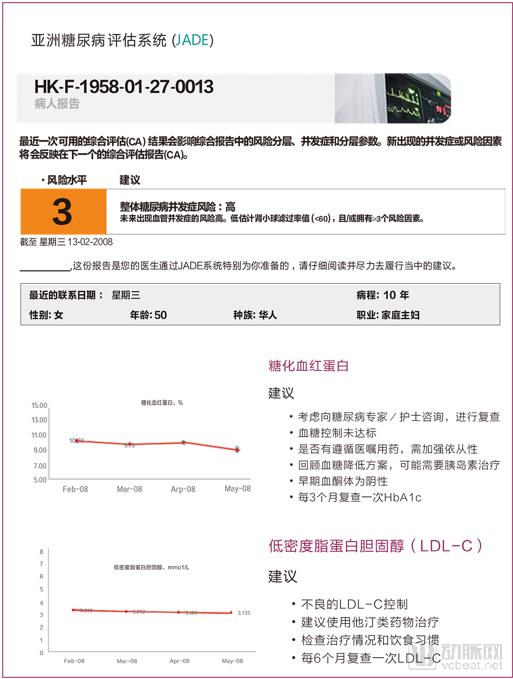
JADE (Joint Asia Diabetes Evaluation) Report Template, Image Provided by Respondent
Compared with the conventional services of traditional medical institutions, which primarily involve diagnosis and prescription, 7+1 Medical Center has added modules such as nutritional therapy and psychological care, thereby creating a differentiated service offering. The offline physical facilities mainly deliver low-frequency member services, including nutritional therapy and psychological care, while high-frequency daily indicator monitoring and medication adherence tracking are remotely managed by the 7+1 Diabetes Management Platform. This forms a service model combining “low-frequency offline” and “high-frequency online” components.
Unlike other disciplines, there is no deeply entrenched concept of “renowned physicians” or “leading experts” in the field of diabetes; physician branding remains relatively ambiguous. At 7+1 Medical Center, medical staff must complete training and pass assessments administered by the Asian Diabetes Foundation (ADF) before they are permitted to assume their duties.
Among the flagship stores currently operating in Changsha, a multidisciplinary healthcare team—comprising two senior associate professor physicians, two attending physicians, four dietitians, four nurses, and two exercise coaches—provides comprehensive services ranging from clinical diagnosis and treatment to glycemic control and nutritional health, delivering exclusive multi-to-one personalized care to patients visiting the facility.
Delivering precision treatment for patients through holistic diagnosis and treatment, comprehensive care planning, and end-to-end management, supported by a collaborative team of physicians, nurses, health managers, and dietitians—this is the “7+1 Sugar Control Formula.” Seven days a week, with undivided dedication—this is the “7+1 Philosophy of Sugar Control.”
Exploring Interactive Insurance to Solve the Challenges of Customer Acquisition and Payment Conversion
In diabetes management, patient acquisition and monetization are the most critical challenges. At its inception, 7+1 Medical Center leveraged locally trusted media channels to communicate its brand and service philosophy. By inviting patients to visit the center for firsthand experiences, it established deep engagement, during which patients developed an understanding of systematic glycemic control management, ultimately leading to conversion into paying customers.
Chronic diseases are characterized by long disease courses and extended management cycles. Receiving care at high-end medical institutions often entails higher costs, whereas chronic disease management is a form of mass-market healthcare. Consequently, high-end medical providers tend to reduce the frequency of services accordingly. Therefore, 7+1 Medical Center has prioritized second-tier cities such as Changsha, which benefit from the endorsement and patient referral capabilities of Xiangya Hospital, as well as a mature customer base.
Leveraging its high-quality, professional services and effective blood glucose management outcomes, 7+1 has continuously expanded its customer base and repeat visitor traffic. To date, the repurchase rate and store visit rate among 7+1’s paying members have exceeded 90%. Since its opening one year ago, the 7+1 Diabetes Medical Center has served more than 2,400 patients with diabetes, including over 300 annual fee-paying members, achieving a management effectiveness rate of 95%.

Leveraging existing data on the efficacy of glycemic control, after a year of product refinement and in-depth analysis of the market and target customer profiles, 7+1 Medical Center partnered with Ping An Insurance to launch the market’s first insurance plan designed to effectively lower blood glucose levels for diabetes patients. Co-developed by 7+1 Medical Center and Ping An Insurance, this diabetes insurance initiative not only alleviates patients’ financial barriers to accessing 7+1 Medical Center’s services but also expands customer acquisition channels for insurance sales.
Founder Xu Jianqun stated, “The customer resources held by insurance sales personnel are precisely the buyers of our products: they are young, possess strong discernment, and make quick payment decisions, enabling them to purchase coverage for their families.” By introducing commercial health insurance into the field of chronic disease management, risk control is achieved through cost-containment measures implemented by the “7+1” model. Meanwhile, the sales capabilities and customer networks of insurance agents help address the initial challenges of patient acquisition and payment collection inherent in the chronic disease management model.
Patients can access the “7+1” diabetes management service by purchasing an insurance package. The online service portal is primarily provided by Ping An Good Doctor, while in cities without “7+1” physical stores, offline services are delivered by Wanjia Clinics. Patient data will be submitted to the “7+1” Diabetes Management Platform for remote monitoring and management.
Meanwhile, this policy adopts the latest interactive format, incorporating a blood glucose control reward mechanism. If key indicators remain within the effectively managed range during the first year of blood glucose management, the premium for the following year will be waived. Additionally, patients with excellent blood glucose control performance will receive certain rewards to enhance adherence to management protocols.
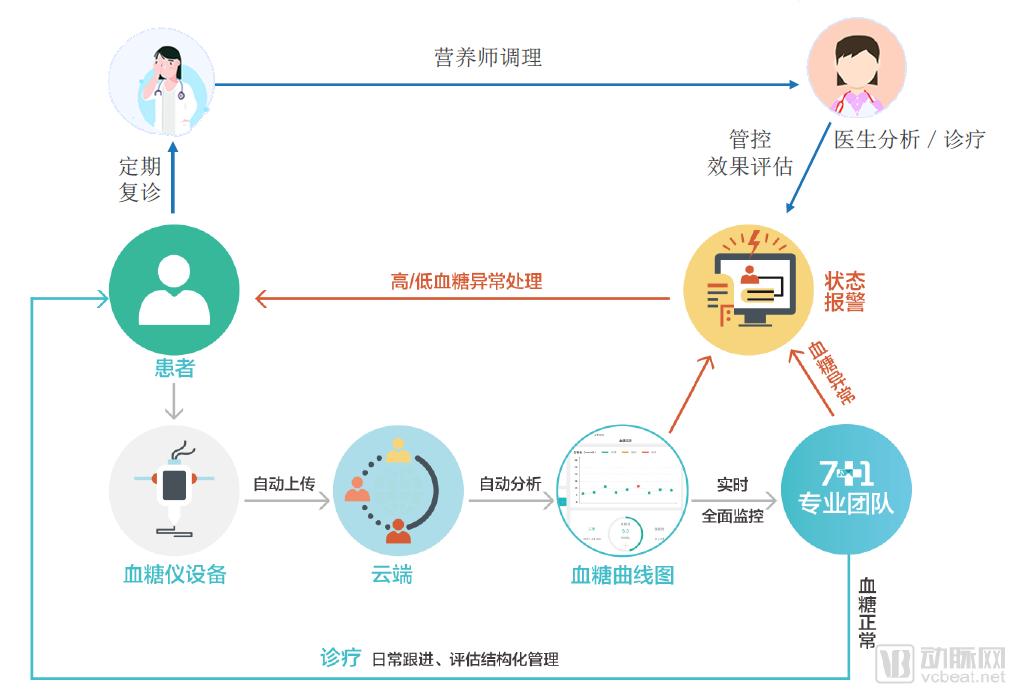
Operational Workflow of 7+1 Medical Center, Photo Provided by Interviewee
Compared with internet-based chronic disease management, the “7+1” model fully leverages the convenience of the internet to address patients’ daily self-management needs and enable comprehensive monitoring through continuous team-based remote follow-up. Meanwhile, it establishes a physical care center that delivers differentiated medical services, managing both low-frequency and high-frequency interventions throughout the treatment and management process. Across the entire course of treatment and management, an optimized closed-loop system is formed by appropriately balancing online and offline care activities.
In terms of product form, 7+1 leverages the Joint Asia Diabetes Evaluation (JADE) program, a research technology developed by the Asian Diabetes Foundation (ADF) over a decade, to establish core standards for chronic disease management. By integrating commercial insurance, it has created the market’s first effective blood glucose-lowering insurance plan for diabetes, available for sale across all online platforms.
As an emerging star in the diabetes care sector, Xu Jianqun revealed that 7+1 Medical Center’s next step is to further expand its market presence in Changsha, Guangzhou, Shenzhen, and Zhejiang province, with a three-year plan to open 10 stores. Previously, 7+1 Medical Center completed its angel funding round. Having validated the business model of its first store, the company is now in the replication phase and is actively engaging with investors.
“Chronic disease management is a societal challenge. How can we establish systematic and effective control measures? How can we foster a correct understanding of diabetes? Relevant institutions in the health industry need to participate jointly to better manage this large population of chronic disease patients in China,” said Xu Jianqun.
Note:
The JADE Programme: As early as 1995, the Chinese University of Hong Kong and Prince of Wales Hospital pioneered a pilot initiative to improve the quality of healthcare services, employing a nurse-coordinated risk stratification scheme to triage patients into different levels of care. This initiative inspired a series of studies on disease risk equations and their impact on care and morbidity. The Asian Diabetes Foundation (ADF), a charitable organization registered in Hong Kong, aims to promote evidence-based chronic disease management programs across Asia. In 2007, the ADF consolidated these research findings into an online platform designed to support disease management, known as the “Joint Asia Diabetes Evaluation” programme, or “JADE” for short.
The JADE platform system employs validated disease risk equations to stratify patients’ risk of diabetic complications. Aligned with clinical care benchmarks, it provides healthcare professionals with decision support and reporting tools, facilitating the formulation of individualized care goals for diverse patient populations. Furthermore, it offers a benchmark for peer comparison, enabling providers to enhance service quality.。