

Zhejiang's Health Industry: A Strategic Framework Driving 648.3 Billion Yuan Output and Over 79 Listed Companies
When Zhejiang is mentioned, people’s impressions extend beyond its economic prosperity, scenic beauty, and status as a cradle of reform to include elements such as technology, the internet, and healthcare.
Zhejiang is one of China’s most economically dynamic provinces. By fully leveraging the leading role of the state-owned economy while driving economic takeoff through the development of the private sector, it has formed a distinctive “Zhejiang Economy.”
In recent years, with the advancement of the new healthcare reform, Zhejiang Province’s health industry has been flourishing. The industrial development has been continuously optimized alongside the improving environment, featuring a more refined structure and stronger platform support. According to preliminary statistics, in 2017, the total output of the province’s health industry reached RMB 648.3 billion, with a value-added of RMB 259.7 billion, accounting for 5.0% of its GDP. There were 79 listed companies in this sector.
On the other hand, with the continuous rise in consumption levels among Chinese citizens, growing demands for quality of life, an accelerated upgrade in consumption patterns, and an increasingly severe aging population, the demand for health services will continue to expand, ushering in unprecedented development opportunities for the big health industry.
In this context, Zhejiang Province has also designated the big health industry as the most critical sector for its provincial development. Currently, the province’s big health industry is not only seeing numerous traditional enterprises seeking new directions, but also attracting an increasing influx of entrepreneurs. Underlying strategic frameworks in the hottest fields—such as internet healthcare, artificial intelligence, big data, medical services, and novel clinics—are beginning to enrich the structure of Zhejiang’s health industry, positioning it as a bellwether for the development of China’s health sector.
Behind the industry’s prosperity lies Zhejiang’s effective utilization of four key levers: “Specialized Health Towns – Demonstration Bases – Key Enterprises – Key Projects.”
According to the data:From 2014 to 2017, the total output of the province’s health industry grew at an average annual rate of 9.4%, while its value-added grew at an average annual rate of 13.8%. The province’s key enterprises rank among the top nationwide, with 79 listed companies in the broader health sector, placing it third in China. The health industry has become a pillar industry supporting Zhejiang’s economic transformation and upgrading.Meanwhile, the health industry model is continuously innovating, initially forming a structure based onAn industrial layout featuring “a batch of characteristic towns, a batch of demonstration bases, a batch of key enterprises, and a batch of key projects” as its development carriers.
Let’s take a closer look at these key levers.
Following the 19th National Congress of the Communist Party of China, “Healthy China” has become a core concept in China’s development, with the health industry poised for vigorous growth. Meanwhile, the implementation of the national strategy for “characteristic towns,” coupled with a series of policies introduced in recent years, has encouraged local governments to develop such towns. The dual impetus of policy support and public demand has given rise to a number of “characteristic health towns.”
Among the 106 innovative characteristic towns in Zhejiang Province, nine are health-themed towns. From 2015 to 2017, these towns completed a total investment of RMB 24.349 billion, accounting for 46.7% of the total investment. Investment in specialized industries amounted to RMB 7.46 billion, representing 79.8% of the total. In terms of corporate investment structure, soft investment accounted for a relatively high proportion. In 2017 alone, soft investment by enterprises in health-themed characteristic towns reached RMB 1.36 billion, with an average of RMB 170 million per town. Industrial and financial cooperation has been further strengthened, achieving coordinated development between health-themed towns and finance-themed towns, as shown in the figure below:
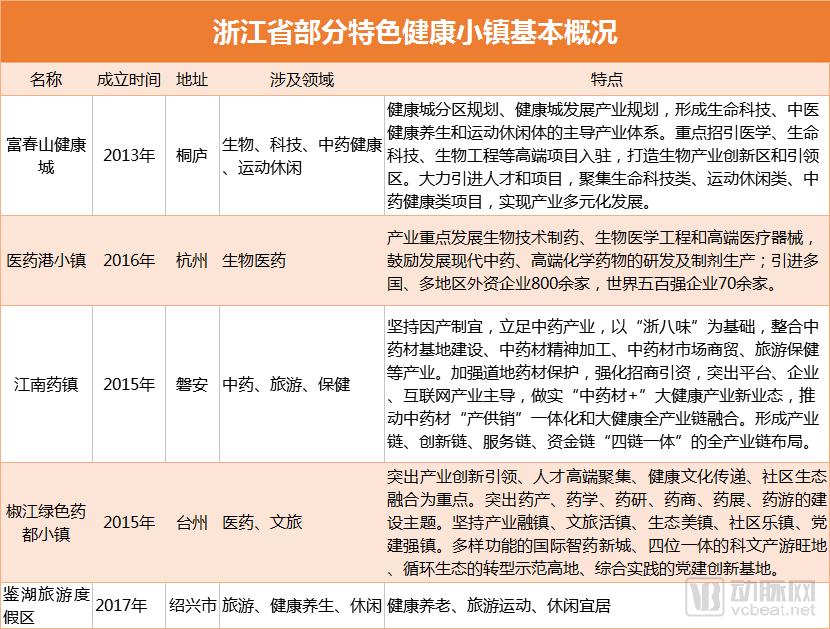
As shown in the table above, Health Towns are a group of emerging and vibrant towns primarily involving sectors such as pharmaceuticals, healthcare, cultural tourism, and sports leisure, thereby achieving diversified industrial development. By leveraging their distinctive industries, integrating innovative operational models, and combining with the new business formats of the “Internet Plus” big health industry, these towns emphasize technological innovation and talent acquisition, increase investment in soft power, and consolidate core competitiveness. Furthermore, by capitalizing on advantages in transportation, culture, and geography, they develop the tourism industry to drive the broader economic value chain.
Taking the Jianhu–Keyan Sports and Leisure Cluster as an example, it is a health industry system centered on sports and leisure.This region boasts the material foundation and locational advantages necessary for developing the health industry, along with natural and cultural tourism resources, providing a solid basis for the resort’s development of leisure tourism products. It is committed to building Changjiao into a premier tourist destination characterized by healthy elderly care, sports tourism, and a leisurely, livable environment. Located in the southern wing of the Yangtze River Delta and within the core economic and transportation hub, the resort recorded a gross domestic product (GDP) of RMB 135.1 billion in 2017, with a per capita GDP of RMB 202,400—the highest in Zhejiang Province. For nine consecutive years, it has been recognized as one of the “Top Ten Demonstration Zones for Comprehensive Well-being in China.”
The resort area drives the development of the entire health industry through sports and leisure. Major projects within the area include: Phase I and Phase II of Oriental Landscape, Tianma F2 Racing Circuit, Qiaobo Ice and Snow World, Ruohang Heliport, Jianhu Golf Course, and Zhejiang Yiteng Football Development Base. With the vibrant scenery of Jishan Mountain and Jianhu Lake, Oriental Landscape has become a major ecological park and has been successfully established as a National 4A-level Tourist Attraction. The Tianma F2 Racing Circuit features a main track built to FIA Grade 2 standards and has successfully hosted numerous international competitions. Qiaobo Ice and Snow World, the only indoor ski hall in China, has become the ski training base for the Winter Paralympics in Zhejiang Province. Ruohang Heliport has realized the dream of Shaoxing residents to soar in the blue sky. Jianhu Golf Course has been ranked among the “Top Ten National Courses of International Championship Standard” for seven consecutive years. The Yiteng Football Development Base aims to popularize football and promote football culture.
In the future, Jianhu Tourist Resort will focus on building a health industry system centered on the sports and leisure sector, while introducing health industry projects such as elderly care, wellness, and biomedicine to enrich its health industry portfolio. It is committed to becoming a premier tourism and vacation destination in the Yangtze River Delta that integrates sports, leisure, and wellness.
According to relevant data, a total of 17 health industry bases in Zhejiang Province have been included in the “Four Batches” cultivation list, primarily distributed across the central and northern regions. In 2017, the total output value of the health industry demonstration bases reached RMB 88.53 billion, with an average output value per mu of RMB 1.914 million. There were 44 key projects at or above the provincial level, with research and experimental expenditures accounting for 10.9% of the total.
Among these health industry bases, the top three in terms of total output value are Xinchang, Hangzhou Bay Shangyu, and Moganshan Industrial Parks. The top three in terms of output value per mu are Hangzhou Bay Shangyu, Eastern Health Industrial Park, and Xinchang High-Tech Industrial Park. The top three in terms of investment funding are China Silicon Valley Jiashan Science and Technology Park and Anji Moganshan Health and Pharmaceutical Industrial Park. Over 70% of the province's health industry bases are dedicated to pharmaceuticals and health foods, with biomedical industrial bases showing particularly strong growth momentum.
Taking the Silicon Valley Jiashan Science and Technology Park as an example, it is deeply committed to the artificial intelligence and healthcare industries.Established in May 2013, the park covers a planned area of 5.57 square kilometers and serves a surrounding region of 10 square kilometers. It advocates development principles centered on low-carbon practices, high quality, innovation, environmental sustainability, and inclusive growth. Leveraging its industrial foundation, the park attracts top-tier talent to build dual hubs for the commercialization of high-tech achievements and industrial development.
The park has been deeply cultivating the two major industries of artificial intelligence and healthcare, and has initially established a clustering effect for healthcare projects. Its healthcare industry mainly involves areas such as in vitro diagnostic reagents, detection equipment, implants, and imaging diagnostics.Specifically, the key practices of health and medical industry bases are prominently reflected in three aspects: improving policies, optimizing platforms, and deepening services.
(1) Improve policies and provide policy support.In March 2017, Jiashan County issued the "Several Opinions on Creating the Optimal Talent Ecosystem and Promoting the Construction of a High-Level Hub for Talent Entrepreneurship and Innovation in the County," introducing 32 new talent policies—the most targeted talent policy measures to date. Meanwhile, the industrial park has been continuously improving and establishing supporting policies for the development of the health and medical industry, providing policy support for the entrepreneurial and innovative development of talent in this sector.
(2) Optimize the platform and intensify efforts in attracting talent and investment.The park has introduced a new specialized bio-pharmaceutical incubator targeting enterprises in biotechnology, pharmaceutical R&D, and medical services. This incubator model creates a synergistic integration of incubation, technology transfer, and industrialization. Meanwhile, the park prioritizes investment promotion to attract industrialization projects; for instance, it successfully attracted Zhejiang Lan Yi Pharmaceutical Co., Ltd., which achieved annual sales revenue exceeding RMB 300 million in 2017. Furthermore, the park emphasizes talent attraction through existing experts and competitive events. The "Dream China Zhihui Jiashan" Entrepreneurship Competition, launched in 2016 and held for three sessions, has successfully facilitated the establishment of eight health and medical projects from Silicon Valley.
(3) Deepen services and optimize the entrepreneurial ecosystem.Establish a comprehensive technical service team for innovative medical devices to assist park enterprises in resolving issues related to registration testing, applications for innovative medical devices, and Quality Management System (QMS) audits. This initiative streamlines the processing of medical enterprise certifications, ensuring rapid and convenient procedures that effectively implement the “At Most One Visit” service philosophy. Furthermore, by integrating healthcare resources, we provide end-to-end services covering clinical trials, testing, registration, production, and sales for enterprise products.
The future development plan for the Silicon Valley Park will further drive park growth and cultivate an optimal talent ecosystem by expanding medical device exhibitions, attracting enterprises and high-level professionals, facilitating cross-border exchanges, and broadening its footprint in the health and healthcare sectors.
Last year, among the key enterprises included in statistical reporting in Zhejiang Province, there were 49 non-medical enterprises and 10 privately run healthcare institutions. The overall operational performance of the 49 non-medical enterprises showed that their main business revenue increased from RMB 61.074 billion in 2016 to RMB 72 billion, representing a growth rate of 17.9%. Their tax contributions rose from RMB 5.125 billion in 2016 to RMB 6.358 billion in 2017, marking an increase of 24.1%.Zhejiang NHU, Zhejiang Dian Diagnostics, Hangzhou Zhongmei Huadong Pharmaceutical, and Zhejiang Qinglian Food each recorded an increase in main business revenue exceeding RMB 1 billion. Zhejiang Medicine, Zhejiang Xianju Pharmaceutical, and Zhejiang Hisun Pharmaceutical contributed an increase in tax revenue of more than RMB 150 million, demonstrating outstanding performance.
The province's privately operated healthcare sector is demonstrating strong growth momentum.By the end of 2017, the total number of non-public medical institutions in the province reached 15,106, including 763 non-public hospitals, representing year-on-year increases of 17.6% and 54.5%, respectively, compared with 2014. The number of beds in non-public medical institutions amounted to 74,900, marking increases of 95.6% and 97.6%, respectively, from 2014 levels. New models of collaboration between high-quality resources in public hospitals and social capital have continued to emerge. The province pioneered pilot programs involving renowned experts establishing prestigious medical practices, thereby fostering influential non-public healthcare brands such as Kangning and Shulan on a national scale.
Taking Kangning Hospital as an example, the institution was founded in 1997 and has evolved from a local private psychiatric specialty hospital into a chain hospital group integrating medical care, teaching, and research. On November 20, 2015, “Kangning Hospital” was listed on the Main Board of the Hong Kong Stock Exchange, becoming the first publicly listed psychiatric specialty company in Asia. The group currently operates 41 hospitals within its system, with more than 8,000 open beds, and is the only non-public tertiary Grade A psychiatric specialty hospital in China.
Recently, the development and management model of Wenzhou Kangning Hospital was included in a case study by Harvard Business School at Harvard University, becoming the first hospital case from China to be featured.
Over the past two decades, Wenzhou Kangning Hospital has established a unique development model and distinctive strengths. Its key features are as follows:
First, robust disciplinary support.The Department of Clinical Psychology and the Department of Behavioral Medicine are the hospital’s clinical specialty disciplines. Meanwhile, the hospital is strengthening the development of multiple subspecialties to establish a multidimensional psychiatric discipline system.
Second, cutting-edge scientific research capabilities.In 2003, the hospital introduced overseas PhD-level research leaders and established the Wenzhou Kangning Mental Health Research Institute, which now possesses multiple core experimental capabilities.
Third, a flexible talent development mechanism.The hospital has launched a talent development program in psychiatry, established new training collaborations with multiple hospitals, and jointly initiated the “Kangning Class” with Wenzhou Medical University, providing students with regular opportunities for practical teaching and training in psychiatry and psychology. In terms of talent recruitment, a series of innovative measures have been introduced: senior talents hired are offered dual positions with dual salaries, granted full public institution staffing status at Wenzhou Medical University, and covered by public institution pension insurance. Their compensation package follows a dual-track system combining the national standard salary structure for public institutions and an annual salary scheme.
Fourth, world-class medical services.Five-star hotel amenities combined with professional medical services provide dignified healthcare for patients with mental disorders.
In 2017, Kangning Hospital launched the upgrade project for its headquarters base, providing hardware support to further strengthen and expand its medical care, teaching, and research capabilities.In the future, we strive to establish a nationwide chain of large-scale mental health medical groups, promoting Wenzhou Kangning Hospital’s unique management, technical, and humanistic models to the world through new construction, equity participation, investment, mergers, and acquisitions.
A total of 1,003 health industry service projects were identified in the “Four Batches” service list, including 80 medical projects and 20 privately operated medical projects. Health industry service projects are categorized into medical and non-medical projects. The details are as follows:
I. Healthcare Projects. There are 20 projects in the category of privately-run healthcare institutions, with an estimated total investment of RMB 10.15 billion. By the end of 2017, RMB 2.631 billion had been invested, representing a completion rate of 26%. The total planned bed capacity for these projects is 9,038 beds.
II. Non-medical Projects. The total investment amounted to RMB 65.26 billion, with RMB 21.62 billion completed by the end of 2017. In terms of benefit per mu, projects in the health information and pharmaceuticals and health food sectors demonstrated higher returns. The project on innovative applications of information technology to support the healthy aging industry achieved a remarkable benefit per mu of RMB 33.06 million. The top ten projects were predominantly from the health information and pharmaceuticals and health food categories.
Taking the Yigu Cultural Industry and Tourism Complex Project for the Traditional Chinese Medicine (TCM) Industry in Kecheng District, Quzhou City as an example, its core theme integrates the “Eight Famous Herbs of Zhejiang” with the Shenlong Butterfly Valley to create a comprehensive region-wide tourism system. Positioned around five pillars—production, tourism, wellness, education, and research—the project is built upon a TCM herb industrial base within the park. It features a tourism complex specializing in health-oriented products and services, including medicinal cuisine, herbal therapy, wellness and elderly care, rural family-friendly activities, beauty and body care, and fumigation-based healthcare.
The Zheba Wei Shennong Butterfly Valley Project, rooted in land development, represents a robust exploration by Zhejiang Province to elevate the standards of modern agricultural development. It fully embodies an enterprise-led, technology-driven, and market-oriented approach, paving a new path for the advancement of modern agriculture. The project aims to transform traditional rural farmland into high-standard fields, converting fragmented plots into contiguous, high-quality agricultural land. It is dedicated to developing the existing landscape of mountains, waters, forests, fields, and lakes, along with the authentic medicinal herb theme park, into the most influential medicinal herb park in China.
Zhejiang Province’s “Four Batches” development platforms have become the primary stronghold for the growth of the health industry, achieving satisfactory results since their implementation. Moving forward, the province will concentrate efforts to elevate these “Four Batches” development platforms to new heights, with specific measures to be implemented in the following areas:
First, plan and implement the capacity enhancement project for key industrial platforms.In accordance with the principle of prioritizing key areas and advancing in phases, we will concentrate efforts on health-themed towns and demonstration bases with solid foundations and mature conditions, to establish one or two clusters of emerging health industries with international competitiveness.
Second, strengthen the health information service platform.
1) Comprehensively advance the development of the “Zhejiang Health Cloud,” improve the provincial health information service framework, and accelerate the construction of a unified, authoritative, and interoperable population health information platform.
2) Accelerate the development of public service platforms for health big data and plan the establishment of the Zhejiang Provincial Medical and Health Big Data Center.
3) Strive to establish a national-level pilot base for health big data.
Third, research breakthroughs in policy bottlenecks constraining the development of the health industry.In the five areas of import registration and approval for medical devices and pharmaceuticals, construction of clinical pilot bases for innovative drugs, cell therapy, configuration approval for large-scale medical equipment, and allocation of new land use quotas for major projects, we will clearly define the primary directions for future policy breakthroughs and strengthen targeted support for the development of key sectors in the health industry.
4. Study and formulate specialized policies for the development of the workforce in the health industry.Targeted support for the introduction and cultivation of talent in key areas across medical services, health and elderly care, and biopharmaceuticals to promote the agglomeration of professionals in health industry-related fields.
5. Research and establish a long-term mechanism for monitoring and evaluating the development of the health industry.
1) Improve the monitoring and evaluation system for the health industry;
2) Establish a long-term mechanism for the regular submission, monitoring, and evaluation of data related to the “Four Batches” initiative in the health industry;
3) Strengthen precise support for the dynamic management of health industry development;
4) Strengthen targeted services for the “Four Batches” carriers in the health industry.