

Quanshi Elder Care Files IPO Prospectus: Building a LBS-Based Elderly Service Ecosystem Bridging Government, Businesses, and Seniors
China’s elderly care sector is trapped in a paradoxical cycle: “tight regulation stifles innovation, while deregulation leads to chaos.” Poor communication between the government and elder-care service providers means that government funding cannot be tracked in real time to verify service delivery. Meanwhile, enterprises, constrained by overly rigid regulations, lack the capacity for self-sustaining revenue generation. As a result, seniors fail to receive tangible benefits.
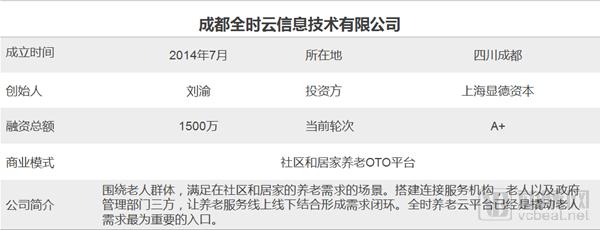
In July 2014, Liu Yu established Quanshi Elderly Care in Chengdu, targeting government agencies and elderly-care service providers. By leveraging technologies such as the Internet, the Internet of Things (IoT), and cloud computing, the company developed integrated smart aging solutions for home-based and community-based care.
Quanshi Elderly Care leverages its cloud platform to establish a location-based service (LBS) system for the elderly, integrating their needs into curated “service packages” and creating a more comprehensive and convenient ecosystem encompassing medical care, dining, housing, transportation, entertainment, and wellness. It builds a communication bridge between government and enterprises, empowering governments, elderly-care service providers, and seniors alike.
VCBeat (WeChat ID: vcbeat) has learned that Quanshi Elderly Care has been implemented in over 150 districts and counties, serving more than ten million elderly individuals. Approximately RMB 2–3 billion in funds are distributed annually through the Quanshi Cloud Platform, which handles tens of thousands of concurrent transactions daily.
Building a G-B-C Communication Bridge
Source: Internet
Elderly care cannot be separated from government involvement; the B-side (business sector) and G-side (government sector) are inextricably linked.
Excluding the 3% of elderly individuals within the 9073 framework who are managed by large-scale senior living communities, the majority of the remaining population relies on government-backed support, with services procured by the government. However, despite this expenditure, the government often lacks accurate and timely visibility into service implementation. Poor communication among the government, service providers, and the elderly results in low satisfaction levels for all parties involved.
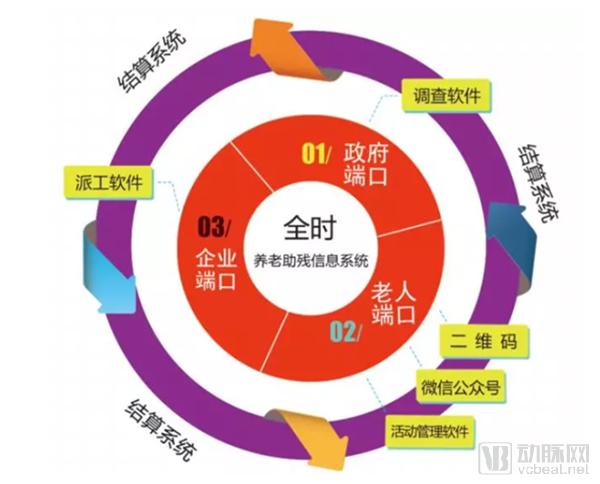
Quanshi Elderly Care has developed the Quanshi Cloud Platform to facilitate effective integration between government (G-end) and business (B-end) stakeholders. Meanwhile, consumers (C-end), specifically seniors, require a medium to identify nearby accredited elderly care service providers. This enables effective interaction between B-end providers and C-end users under governmental oversight.
On the Quanshi Cloud platform, elderly individuals post their care needs, which are then accepted by contracted enterprises. These enterprises develop customized service plans, upload them to the service platform, and assign service personnel, who subsequently accept the assignments and provide in-home services. To ensure service quality, Quanshi Cloud generates a unique QR code for each elderly resident in the community. Service personnel must scan this code upon arrival, take photos to document the service process, and obtain final evaluations from the elderly clients, thereby preventing elder abuse.
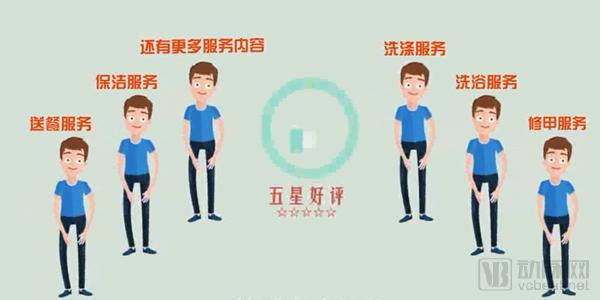
Image source: Provided by the enterprise
Quanshi Elderly Care leverages government partnerships and its self-developed assessment system and software to establish a dynamic database of seniors, capturing comprehensive personal information. It then matches services to individual needs based on this data and pushes tailored recommendations to seniors, thereby serving as an effective nudge mechanism.
Under the "9073" model, full-time elderly care primarily targets the 90% of seniors who age in place, leveraging the 7% of community-based service resources to provide support. With community day-care centers as key hubs, a comprehensive home-based elderly care solution—the "Elderly Care Service Package"—is offered. This approach optimally matches nearby resources to create a "One Bowl of Soup Distance" care map, ensuring that day-care centers respond immediately in the event of an emergency, thereby safeguarding the well-being of seniors.
Meanwhile, the system can help governments and enterprises establish a long-term liaison and approval mechanism, invigorating day care centers. By leveraging a full-time embedded CRM (Customer Relationship Management) system that integrates with government management platforms, day care centers are empowered to independently provide certain services, subject to registration requirements.
Furthermore, Quanshi Elderly Care has also launched IoT-enabled services tailored for special populations, including infrared life detectors, fiber-optic smart mattresses, electronic fences, and GPS positioning; as well as regulatory services for day care centers, such as people-flow counters and camera-based monitoring.
Boosting Elderly Engagement, Building the Information Superhighway
Quanshi Elderly Care, with government support, targets all elderly individuals as its service recipients.
Liu Yu stated that Quanshi Elderly Care will continue along this path to expand its market share, deepen its community presence, and establish an “information highway” for the elderly, thereby realizing the true value of the Quanshi platform: mediating goods and services.
Liu Yu anticipates that the platform’s commission-based revenue will gradually stabilize as the platform matures and the spending power of the elderly is unleashed. Currently, business revenue is primarily derived from government services, with the aim of rapidly capturing market share and enhancing competitive advantage. Additional revenue streams include: sales of smart elderly-care devices (such as smart mattresses and watches) that leverage the platform to create a closed-loop service ecosystem; and the usage of various assessment tools.
Quanshi Elderly Care is committed to thoroughly resolving the predicament in the elderly care industry where “tight regulation leads to stagnation, while deregulation results in chaos.” By ensuring smooth communication with top-level policymakers and maintaining accurate data on the elderly population, Quanshi empowers B-side enterprises to achieve self-sustainability, thereby enabling them to develop products that truly meet the needs of senior citizens.
From the consumer-facing perspective, it is essential to gain a deep understanding of elderly users and establish trust-based relationships. This ensures that seniors think of your platform first when needs arise, fostering strong engagement, revitalizing the platform, and transforming it into a dedicated service and communication hub for the elderly.
Regarding the founding team, Mr. Liu Yu, founder of Quanshi Elderly Care, returned from the United States and co-founded Quanshi Company with Professor He Chunshui, a postdoctoral fellow at the Cleveland Clinic, and Mr. Dai Yonglin, a senior internet product manager.
Liu Yu stated that the data collected by Quanshi Cloud would be de-identified and made available to the public as a public utility.