

Mira Files for IPO: A Palm-Sized, All-in-One Health Monitoring Device Focused on Women's Reproductive Health

Mira Aesthetic Medical Center and Day Spa
Aesthetic Surgery Medical Center
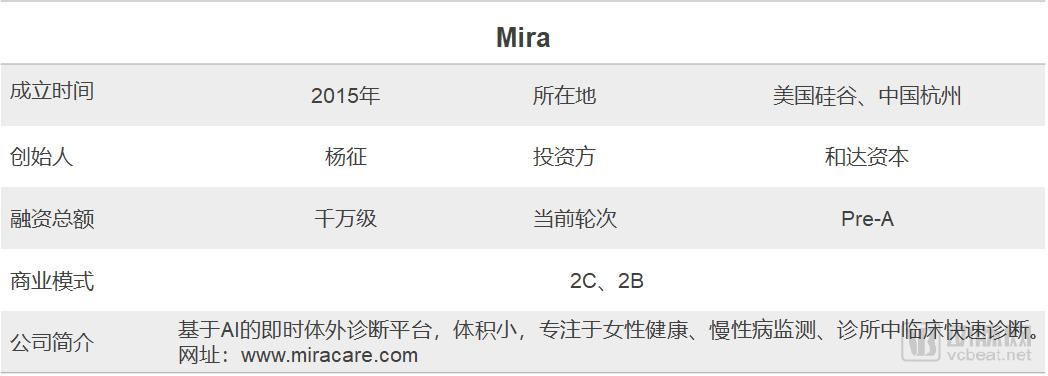
Whether acknowledged or not, women are playing an increasingly important role in the workplace. As women’s focus shifts from the family to society, delaying childbirth has become a reluctant choice. However, time waits for no one, and conception at an advanced maternal age is relatively more difficult. According to statistics, with the rise in the average age at which women begin trying to conceive, 43% of couples require more than three months to achieve a successful pregnancy.
A woman’s ability to conceive is influenced by many factors, among which progesterone levels are the most critical. The accuracy of traditional ovulation predictor kits and basal body thermometers is questionable in practical use. For instance, ovulation predictor kits rely on fixed hormone thresholds to determine ovulation, leading to false-positive and false-negative results. Basal body thermometers, on the other hand, exhibit a lag effect; a woman’s body temperature rises only after ovulation has occurred, meaning such devices can detect fertility in merely half a day out of the six-day fertile window.
Furthermore, the timing of conception in women can also be determined based on progesterone levels. Since ovulation does not occur at a fixed time each month, women cannot rely on past experience to predict their ovulation window. However, normal ovulation is a prerequisite for conception, making timely monitoring of hormone levels an essential need for women trying to conceive.
Currently, accurate hormone level testing can only be performed in hospital settings using large-scale equipment. Due to high costs and limited convenience, hospital-based testing is rarely the preferred option for women preparing for pregnancy.
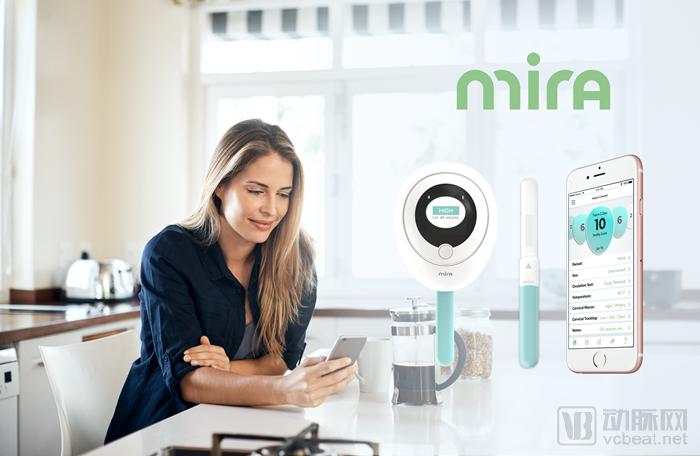
Mira product. Image provided by the interviewee.
Mira is a portable point-of-care testing (POCT) system, no larger than the palm of your hand. Unlike traditional home chemical test strips that rely on subjective visual interpretation of color changes, Mira employs quantitative fluorescence immunoassay—the same measurement method used by large-scale instruments in hospitals.
During use, Mira quantitatively measures the levels of biomarkers in user urine, including LH, E3G, Progesterone, FSH, and hCG (covering five of the six markers tested in hospitals), thereby providing hospital-grade accuracy in determining ovulation timing, fertile days, ovarian reserve, fetal development, and signs of miscarriage, offering women a one-stop solution.
Sylvia Kang, co-founder of Mira, told VCBeat that validation using 400 clinical samples demonstrated an accuracy rate of 99% for Mira, with no significant bias from common interferents in body fluid samples. Its sensitivity and specificity exceeded 98% and 95%, respectively.
Meanwhile, all Mira products are manufactured in-house. The company has established a GMP-compliant cleanroom facility exceeding 1,000 square meters in Hangzhou, which houses over 40 functional workshops certified under the ISO 13485 quality management system, ensuring product quality and stability. Reportedly, Mira demonstrates high sensitivity in fluorescence signal capture, with a limit of blank (LoB) as low as 0.63 mIU/mL and an average intra-assay coefficient of variation (CV) of less than 11%.
Kang Manman stated that Mira has obtained FCC certification from the United States, FDA approval from the United States, and CE marking in Europe. It is currently applying for Class II medical device certification with the China Food and Drug Administration (CFDA), with approval expected in the first quarter of next year.
Furthermore, Mira effectively integrates artificial intelligence with medical diagnostics. By learning personalized parameters from physiological indicators, the Mira APP presents users with continuously optimized, intuitive analyses and predictive results, while providing personalized medical recommendations. Reportedly, the Mira App connects users with physicians, ensuring that user inquiries receive timely and accurate responses. It also enables physicians to conveniently access continuous and comprehensive data, thereby facilitating specific diagnoses and health recommendations.
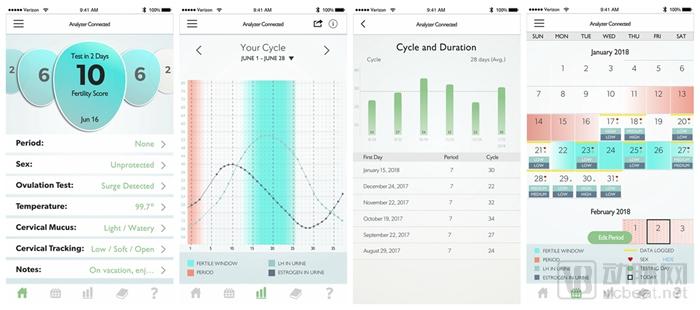
Mira APP images provided by the interviewee
According to Kang Manman, Mira’s R&D team is distributed across Silicon Valley in the United States and Hangzhou in China, comprising a total of 36 members. After three years of independent research and development, the Mira team has filed a cumulative total of 18 intellectual property rights applications, six of which have already been granted as patents. The Mira team is divided into three departments: Immunology, Instrument Hardware, and Business Development. The Immunology department is led by Dr. Chang Xing, the Instrument Hardware division by Dr. Yang Zheng, and the Business Development department by Kang Manman. Dr. Chang Xing holds multiple prestigious positions, including postdoctoral fellow in immunology at Yale University and doctoral supervisor at the Chinese Academy of Sciences. Dr. Yang Zheng completed his postdoctoral training at the University of California, San Francisco, and worked for several years at a biotechnology company in the Bay Area that was acquired by Bristol-Myers Squibb (BMS) in 2014. Kang Manman has studied and worked in the United States since graduating from high school. She holds an MBA from Cornell University and a Master’s degree in Bioengineering from Columbia University. Previously, she served as Commercial Director at a Fortune 500 global biopharmaceutical company, where she was responsible for $100 million in global sales.
According to Kang Manman, Mira will be launched in the US, European, and Chinese markets starting in the third quarter of 2018. In the US, Mira primarily employs content marketing, leveraging social media and search engines to strategically build its brand among consumer-facing (C-end) users. Since its launch this September, Mira has achieved a high conversion rate in the US market. Furthermore, capitalizing on the mature Pharmacy Benefit Manager (PBM) system in the US, business-to-business (B2B) engagement constitutes another key market strategy for Mira in the country. Mira’s B-end clients include hospitals, insurance companies, pharmaceutical enterprises, and large employers; the company mainly establishes connections with these B-end users by providing data services.
However, Kang Manman emphasized to VCBeat that Mira’s market strategies in China and Europe will differ. Specifically, when entering the Chinese market, Mira will prioritize active online communities as its primary channel, given their dual function as both community platforms and e-commerce venues in China; in Europe, the focus will be on integrating with existing distribution channels.
Kang Manman stated that Mira’s ultimate product vision is a home testing platform. While continuously launching women’s health products, the company plans to expand into chronic kidney disease and infectious disease testing in the future, with these capabilities becoming Mira’s primary source of sales revenue. She revealed that Mira is currently preparing to extend its testing samples to blood, enabling the detection of biomarkers in blood through the integration of micro-blood collection devices.
Mira is currently conducting its Series A financing round to expand product marketing, broaden its product line, and provide ancillary services required by its community users. Investors interested in this project may add the author on WeChat (ID: no_th_ing) to connect with the founder.