

Burning Calories with Gene Technology: Tackling a Multi-Billion-Dollar Precision Fitness Market
Searching online for “how to stay in shape” may yield a plethora of varied advice:
Vegetarian diet,
Eat protein,
Cut out carbohydrates,
Aerobic Exercise,
Pay attention to sleeping posture,
Do not wear high heels,
Slimming Coffee,
Yoga,
........
It sounds like each perspective has its merits, but as the saying goes, “There are a thousand Hamlets in a thousand people’s eyes.” The same treatment plan will ultimately yield different outcomes when applied to different individuals.
Among entrepreneurs in the gene sequencing sector, some have begun to integrate the concept of “precision” into fitness. Genetic testing can decode an individual’s metabolic response to food and their athletic potential, thereby enabling the design of personalized fitness plans. For instance, 23andMe and Ancestry, two major consumer genetic testing companies, have long offered reports on food and nutritional metabolism.
Building on this foundation, some companies have begun to delve deeper into product development, leveraging genetic data to provide users with enhanced guidance and process-oriented services.
It is predicted that this market alone in China will reach a scale of tens of billions of yuan.
VCBeat has compiled an overview of several international products and their business models to examine how they operate.

Image from the official DNAFit website
When it comes to “gene + fitness” products, one company that must be mentioned is DNAFit. Founded in 2013, the company is dedicated to pioneering a new era of nutrition and healthy lifestyles through genetic technology. Its team includes genetics PhDs from the University of Cambridge, as well as sports nutritionists who previously worked at the UK–Russia Joint GWAS Consortium, a top-tier sports research institution.
DNAFit focuses on nutrition-related products, with its flagship offering named DietPro. By leveraging genetic testing, the company assesses each user’s unique nutritional metabolism and absorption capabilities, using these insights to formulate personalized dietary plans. Upon completion of the test, users receive a DNA analysis report, along with a complimentary 30-minute telephone consultation. Recognizing that users may find their reports confusing, DNAFit provides access to trained dietitians who help them better understand the results. These dietitians also optimize food choices based on the user’s DNA report and provide 12 weeks of nutritional planning support.
Unlike products such as 23andMe that merely provide reports, DNAFit has developed a mobile application called Mealplanner. Users can input their current data, daily habits, and desired goals, and the system will automatically generate a personalized dietary plan for them.
Moreover, Mealplanner features an integrated shopping community, enabling users to purchase groceries online based on their customized recipes and needs. This not only facilitates recipe execution for users but also generates additional revenue streams and partnership opportunities for the company.
Another product, Diet FitnessPro 360, adds exercise guidance features to the first-generation model. In addition to nutrition and dietary advice, Diet FitnessPro 360 uses genetic reports to identify personalized training methods for users. The genetic testing covers analysis of athletic performance and endurance, leveraging genetic predispositions to guide training and prevent injury during exercise. Compared with DietPro, the sports scientists behind Diet FitnessPro 360 provide personalized coaching based on user goals, offering comprehensive 360-degree guidance that spans from daily diet to exercise plans.
Integrating genetic technology with health management will undoubtedly provide users with more precise health management solutions. Most features of Boohee Health and KEEP are offered to users free of charge, which serves as a strategy to lower the barrier to entry. However, on the other hand, the lack of payment has led to relatively poor adherence among some users.
DNAFit is a paid product. Users demonstrate strong adherence to the recommended plan after receiving it, and the service includes a period of post-report consultation to help users better understand the report’s content.
In addition to selling on its own website, DNAFIT has launched several products on Helix and supports the import of 23andMe data. As both Helix and 23andMe are major traffic channels, this bridge enables DNAFIT to reach a broader audience interested in genetic testing. Furthermore, since no sequencing is involved for users coming from these two channels, the product prices are slightly lower.
However, DNAFit’s products are not without flaws, one of which is their price. The DietPro and Diet FitnessPro 360 are priced at $149 and $179, respectively, equivalent to 3.8 to 4.5 months of gym membership fees (Google search results indicate that monthly gym memberships in the United States cost around $40). Such pricing makes it difficult to promote these products in the Chinese market.
Furthermore, setting aside whether diet plans prescribed by nutritionists are applicable across all regions, it is highly impractical for office workers and students to strictly adhere to such meal plans, resulting in poor compliance.

Image from the Pathway Genomics official website
Since its establishment in 2008, Pathway Genomics has been dedicated to the commercial application of genetic technologies. The company operates a CLIA- and CAP-certified clinical laboratory in San Diego, providing services to clients in more than 40 countries worldwide. Sports and nutrition testing constitutes a key business segment for Pathway Genomics, which has launched three products in this area.
The first product, Fit IQ, targets the general consumer market. In addition to reports on food metabolism and exercise capacity, the product’s test report provides personalized dietary and exercise recommendations based on these data. As illustrated in the sample report, Fit IQ places greater emphasis on improving physical condition through a balanced diet. It selects the most suitable foods based on genetic information, offering options such as “lowest fat,” “lowest calorie,” and “most balanced diet.”
Based on the sample report, Fit IQ differs from the “broad but shallow” testing reports represented by 23andMe (which offer extensive testing content but lack depth). Fit IQ provides detailed explanations for each item, including recommended foods and dosages, as well as daily protein and fat intake.
Sport IQ is more geared toward professionals. Pathway Genomics employs an AI-based algorithm to quantify the impact of genetic information on traits such as Achilles tendon injury resilience and emotional states like anxiety, having established the largest marathon runner database in history. After performing whole-exome sequencing on users, the company uses specialized AI algorithms to compare user data with the genetic profiles of 119 elite marathon runners, thereby providing guidance for their daily training.
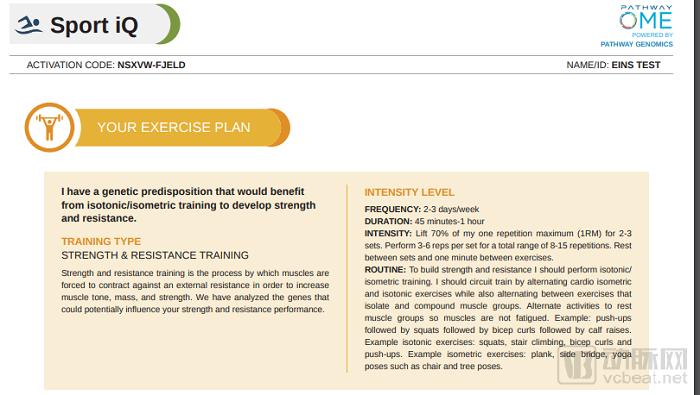
The figure shows a sample report from Pathway Genomics.
The final product, Pathway Fit, is a combination of the previous two models.
Pathway Genomics’ core values center on leveraging DNA data to help users transform their lifestyles and incorporating artificial intelligence to assist in the interpretation of test results. Each of its single-product test panels covers at least 20 items, with all testing conducted in certified laboratories. Its flagship products are strategically differentiated to cater to both professional and non-professional users.
The product prices are $99, $99, and $299, respectively, offering certain advantages over DNAfit.
However, regardless of the product, the service effectively terminates the moment the user receives the report, with only a brief 15-minute consultation provided (each report is approximately 20 pages in length). Pathway Genomics offers no follow-up management to address users’ implementation challenges; issues regarding adherence and coordination must be resolved by the users themselves.
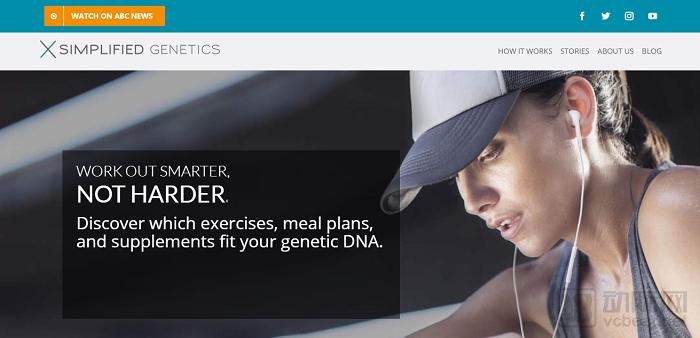
Image from the Simplified Genetics official website
Simplified Genetics, founded in 2005, claims to be the only provider of whole-genome sequencing services for consumers in the United States. Its founder, Kurt Johnsen, is a sports enthusiast. Compared with the first two companies, Simply Fit has made substantial efforts in product marketing.
Upon visiting the official website, one finds that Simplified Genetics provides only a brief overview of its product and service offerings. Instead, it devotes substantial space to customer case studies, aiming to ignite consumer enthusiasm through a series of vivid success stories. Furthermore, the company has aired video advertisements on ABC, YouTube, and other video-sharing platforms, while publishing fitness-related educational content on various blogs. In short, Simplified Genetics is employing diverse strategies to convey a single message to consumers: “Buy our product, and you will successfully lose weight.”
However, it is difficult to find extensive product descriptions or sample reports on Simplified Genetics’ website; indeed, no purchase links could be located. In terms of service, Simplified Genetics similarly prioritizes the delivery of test results to users, without optimizing post-report services.
As no shopping links were found, the author was unable to determine the product prices at this time. According to information disclosed by Chinese media, the products are priced at $249 and $299, respectively.
Kinetic Diagnostics, established in 2014, is a project incubated by the University of California, Berkeley. The company targets the high-end market, aiming to maximize the performance of athletes and fitness enthusiasts through genomics while minimizing sports-related injuries.
In October 2015, Kinetic Diagnostics established and delivered a genetic data analysis engine, and commenced genetic testing and blood analysis services. The company also signed contracts with a large sports medicine diagnostic center and several small retailers, with plans to establish related fitness centers and clubs, and to develop a mobile application in the medium term.
Kinetic Diagnostics’ vision is admirable; it aims to establish a service ecosystem encompassing genetic testing, data services, and sports health through resource integration. However, current outcomes are far from encouraging.
Kinetic Diagnostics once launched a crowdfunding campaign on the IndieGOGO platform. The final amount raised was $1,202, achieving only 2% of its funding goal. The author attempted to obtain more information through its official website, but the company’s domain name is now listed for sale, and its introductory video on YouTube is no longer playable.
Kinetic Diagnostics was one of the few “genetics + fitness” companies that launched its operations offline, initially targeting the high-end market. However, a small user base and heavy reliance on gyms and physical stores for customer acquisition placed Kinetic Diagnostics in an awkward position. It was likely this combination of factors that ultimately led to the company fading from public view.
In addition to the above, we have identified several startups similar to 23andMe and Ancestry, such as Titanovo and VITAGENE. Their products are also similar to those of 23andMe and Ancestry, with some even being derived directly from 23andMe; therefore, they will not be discussed in detail here.
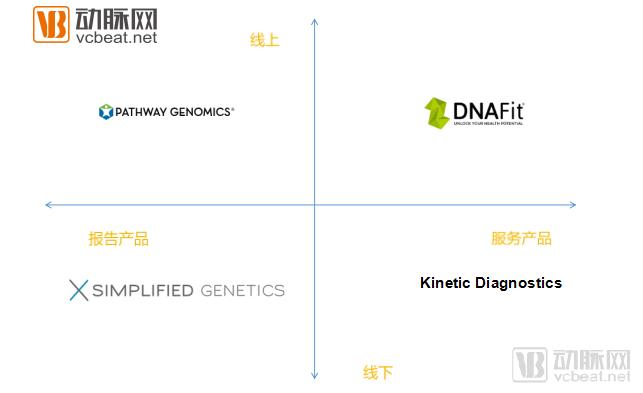
Each company has its own approach, but in essence, there are only a few models: one aims to complete the industry chain through resource integration, while the other focuses on refining its products to perfection.
DNAdnaFit is undoubtedly the former, extending its reach beyond products into downstream services. However, whether it is DietPro or Diet FitnessPro 360, the business models of both products evoke a sense of unfamiliar familiarity—essentially, they are “genetics + internet-based health management.” Products for internet-based health management have already been launched in China over a decade ago.
Boohee Health, which focuses on dietary plans, was launched on the App Store as early as 2007 and introduced its own branded food e-commerce platform in 2014. Keep, another health and weight-loss app centered on fitness, went online in 2015 and has since accumulated over 120 million users. Qingjia, launched in 2014, aims to integrate exercise with diet, serving as an assistant for users’ weight-loss workouts and healthy eating.
Similarly, Kinetic Diagnostics also falls into the former category. However, for a startup with a team of fewer than 10 people, the heavy integration of resources required in the offline high-end market undoubtedly creates immense pressure.
Pathway Genomics and Simplified Genetics fall into the latter category, yet there is a significant distinction between the two. Simplified Genetics focuses primarily on product promotion and marketing, whereas Pathway Genomics emphasizes the professional quality of its reports.
Pathway Genomics maintains rigorous standards in product design. In addition to operating a CLIA-certified laboratory, the company places significant emphasis on data interpretation and comprehensive reporting. Beyond artificial intelligence, its interpretation tools incorporate 21 technologies, including Google Analytics.
Pathway Genomics has raised a total of $43 million in financing, with its final round amounting to $40 million, led by IBM Watson and participated in by IBM Ventures.
GeneCard is one of the few companies in China specializing in “genetics + weight management,” with its current business deeply integrated into the fitness industry. Unlike traditional fitness coaching, GeneCard integrates dietary management with exercise regimens. This dual approach not only provides a practical application for genetic testing but also addresses the common shortfall of dietary guidance in gyms.
“Most people who go to the gym have fat loss and slimming as their primary goal, with very few engaging in professional training,” Hou Yubin, founder of Gene Card, told VCBeat. In this process, fitness trainers are only responsible for getting clients to exercise, offering little assistance with dietary control.
“Fitness accounts for 30% and diet for 70%; dietary management makes fat loss and slimming twice as effective, while nutritional genetic testing results significantly reduce the risk of malnutrition associated with weight loss,” he added. Gene Card’s team includes a group of registered dietitians, possibly constituting the largest cluster of registered dietitians in China currently.
While numerous other companies in China have entered this space, most merely incorporate it as a component of their products, informing users about their metabolic characteristics by testing a limited number of genetic loci, with few engaging in in-depth exploration. This is partly due to disparities in consumer understanding of genetic technologies, and partly to the varying levels of attention consumers pay to fitness.
Consumer genomics in the United States has undergone extensive development, with 7 million people having completed genome sequencing by 2017. In China, this figure stands at 300,000. At a time when even products addressing essential needs are not easy to promote, those catering to non-essential demands must make greater efforts in product refinement and cost reduction to meet consumer expectations.
In terms of the level of attention paid to fitness, it has actually only begun to rise in recent years. Ultimately, fitness is a product of consumption upgrading.
“The market is vast, but tough to crack.” This is how an entrepreneur described the “genes + fitness” sector. Nevertheless, physical vitality and an aesthetically pleasing physique have become symbols of one’s personal brand, and the concept of healthy living is gaining acceptance among a growing number of people. According to data released by the National Bureau of Statistics of China, the total scale of domestic sports consumption will reach RMB 1.5 trillion by 2020, with 435 million people regularly engaging in physical exercise. Assuming a market penetration rate of 5% and an average transaction value of RMB 500, this would constitute a market worth tens of billions of yuan.
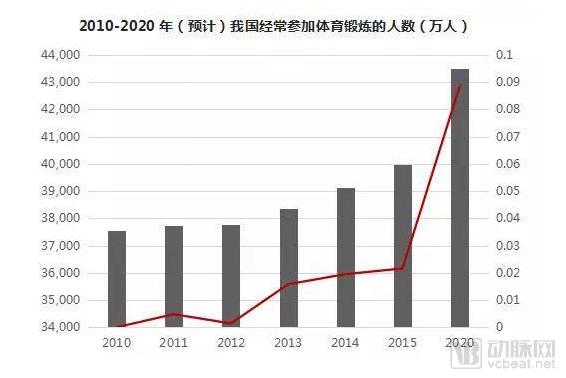
Image from RET Ruiyide
Although the market has not yet experienced explosive growth, it is expanding rapidly and offers substantial room for development. While leading companies have already emerged in the broader sequencing sector, this specific niche remains largely underserved, representing a significant market gap—or even a blue ocean opportunity.
Meanwhile, China’s fitness market is diverse. In addition to physical entities such as traditional gyms, mini-gyms, and weight-loss clinics, there are various internet-based fitness tools. These venues, particularly online fitness platforms, boast large and relatively well-targeted user bases, making them potentially ideal channels for customer acquisition.