

Mindray Medical Debuts on ChiNext with Largest-Ever IPO—Can It Lead China’s Domestic Medical Device Substitution?

Title | The Sick Doctor
Author | Jean-Georges Vibert
Medical History in Pictures | Issue 20181021
VCBeat (WeChat ID: vcbeat) has learned that on October 16, 2018, Shenzhen Mindray Bio-Medical Electronics Co., Ltd. (hereinafter referred to as “Mindray Medical”) was listed on the ChiNext board of the Shenzhen Stock Exchange. With the stock abbreviation “Mindray Medical” and stock code “300760,” its shares surged upon opening, triggering a temporary trading halt after hitting the 44% price increase limit for new listings. The issue price was RMB 48.8 per share, the opening price was RMB 58.56 per share, and the current price stands at RMB 70.27 per share, corresponding to a market capitalization of RMB 85.427 billion. Despite various challenges and difficulties, Mindray Medical has made ample preparations and made a strong debut on the ChiNext board. This also highlights the promise of domestically produced medical devices in China. What are your thoughts on this?
Monday | Unveiling Startup Unicorns: What Are Their Characteristics & Where Will the Next Wave Emerge [Super Unicorn]
During the growth trajectory of startups, two extreme phenomena often emerge: some companies toil for years only to secure meager funding, while others, like magnetizing forces surrounded by adoring investors, rapidly close multiple rounds of substantial financing within just a few years, swiftly ascending to become industry unicorns. In this special feature titled “Super Unicorns,” VCBeat has compiled a list of companies that achieved unicorn status within three years of founding, drawing from its proprietary knowledge base, and has carefully selected six enterprises for in-depth case analysis.
Tuesday | What Pain Points Must the Next-Generation Hospital Information Platform Address? Experts from Grade A Tertiary Hospitals, Alibaba Cloud, and Ewell Technology Share Their Insights in a Panel Discussion
Shen Chongde, Vice President of Wuxi People’s Hospital; Chen Lie, Medical Architect at Alibaba Cloud; and Zhang Lizhong, Chairman of Ewell Inc., serving as representatives from the hospital, internet enterprise, and medical IT sectors respectively, have assessed that the next-generation hospital information platform may exhibit the following characteristics:
1. Centered on electronic medical records, it achieves multi-dimensional clinical decision support based on a knowledge base, implements artificial intelligence applications ranging from basic to advanced levels, meets the needs of management decision support focused on the operational aspects of personnel, finances, and materials in healthcare, and facilitates interconnectivity with regional information platforms;
2. Leverage cloud infrastructure to build a platform that maps and outlines hospital operations, extract core capabilities, and achieve unification at the data level.
3. Multidimensional monitoring can be provided to medical personnel through various sensors, such as temperature and humidity sensors, body temperature sensors, or vital sign-monitoring mattresses, enabling doctors and nurses to implement closed-loop management.
Wednesday | How Effective Is Channel Transformation Through Chronic Disease Services? A Comprehensive Review of 18 Listed Pharmaceutical Companies
VCBeat has analyzed the chronic disease management strategies of 18 pharmaceutical companies, both domestic and international, to evaluate their performance in the chronic disease management market and assess the effectiveness of the services involved. Our key findings include:
1. Medication adherence represents a significant market opportunity for pharmaceutical companies;
2. Pharmaceutical companies have weak service capabilities; most large pharmaceutical firms that invested heavily in chronic disease management services have failed;
3. Driven by policy and market forces, pharmaceutical companies concentrated their initiatives in chronic disease management during the two-year period from 2015 to 2016;
4. Pharmaceutical companies’ service layouts are typically aligned with their own business lines, with diabetes being a “major segment”;
5. More than half of pharmaceutical companies provide services through collaborations with e-commerce platforms, internet healthcare platforms, and chronic disease management apps;
6. “Internet platforms, smart hardware, and offline services” rank among the top three forms of chronic disease management services offered by pharmaceutical companies.
Thursday | Tumor Immunology, Domestic Substitution, Genomic Big Data... Which Is the New Track for the Gene Sequencing Industry?
Although the most mature product categories in the market remain severely homogenized, it is evident that both established companies and startups are seeking products with greater substantive value and more diverse business models. It can be said that products represented by NIPT have demonstrated the market value and future potential of gene sequencing, heralding an era of diversified development for the industry.
Friday | Average Financing Amount of RMB 150 Million, 113 Financing Rounds, Exceeding the United States in Number of Deals: Q3 2018 Healthcare Industry Investment and Financing Report
This report provides a multi-dimensional analysis covering financing amounts, funding rounds, investment sectors, and geographic distribution, while offering a detailed comparison of investment and financing activities between China and the United States, aiming to comprehensively present the global healthcare industry’s investment and financing landscape in the third quarter.
Keywords: Pharmaceuticals
Lyrica Fills the Treatment Gap for Fibromyalgia in China
On October 15, Pfizer China announced that the National Medical Products Administration (NMPA) had formally approved the marketing application for Lyrica® (pregabalin), Pfizer’s next-generation calcium channel modulator, for the indication of fibromyalgia. As a result, Lyrica has become the leading approved therapeutic agent for fibromyalgia in China, filling a treatment gap in this disease area within the country.
LiuYao Pharmaceutical Acquires Wantong Pharmaceutical for RMB 1.1 Billion
On October 16, Liuzhou Pharmaceutical Group Co., Ltd. announced that it would verify and provide supplementary disclosure regarding the proposed cash acquisition of a 60% equity stake in Guangxi Wantong Pharmaceutical Co., Ltd.
Fourth PARP Inhibitor! FDA Approves Pfizer’s New Drug for Breast Cancer Treatment
On October 17, the U.S. FDA announced the approval of Pfizer’s new anticancer drug, Talzenna (talazoparib), for the treatment of patients with locally advanced or metastatic breast cancer who are HER2-negative and carry germline BRCA mutations (deleterious or suspected deleterious). Talazoparib is a PARP inhibitor developed by Pfizer. This marks the fourth PARP inhibitor approved by the FDA to date.
Improving Mental Health Therapies: Otsuka Partners to Promote the World’s First Digital Pill
Recently, Otsuka Pharmaceutical and Proteus Digital Health announced an expansion of their global collaboration agreement to further develop and promote a product portfolio that includes Abilify Mycite (aripiprazole tablets with a sensor). Approved by the U.S. FDA in November 2017, Abilify Mycite was the first digital pill to receive FDA approval.
Medication-Dispensing Robots Enter Pharmacies! The Era of Smart Pharmacies Has Arrived
Recently, the Xi’an Municipal People’s Government of Shaanxi Province issued the “Xi’an ‘Robot+’ Action Plan (2018–2021)” (hereinafter referred to as the “Action Plan”) to vigorously promote the application of robots. The Action Plan proposes promoting the use of dispensing robots in pharmacies by initially selecting three to five pharmaceutical chain enterprises for pilot programs, with broader implementation following the summarization of experience. By 2021, the total number of medical robots deployed across all medical institutions, elderly care service facilities, and pharmacies in the city is expected to reach 1,800 units.
Keywords: Third-Party Testing Center
Ping An Pioneers “Three-in-One” Third-Party Shared Testing Centers, Investing RMB 30 Billion to Build 1,000 Facilities Over the Next Five Years
On October 17, the national launch ceremony and strategic press conference for Ping An Health (Testing) Center’s “100 Free Clinics Public Welfare Campaign” was held. At the event, the white paper on the third-party medical diagnostics industry, titled “Diversified Sharing: New Momentum for Tiered Diagnosis and Treatment,” was released. On the same day, the Wuhan Flagship Center opened its doors. Focusing on medical imaging diagnostic centers, independent clinical laboratories, and pathological diagnostic centers, Ping An Health (Testing) Center pioneered an integrated “trinity” healthcare service model, offering new business model cases and inspirational insights for the healthcare industry.
Keywords: Cooperation
Apple Partners with Orthopedic Giant Zimmer Biomet to Launch Patient Digital Interactive Care Plan App on Apple Watch
Recently, U.S. tech giant Apple has joined forces with orthopedic leader Zimmer Biomet to establish a collaboration in the field of joint replacement surgery. Currently, the two companies are conducting clinical studies, aiming to enhance patients’ pre- and post-operative experiences through the use of Apple Watch and iPhone.
Mami Zhidao Partners with Shanghai Jiao Tong University to Launch the “Pilot Program” for Medical Management in China’s Pediatric Sector
On October 17, Mami Zhidao, a leading domestic maternal and child healthcare service provider, signed an agreement with Shanghai Jiao Tong University, a century-old prestigious institution, to formally launch a strategic partnership for talent development. The two parties jointly pioneered the “Pilot Program” in pediatric medical management within China’s pediatric sector, and officially established a Training and Practice Base for Pediatric Medical Management Talent, aiming to build the premier “Whampoa Military Academy” for pediatric medical management professionals in the country.
Keywords: Hospital
The First People's Hospital of Yuhang District, Hangzhou Offers End-to-End "Facial Recognition" Medical Services
On October 15, patients at the First People’s Hospital of Yuhang District in Hangzhou can easily complete identity verification and payment during medical visits simply by using facial recognition.
Keywords: Market Launch
RMB 85.427 billion! Mindray Medical Lists Today, Marking the Largest IPO on the ChiNext Board
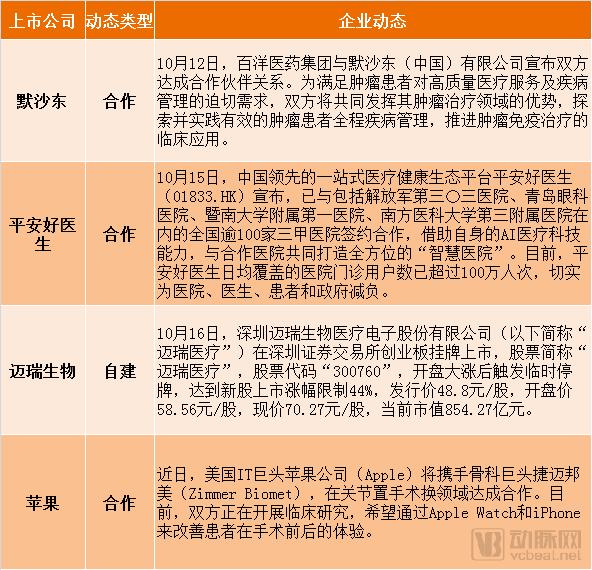
On October 16, Shenzhen Mindray Bio-Medical Electronics Co., Ltd. was listed on the ChiNext board of the Shenzhen Stock Exchange, with the stock abbreviation “Mindray Medical” and stock code “300760.” The stock surged sharply after opening, triggering a temporary trading halt as it hit the 44% price increase limit for new listings. The issue price was RMB 48.8 per share, and the opening price was RMB 58.56 per share.
Keywords: Health Management
Canadian Health Management Center to Launch in Hainan, Pioneering a New Model for Full Life-Cycle Health Services
On October 15, Hainan Province achieved a new breakthrough in the development of integrated medical and elderly care services. With the support of the Hainan Provincial Health Commission and the Chinese Hospital Association, Kerry Sorensen, President of Seven Oaks General Hospital in Canada and CEO of CWI, formally signed a Letter of Intent for Cooperation on China-Canada International Friendly Hospitals with Chen Zhong, Party Secretary and President of the Third People’s Hospital of Hainan Province.
Managing Partner at Qiming Venture Partners, Liang Yingyu
I have always maintained that the success of certain internet healthcare companies in the United States is attributable to the Affordable Care Act (Obamacare). The national conditions in the United States and China differ significantly. In the U.S., most hospitals are private; under the Affordable Care Act, many insurance reimbursement rates were reduced, prompting these institutions to seek new methods to increase revenue. In contrast, in China, the majority of patients visit public hospitals. These hospitals already have a sufficient patient volume, and profitability is no longer their primary concern. Consequently, their strategic perspectives differ markedly...
In short, the investment cycle in the healthcare industry is relatively long, and there are risks associated with new drug approval and government policies. However, the influx of more investors is a positive sign, indicating that the healthcare sector is continuing to expand. It is hoped that the ecosystem of the healthcare industry will gradually strengthen in the future, including the enhancement of supporting professionals such as analysts and lawyers within the sector. (China Entrepreneur Network)
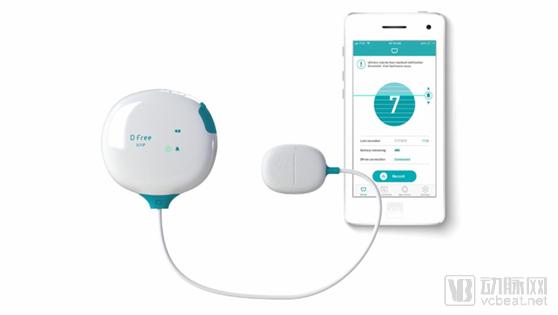
Startup Triple W Launches Wearable Excretion Predictor D Free
Recently, Triple W launched a wearable smart health monitor called D Free, designed to help incontinence patients improve their quality of life by enabling independent living while reducing the burden on caregivers. The device uses ultrasound sensors to monitor changes in bladder size and employs specialized algorithms to convert this data into actionable information, alerting users when they should use the restroom. Priced at $499.99, D Free consists of a sensor attached to the body with medical tape and a small receiver that clips onto the wearer’s belt.
www.mobihealthnews.com
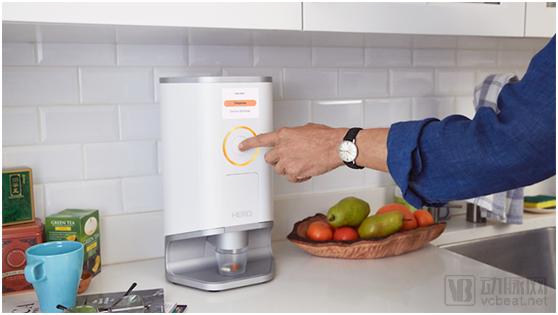
Hero Completes $12 Million Series A Financing, Launches Drug Management Platform
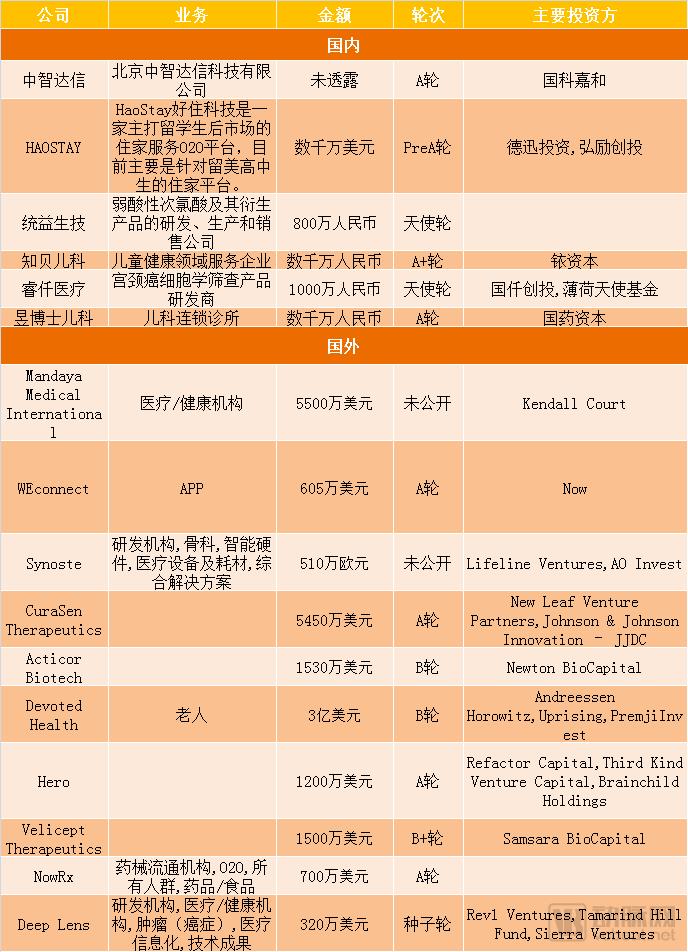
On October 16, Hero announced the completion of a $12 million Series A financing round. The round was led by Brainchild Holdings, with participation from Box Group, Third Kind Venture Capital, Refactor Capital, and Spider Capital, as well as individual investors including Stewart Butterfield, CEO of Slack, and Naval Ravikant, CEO of AngelList. To address issues such as undermedication, overmedication, and missed doses, Hero has launched smart home devices and a mobile application designed to help patients manage their medications, remind them to take their medicine on time, and control dosage. The platform effectively improves patient medication adherence, simplifies the medication-taking process, and enables caregivers to more conveniently monitor patients’ medication usage and communicate with them.
www.mobihealthnews.com
VCBeat: 2018 Q3 Healthcare Industry Investment and Financing Report
In the third quarter of 2018, global investment and financing in the healthcare sector reached a new high, with total funding amounting to $8.36 billion, a year-on-year increase of 28.4%. During the same period, total domestic financing in China increased by 20% year on year to $2.45 billion, accounting for 30% of the global total.