

What Will Truly Differentiate Pharma Companies in the Next Decade? — An Interview with Ross Rothmeier, VP of Technical Solutions and Innovation Labs at Medidata

At the “2018 World Forum on Medical Technology” hosted by VCBeat, there were several international speakers.
Geoffrey Ross Rothmeier from the United States stood out. Not only did he greet the audience with “Da, Jia, Hao” at the beginning of his speech, but he also concluded with a rather authentic Shanghai dialect phrase, “Ya Ya Nong” (thank you).
He also told VCBeat that, based on the pronunciation of his English name, Geoffrey (Jie Fu Li), he could be called “Jiefu” (a playful homophone for “brother-in-law” in Chinese). “Jiefu” is the Vice President of Technical Solutions and Innovation Laboratory at Medidata, a U.S.-based company. He traveled specifically to Shanghai to attend this forum and engage with attendees on how to leverage AI technologies to enhance clinical trials, thereby enabling faster, more precise, and more cost-effective development of new drugs. Following his presentation, he also granted an exclusive interview to VCBeat.
The following content is compiled from interviews and speeches.
About Medidata: Medidata is the leading software provider in the life sciences R&D sector (according to IDC data), with annual revenue exceeding $700 million, more than 2,000 employees worldwide, and over 1,000 clients. Its software platform supports more than 13,000 studies and connects 3.8 million patients.
Medidata has designated China as a core strategic market, having successfully supported over 870 clinical trials. It serves more than 146 clients, including leading Chinese pharmaceutical companies and contract research organizations (CROs) such as Hisun Pharmaceutical, Fosun Pharma, and WuXi AppTec.
Q: What loopholes do you see in the traditional clinical trial process?
A: I believe there are two forces at play in clinical trials today. Medidata sits precisely at the intersection of these two powerful forces, driving innovation in clinical research.
The first force is called the “scientific method,” which has a history of nearly 400 years; the second force has developed rapidly and gradually matured over the past decade, encompassing such prominent fields as artificial intelligence (AI), big data, and data science.
Francis Bacon was a British philosopher. He is regarded as the “father of the scientific method.” Generally speaking, the “scientific method” refers to the process of deriving knowledge from empirical facts or data. In this approach, the generation of knowledge involves four steps: careful observation, formulation of hypotheses based on observations, experimental testing and measurement of hypotheses, and drawing conclusions from the data. These also constitute the fundamental principles of the “scientific method,” and the process of clinical trials is closely aligned with this framework.
It can even be said that our industry fully adheres to the linear rules derived from this knowledge, with each of us playing a significant role in specific, established segments. Therefore, I maintain that by integrating emerging forces such as big data, AI, and deep learning, we can all reap substantial benefits.
We can draw a simple analogy. The “scientific method” is applied to the drug discovery process, where careful observation equates to focusing on new drugs that are likely to be safe and effective for patients in drug development; such observations are typically based on patient data.
Proposing a hypothesis constitutes protocol design: the process of framing research questions (protocol development). Testing the hypothesis is equivalent to conducting clinical trials, and drawing final conclusions corresponds to FDA review and analysis, where data are used to substantiate the hypothesis. If the trial is successful, regulatory authorities must grant approval.
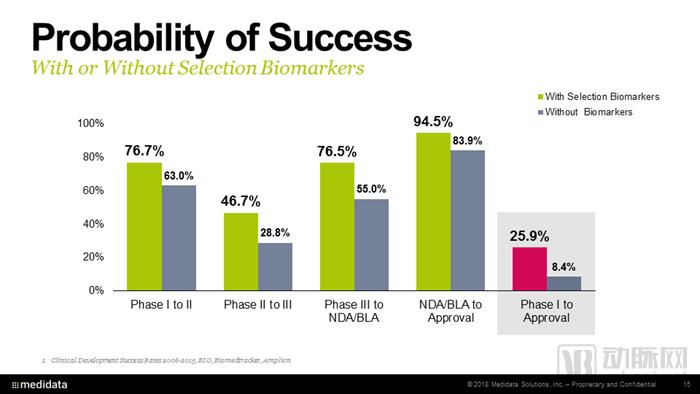
Undoubtedly, the traditional “scientific method” is indeed a scientific approach, but what is happening now? We can see it from the data. First, the success rate of drug development is very low, only 10%, and how much of this is due to the lack of genomic biomarkers? Data shows that the success rate of clinical trials using molecular biomarkers can be increased by three times.
Second, the drug development process is excessively time-consuming, taking an average of 10 years from drug discovery to regulatory approval. Much of this time is wasted due to the selection of inefficient sites or study designs.
Third is the cost of the drug development process, which averages $2.6 billion from R&D to regulatory approval.
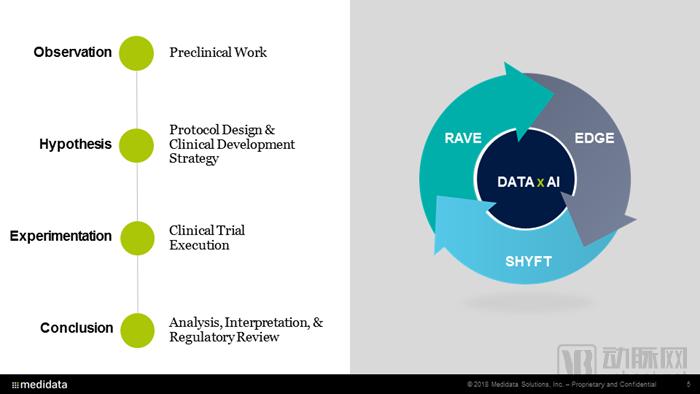
A Dual-Force-Driven Model for Drug Innovation
Medidata’s Clinical Cloud is the industry’s most comprehensive functional platform, driven by data and analytics.
Medidata Clinical Cloud unifies and integrates all critical functions of clinical research into a single platform. Data from patients, clinical trial sites, and research institutions, along with their clinical, financial, and operational data, all flow into MEDS, the Medidata Enterprise Data Store.
Therefore, throughout the entire clinical process, the MEDS system provides actionable cross-study data for intelligent decision-making.
Currently, thousands of studies are running on our platform, and more than 1,000 clients have chosen Medidata for data integration, aggregation, and standardization.
For example, our Phase II trial achieved a success rate of 31%. This outcome was attained by combining our Synthetic Control Arms with single-arm Phase I trials, which helped predict subsequent trial results, facilitated clearer decision-making, and ultimately increased our Phase II clinical trial success rate to 31%.
Q: What role can AI play in clinical trials?
A: Undoubtedly, artificial intelligence and data science are making clinical trials more precise, accurate, and efficient. Medidata’s solutions primarily enable you to address the following issues:
1. Biomarkers are key to better understanding diseases and achieving successful treatment. However, identifying genomic biomarkers remains a challenge for our industry. Over the past year, Medidata’s new artificial intelligence has repeatedly uncovered evidence of novel biomarkers within minutes.
2. Collecting accurate data remains a costly endeavor. Centralized algorithms designed by former FDA statisticians can effectively identify incorrect data points and the operational processes that lead to them.
3. Clinical operational management is complex. Therefore, optimizing clinical operations presents a significant challenge. We have transformed operational management into a more scientific and data-driven endeavor. I will discuss how to leverage MEDS data to enable new benchmarking, performance diagnostics, and feasibility analyses.
Furthermore, artificial intelligence and big data are the foundational underlying technologies we aim to leverage for achieving precision medicine.
At this year’s American Society of Clinical Oncology (ASCO) Annual Meeting in Chicago, a different and broader vision for precision oncology was presented. Among these studies, the most significant may be a very large-scale clinical trial that identifies breast cancer patient populations likely to be unresponsive to chemotherapy based on gene expression patterns in cancer cells, rather than on single-gene mutations. By identifying tumors with such genetic profiles, this study aims to spare tens of thousands of women each year from undergoing costly, highly toxic, and ineffective chemotherapy.
But how can we look beyond the tip of the iceberg to identify more biomarkers? This is a significant challenge. By identifying women who should not be subjected to standardized chemotherapy, we can help more women benefit from precision medicine. While drug labels list 50 biomarkers, there are 20,000 genes... holding immense potential yet to be uncovered. We have developed a novel approach that enables the discovery of new biomarkers in a routine and efficient manner.
Data integration and analysis, which previously took months or even years, can now be completed within minutes after data collection through Rave Omics and its analytical results.
Medidata enables faster discovery of biomarkers. This is precisely what our product, Rave Omics, delivers. We simplify and streamline the upload of genomic data, integrate it with clinical data—including outcomes—and automate machine learning to uncover evidence of complex biomarkers. Our advantages include:
1. To identify these biomarkers, you need to run the correct algorithms in a timely and robust manner.
2. We are designing Rave Omics to significantly streamline patient stratification during clinical trials, thereby enhancing patient safety or efficacy. Our goal is to support the daily workflows of every team involved in trials incorporating genomic data.
3. We can facilitate convenient and user-friendly genetic data transmission in the laboratory, seamlessly integrating with clinical data from Rave EDC. Machine learning methods are utilized for quality control and exploratory analysis, combining both clinical and economic data.
By providing these features early in the trial, it is possible to uncover new insights and thereby help patients as quickly as possible.
Q: Pharmaceutical companies have traditionally spent a significant amount of time on the review process. What issues in the regulatory workflow can Medidata’s solution address?
The output of each clinical trial is a dataset. We assume that the data quality is sufficiently high to achieve our scientific, regulatory, and business objectives. However, upon examining nearly 30 clinical trials using our technology, the results were concerning!
Nearly all clinical trials suffer from data-related issues. These problems could have been avoided. They lead to more ambiguous conclusions, additional questions, increased scrutiny, and reduced efficiency. They also pose regulatory challenges. The potential outcome is clear: if all data were accurate (with zero errors), scientific results could be obtained faster, at lower cost, and with greater precision.
Nearly all data showed discrepancies in adverse event reporting, with 90% inconsistency and 30% indicating potential operational errors.
Here, I can provide an example. When two companies were simultaneously seeking FDA review, the first company chose to use machine learning tools. We were able to identify data quality issues and predict areas of FDA concern. We submitted our findings to the first company, which conducted additional analyses and filed a report. As a result, our client obtained FDA approval within a few months and was able to launch its product in the following quarter.
The latter company submitted its application, but the FDA stated that additional information was required before proceeding with the review, resulting in a delay of the application.
This story illustrates that poor data undermine science and also slow regulatory action.
In China, forming a strategic partnership with Medidata can also help bring safe and effective drugs to Chinese patients more quickly.
Q: What challenges do you believe still exist in clinical trials?
Patient recruitment remains a challenge, with numerous contributing factors.
Awareness of Clinical Trials—Lack of awareness is one of the primary barriers to patient recruitment. Although public understanding of this issue has improved in recent years, it remains low, and discussions with patients rarely occur at the optimal time for treatment decisions.
Misconceptions About Oncology Research – There are many misconceptions regarding oncology trials, such as the occurrence of serious adverse events. Many potential patients also hold the mistaken belief that cancer clinical trials are only applicable after all forms of treatment have been tried and tested. Misconceptions surrounding oncology clinical trials stem from a lack of understanding of the details of clinical trials, as well as a vague comprehension of how clinical trials are conducted overall.
Patient-Centered Oncology Trials Are Gaining Favor—When designing the technical components of clinical studies, it is often overlooked that the first point of interaction between patients and sponsoring companies is the clinical trial itself. This oversight can impose unnecessary burdens on patients who are already in a challenging situation. Consequently, this may lead to patient dissatisfaction, low enrollment rates, and high dropout rates. Furthermore, a lack of patient focus throughout the trial can become a deterrent to their participation. The aim of patient-centered clinical trials is to provide patients with a convenient and pleasant journey, thereby alleviating the burden of participation.
Identifying Suitable Patients—Recruiting eligible patients is particularly challenging in the field of oncology, as participants must meet specific trial eligibility criteria. While patients must have a confirmed cancer diagnosis, they must not be too ill to complete the entire study protocol.
This is further supported by a set of data showing that currently, 80% of clinical trials fail to recruit patients. Fifty percent of clinical trial sites enroll very few patients. Even after a clinical trial has commenced, the patient dropout rate remains as high as 30%.
As Vice President of Medidata’s Technical Solutions and Innovation Lab, Ross Rothmeier contributes specialized expertise and business insights to clinical trial solutions and processes, collaborating with clients on development to maximize their investment value. Ross is a pioneering leader in solution R&D and innovation at Medidata Solutions.
Finally, Ross shared with VCBeat his inspiring journey from a programmer to an AI expert—
In 1994, he was a young and brilliant programmer. Facing cold machines every day, he did not understand the significance of his work for himself or others. Suddenly, he was assigned a new task: to collect and organize medical data using the internet. Thus, he stepped out of the server room and into the hospital wards. One day, he visited the pediatric ward and witnessed a girl whose treatment course, originally scheduled for ten days, was cut in half thanks to the data he had provided, significantly alleviating her suffering.
“That day, my life was completely changed.” He made up his mind to devote the rest of his life to leveraging new technologies to alleviate patients’ suffering. “I also hope that every professional in the medical technology sector keeps patients at heart.”
“Indeed, only when there is love in one’s heart can one find direction beneath their feet.”