

Tumax Deepwise Joins Alibaba Health AI Ecosystem to Advance 'Medical AI + IoT'
VCBeat (WeChat ID: vcbeat) has learned that TumorDeep has announced its joining of the Alibaba Health AI Open Platform. This move introduces deep learning into the fields of intelligent medical diagnosis and medical data analysis, applying it to clinical prevention, diagnosis, treatment, and other healthcare processes, thereby significantly enhancing the efficiency and value of health systems.
Alibaba Group is the only company among China’s internet giants known as BAT to have spun off its healthcare business into an independent internet company, underscoring Alibaba Group’s strong commitment to the medical and healthcare sector.
Cheng Xiao, Operations Director at Alibaba Health, stated that Alibaba Health will empower the entire healthcare industry. This includes assisting the government (G2G) in incubating the AI industry and launching AI application initiatives; collaborating with enterprises (B2B) as strategic hospital partners leveraging AI; and enhancing patient diagnosis and treatment experiences for consumers (C2C) through AI technologies. Alibaba Health will provide medical AI services and IoT smart devices to make medical technology more accessible and affordable, thereby improving patients’ sense of health and well-being.
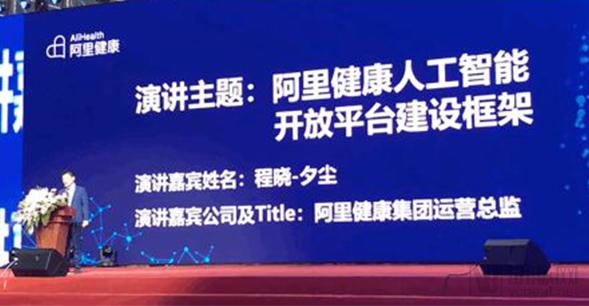
Cheng Xiao, Operations Director of Alibaba Health Group, Outlines the Platform Construction Framework
The construction framework of the Alibaba Health AI Open Platform includes an AI-assisted screening application engine that provides multi-site and multi-disease capabilities for various devices. The development platform offers diverse, rapid, and flexible deployment options, such as on-premise servers within hospitals and public cloud solutions, as well as a medical research platform that leverages core algorithms in AutoML and feature engineering to rapidly develop research models.
Particularly noteworthy is TomoDeep, an intelligent medical imaging company that has announced its integration into the Alibaba Health AI Development Platform ecosystem. Originating in San Diego, USA, TomoDeep has long been dedicated to the development of intelligent medical diagnostic systems. With substantial technical expertise, the company has launched multiple intelligent diagnostic systems and undertaken initial commercialization efforts. TomoDeep has progressively introduced deep learning into the fields of intelligent medical diagnosis and medical data analysis, applying these technologies across clinical healthcare processes—including prevention, diagnosis, and treatment—thereby significantly enhancing the efficiency and value of healthcare systems.
Ke Yan, Vice President of Alibaba Health, stated that the companies included in Alibaba Health’s AI Open Ecosystem Platform are all leading industry pioneers in China. Alibaba does not seek to dominate the AI sector alone; rather, it aims to help more small and medium-sized enterprises grow together and build a robust AI industrial ecosystem.
When asked why TomoDeep chose to join the Alibaba Health AI Open Platform, Zhong Xin, CEO of TomoDeep, stated: “We chose to join the Alibaba platform due to Alibaba Health’s profound accumulation and extensive practical experience in the field of medical AI, as well as its proven track record of successful implementations. This is crucial for TomoDeep, which is currently in a phase of rapid growth. We look forward to growing together with the Alibaba Health ecosystem and achieving new breakthroughs and enhancements in AI model innovation. We hope that Alibaba and TomoDeep will deepen their collaboration and integration, jointly facilitating the practical implementation of medical AI in China, improving the efficiency and value of the healthcare system, and fostering a robust industrial ecosystem.”
The convergence of AI (Artificial Intelligence) and IoT (Internet of Things) is driving the evolution from “artificial intelligence” to “applied intelligence.” The healthcare sector has long been a strategic battleground for the IoT industry. As IoT adoption in healthcare advances and iterates, it will inevitably generate massive volumes of medical and health data, creating greater opportunities for medical AI.
Artificial intelligence will assist hospitals in addressing prominent management challenges, including inadequate support from medical platforms, overall low levels of medical service quality, hidden risks to patient safety and operational security, and high healthcare management costs. This will enable hospitals to increase revenue and reduce expenditures, thereby enhancing the efficiency of the healthcare industry.
Through close collaboration with Alibaba Group’s subsidiaries, including Alibaba Cloud and AliHealth, and against the backdrop of China’s global Belt and Road Initiative, TumorDeep is poised to bring Chinese medical artificial intelligence to the world, ushering in a new era for medical diagnosis.
In the era of AI cloud computing, medical AI applications led by medical imaging AI are rapidly emerging. Zhong Xin, CEO of Tuma Shenwei, believes that the integration of medical AI and the Internet of Things (IoT) offers vast application scenarios. In this age of technological transformation, there is a growing need for multidisciplinary convergence. Tuma Shenwei is currently exploring IoT-based connectivity and integration with medical imaging cloud service providers, medical imaging equipment manufacturers, and underlying computing power companies. These efforts aim to enhance the efficiency of imaging cloud services and computer vision processing, while developing intelligent diagnostic solutions. This will significantly accelerate disease diagnosis, advance big data applications in disease prevention, and promote the digitalization of pathology.
Leveraging Alibaba Health’s robust health ecosystem capabilities and the superior computational power and distributed storage capacity of the ET Medical Brain, particularly its advanced technical prowess in medical text structuring, medical image recognition, physiological signal analysis, and knowledge graph construction, Tuma Shenwei’s AI-driven diagnostic engine will receive significant support. In the future, Tuma Shenwei will integrate extensive data with intelligent algorithms, substantially enhancing diagnostic efficiency and effectively transforming AI into an auxiliary tool for physicians in clinical treatment.
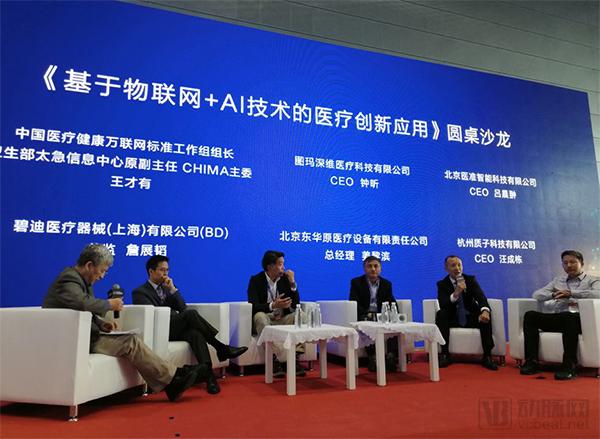
Zhong Xin, CEO of Tumor Deep Vision, Participates in Roundtable Discussion
With the global cancer incidence rate steadily rising and population aging intensifying, the cancer situation in China has become increasingly severe. Currently, lung cancer and breast cancer are the leading causes of cancer-related deaths among men and women, respectively. China accounts for 20% of the global cancer patient population, with liver cancer and esophageal cancer representing a significant proportion.
Numerous clinical studies have demonstrated the substantial value of early cancer screening. Data from the Shanghai Center for Disease Control and Prevention (Shanghai CDC) last year showed a significant increase in the proportion of early-stage malignant tumor diagnoses, with continuously extended patient survival periods. The five-year relative survival rate reached 53%, exceeding the national average of 30% reported by the National Cancer Center. Although the absolute number of deaths has risen, the Shanghai CDC stated that after adjusting for the impact of population aging in the city, the mortality rate attributable to malignant tumors is showing a downward trend.
As a leading medical imaging AI company in China, Deepwise has launched multiple AI-assisted diagnostic products, including intelligent diagnostic systems for pulmonary nodules, stroke, liver cancer, and breast cancer, which have now entered the commercialization stage.
Zhong Xin stated that Tuma Shenwei looks forward to further exploration and collaboration with Alibaba Health in innovating business models, leveraging Alibaba’s channels and brand to expand discussions on cooperation in the consumer (C-end) market. Alibaba will provide support in technology, product development, and commercialization. As medical AI becomes more integrated into clinical pathways, both parties anticipate increased opportunities for collaboration.
Regarding data security, Zhong Xin stated that there is little cause for concern: “Data and information security is a challenge faced by the entire industry. We have confidence in Alibaba’s technology and security capabilities, and we look forward to working with the broader industry, including Tumour Deepwise, to address this issue.”