

Dimitris Metaxas, Chief Scientist of SenseTime Smart Healthcare: Empowering Clinicians with AI Across the Diagnosis-Treatment-Recovery Workflow
VCBeat (WeChat ID: vcbeat) has learned that Professor Dimitris Metaxas, Chief Scientist of SenseTime’s Smart Healthcare division, was recently invited to attend the 2nd International Symposium on Image Computing and Digital Medicine (ISICDM 2018) held in Chengdu, where he delivered a keynote address as Conference Chair. The conference attracted numerous top international medical experts and scholars to discuss exchange and collaboration across fields such as electronic information, mathematics, and medicine.
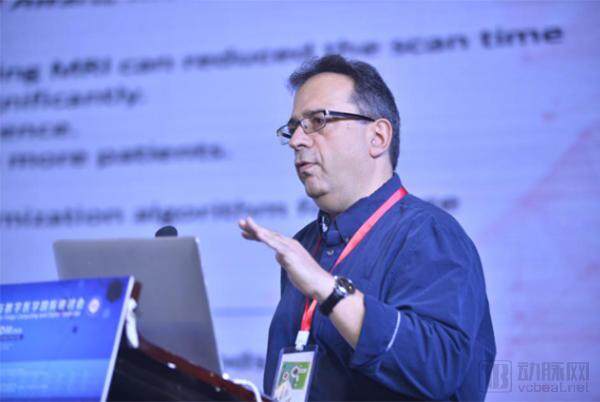
Professor Dimitris Metaxas, Chief Scientist of SenseTime’s Smart Healthcare Division, Delivers Keynote Address
Dr. Dimitris Metaxas is currently a Distinguished Professor in the Department of Computer Science at Rutgers University, USA, and Director of the Center for Biomedical Imaging and Modeling (CBIM). Leveraging his 30 years of research experience in computer vision, biomedical engineering, and graphics, along with his extensive academic achievements and collaborative resources, he will provide comprehensive support to SenseTime’s smart healthcare development, spanning from academia and technology to practical applications.
At the conference, Dimitris Metaxas delivered a keynote address titled “Robust and Scalable Analytics for Bio-medical Application.” The presentation highlighted the cutting-edge research achievements of CBIM and SenseTime’s Smart Healthcare division, showcasing their extensive technical expertise across various domains, including medical imaging, image registration, image segmentation, 3D modeling, computer-aided diagnosis, and medical image visualization. Additionally, he shared insights into the projects that enabled SenseTime to secure multiple world championships at MICCAI 2018 last month.
Quantification and segmentation of the ventricles and atria are critical indicators for studying cardiac diseases such as arrhythmias and serve as the foundation for surgical planning. By quantitatively analyzing parameters including the myocardial layer, cardiac chambers, and cardiac motion temporal cycles, changes in myocardial kinetic function can be directly reflected. Meanwhile, the three-dimensional cardiac structure reconstructed based on segmentation provides clinicians with more intuitive reference information. However, such complex quantification analysis and segmentation tasks are difficult to perform manually.
SenseTime’s Smart Healthcare Team secured first place in two of the four competitions at the MICCAI 2018 conference, specifically in the tasks of left ventricle quantification and left atrium segmentation. Through the efforts of its young researchers and leveraging SenseTime’s leading deep learning technologies, the team emerged as the champion in both tasks, outperforming renowned institutions and companies such as Harvard Medical School and the University of Oxford. This achievement lays a solid technical foundation for the future clinical application of cardiac technologies.
Meanwhile, Dimitris Metaxas also noted that SenseTime’s smart healthcare team has built up relevant expertise in orthopedics, neurology, respiratory medicine, radiation therapy, and precision medicine, and is actively seeking collaborations with top-tier medical institutions.
That evening, Dimitris Metaxas also participated in the roundtable discussion on “Opportunities and Challenges in Smart Healthcare,” engaging in lively discussions and sharing forward-looking insights with fellow panelists on the future development of the “AI + Healthcare” industry.
Dimitris Metaxas believes that “AI research should be driven by the actual clinical needs of physicians. Over the past few decades, I have been collaborating closely with many leading U.S. medical institutions and radiologists. For instance, by leveraging AI technology to assist radiologists in providing precise automated quantitative analysis and enhancing their understanding of diseases, we have significantly improved diagnostic accuracy and efficiency. However, we have also identified substantial pain points and unmet needs beyond the diagnostic phase, particularly in surgical planning, surgical execution, and rehabilitation monitoring. For example, many patients with orthopedic conditions require personalized treatment through 3D-printed joint replacements. This therapeutic approach is still in its early stages, and the precision of consumable design and treatment implementation requires further improvement. These treatment phases often have a more direct impact on prognosis than diagnosis alone. Therefore, after comprehensive consideration, we have decided to address the entire workflow encompassing diagnosis, treatment, and rehabilitation, aiming to make AI a comprehensive and capable assistant in physicians’ daily practice.”
Currently, the SenseTime Smart Healthcare team has established branches in Beijing, Shanghai, Shenzhen, and New Jersey, USA. The New Jersey laboratory will collaborate with top-tier medical institutions, such as the NYU Grossman School of Medicine, to explore cutting-edge academic research topics. Meanwhile, the China team will focus on clinical practical exploration across the entire “diagnosis-treatment-recovery” workflow in the vertical healthcare sector, developing implementable technological solutions tailored to China’s medical environment and workflows. Previously, SenseTime had established an office in Chengdu, and its Smart Healthcare team has actively expanded collaborations across North, East, and South China. The company looks forward to engaging in extensive cooperation with medical institutions and experts in Southwest China, thereby extending the benefits of AI technology to doctors and patients in more regions.
About SenseTime
As a globally leading artificial intelligence platform company, SenseTime has been designated by China’s Ministry of Science and Technology as the national next-generation AI open innovation platform for “intelligent vision” (the other four national AI platforms are Baidu, Alibaba Cloud, Tencent, and iFlytek). Meanwhile, SenseTime is also recognized as the “world’s most valuable AI innovator,” with total financing exceeding $1.6 billion and a valuation surpassing $4.5 billion.
SenseTime is committed to the mission of “upholding original innovation and letting AI lead human progress.” The company has established a world-class, independently developed deep learning platform and supercomputing center, and has pioneered a series of AI technologies, including facial recognition, image recognition, text recognition, medical imaging analysis, video analytics, autonomous driving, and remote sensing. As a result, SenseTime has become China’s largest provider of AI algorithms.