

Si-Bone Completes IPO, Raising $124 Million to Advance 3D-Printed Titanium Implants for Sacroiliac Joint Fusion
On October 23, 2018, VCBeat (WeChat ID: VCbeat) learned that medical device company Si-Bone (NASDAQ: SIBN) had completed its initial public offering (IPO), pricing its shares at $15 each and issuing a total of 7.2 million shares. The IPO raised $108 million, exceeding Si-Bone’s target fundraising range of $90 million to $104 million as stated in its September IPO registration. Additionally, Si-Bone issued an over-allotment of 1.08 million shares, bringing its total proceeds to $124 million. Morgan Stanley and BofA Merrill Lynch served as joint book-running managers for the IPO, while Cannaccord Genuity and JMP Securities acted as joint managers.
Si-Bone, founded in 2008, completed six rounds of financing prior to its IPO, raising a total of $108 million. The company’s major investors include Montreux Equity Partners, Arboretum Ventures, Redline Capital, Skyline Ventures, and OrbiMed.
Si-Bone has developed the iFuse-3D implant for minimally invasive sacroiliac (SI) joint fusion surgery. Leveraging the latest patented 3D printing technology, the iFuse-3D implant features a porous surface structure that mimics the trabecular architecture of natural cancellous bone, while also being coated with a machined solid triangular titanium plasma spray (TPS) layer. This design facilitates both outward and inward bone growth through intra-articular fusion. The iFuse-3D is the only FDA-approved device for treating SI joint dysfunction. To date, more than 60 articles have reported on the safety, efficacy, biomechanics, and cost-effectiveness of the iFuse implant. Clinical data demonstrate that the use of the iFuse implant in minimally invasive SI joint surgery can alleviate pain, improve physiological joint function, and enhance quality of life for patients with SI joint movement disorders. It is reported that the iFuse-3D implant has been granted a patent by the United States Patent and Trademark Office. The patent description states that the patent covering the 3D-printed implant, including its structural design features, has a term of 17 years, expiring in September 2035.
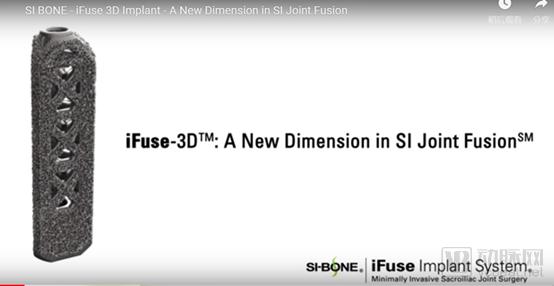
iFuse-3D Implant Surface Structure (Image from Official Website)
Sacroiliac (SI) joint pain refers to pain originating from the joint itself due to SI joint dysfunction caused by trauma, childbirth, degeneration, arthritis, or other conditions. Current treatments for SI joint pain primarily include physical therapy, injections, pharmacological management, SI joint fusion, and surgical intervention. The efficacy of non-surgical therapies is often limited, while traditional open SI joint surgery involves extensive soft tissue dissection and a complex procedure, including extensive joint debridement, resection of damaged tissue, and preparation for arthrodesis. Patients require a prolonged recovery period and face a significant risk of postoperative complications. Compared with traditional open SI joint surgery, the iFuse minimally invasive procedure offers advantages such as smaller incisions, shorter operative room (OR) time, reduced hospital stay, and faster recovery.
The 2016 updated policy of the International Society for the Advancement of Spine Surgery (ISASS) covers minimally invasive sacroiliac joint fusion surgery. Since then, insurers such as Blue Cross and Blue Shield in Illinois, Montana, and New Mexico, Geisinger Health Plan, and Health Care Service Corporation (HCSC) have included minimally invasive sacroiliac joint surgery in their coverage. Si-Bone also provides Patient Insurance Coverage Support (PICS) to help patients obtain insurance authorization prior to undergoing the iFuse minimally invasive procedure and to assist with postoperative insurance claim appeals.
About Si-Bone
Si-Bone, founded in 2008 and headquartered in San Jose, California, offers a novel therapeutic option for patients with sacroiliac (SI) joint dysfunction who have failed conservative management. The company’s patented iFuse-3D implant, utilized in minimally invasive procedures since 2009, effectively alleviates pain and improves joint function and quality of life in patients with SI joint dysfunction.