

LSK BioPharma and Jiangsu Hengrui Medicine Announce Global Clinical Collaboration to Evaluate Rivoceranib and Camrelizumab Combination Therapy for Advanced Hepatocellular Carcinoma
On October 23, 2018, VCBeat (WeChat ID: VCbeat) learned that U.S. biopharmaceutical company LSK BioPharma (LSKB) had entered into a global clinical collaboration with Jiangsu Hengrui Medicine Co., Ltd. (SHA: 600276, “Hengrui”), the largest biopharmaceutical company in China, to evaluate the safety and efficacy of combination therapy with LSKB’s rivoceranib (also known as apatinib or Aitan®) and Hengrui’s camrelizumab for the treatment of advanced hepatocellular carcinoma (HCC).
Rivoceranib is a selective and potent VEGFR-2 inhibitor, and Hengrui’s camrelizumab (SHR-1210) is a humanized anti-PD-1 monoclonal antibody. Currently, the drug is undergoing New Drug Application (NDA) review for the treatment of classical Hodgkin lymphoma (cHL). Under the terms of the clinical collaboration agreement, Hengrui will be responsible for managing the clinical trials, with all research costs outside China shared equally by both parties. LSKB will retain full commercial rights to rivoceranib in all countries except China, while Hengrui will retain global commercial rights to camrelizumab.
Currently, Hengrui is conducting an open-label, single-arm, multicenter Phase 2 study (NCT03463876) to evaluate the efficacy and safety of camrelizumab in combination with rivoceranib for the treatment of Chinese patients with advanced hepatocellular carcinoma (HCC). Hengrui’s apatinib has already been approved as a monotherapy for advanced gastric cancer. According to reports from the 2018 ASCO (American Society of Clinical Oncology) Annual Meeting, an open-label Phase 1 clinical trial in China (NCT02942329) showed that among 14 patients with advanced HCC treated with camrelizumab plus rivoceranib, the objective response rate (ORR) and disease control rate (DCR) were 50.0% and 85.7%, respectively. Furthermore, Hengrui is also evaluating the safety and efficacy of the camrelizumab and rivoceranib combination across multiple indications, including non-small cell lung cancer (NSCLC), small cell lung cancer (SCLC), and gastric cancer (GC).
It is hypothesized that the combination of rivoceranib and camrelizumab can enhance the immune system to help combat cancer. In addition to its known anti-angiogenic effects, rivoceranib can normalize the tumor vasculature and restore the immunosuppressive tumor microenvironment, thereby enhancing the antitumor activity of camrelizumab.
Currently, LSKB is conducting a global Phase III clinical trial of rivoceranib for the treatment of patients with advanced or metastatic gastric cancer across 12 countries, including the United States, Japan, South Korea, Italy, Germany, and Russia. Data from the Chinese Clinical Trial Registry indicate that there are 220 clinical trials involving rivoceranib, with approximately 20,000 patient enrollments. These trials cover various indications, including gastric cancer (GC), colorectal cancer (CRC), hepatocellular carcinoma (HCC), non-small cell lung cancer (NSCLC), esophageal cancer, thyroid cancer, mesothelioma, and neuroendocrine tumors. The data also suggest that combining rivoceranib with chemotherapy agents and immunotherapy holds significant potential to improve patient prognosis. Rivoceranib has been designated as an orphan drug for the treatment of gastric cancer by the European Commission in the EU, the U.S. Food and Drug Administration (FDA), and South Korea’s Ministry of Food and Drug Safety (MFDS).
Dr. Zhang Lianshan, President of Global R&D at Hengrui Medicine, stated, “We will conduct approximately 20 clinical trials of camrelizumab in China. Current robust scientific evidence and preliminary clinical data demonstrate a synergistic effect of the combination of camrelizumab and rivoceranib. We look forward to collaborating with LSKB to further explore this combination therapy for the treatment of patients with hepatocellular carcinoma, building upon existing preclinical and clinical data, so as to address unmet medical needs in the field of oncology.”
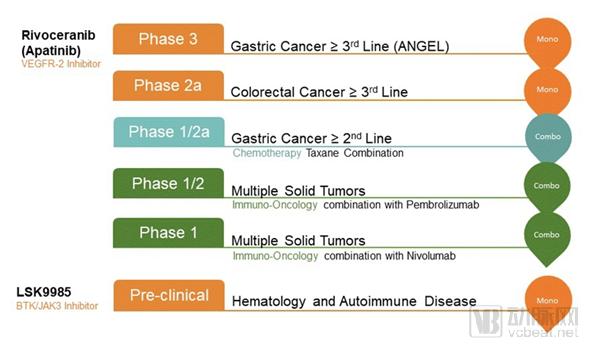
LSKB R&D Pipeline
About LSK BioPharma
LSKB, founded in 2005 and headquartered in Salt Lake City, Utah, USA, is a private biopharmaceutical company with offices in Utah, California, and South Korea. LSKB is dedicated to developing promising cancer therapeutics. The company’s two primary patented drug candidates are rivoceranib and LSK9985. Rivoceranib, a selective VEGFR-2 inhibitor, has entered Phase III clinical trials, while LSK9985, a selective dual BTK/JAK3 kinase inhibitor, is currently in preclinical studies.
About Hengrui
Jiangsu Hengrui Medicine Co., Ltd., established in 1970, is the largest research and production base for antineoplastic and perioperative medications in China, and one of the most innovative large-scale pharmaceutical enterprises in the country. Hengrui ranks first in domestic sales of antineoplastic drugs, with a market share exceeding 12%, annual net sales revenue surpassing USD 2.2 billion, and a workforce of over 20,000 employees. It is a state-designated manufacturer of narcotic drugs. Currently, Hengrui has four new molecular entities approved by the Chinese National Medical Products Administration (NMPA) and two New Drug Application (NDA) projects in China.