

Duchang EMR Editor Takes Root in Taiwan with Strategic Collaborations and Innovative Solutions
Recently, VCBeat (WeChat Official Account: vcbeat) learned that a delegation from Nanjing Duchang Information Technology Co., Ltd. traveled to Taiwan to engage in in-depth exchanges with local healthcare professionals and hospital executives on the current state and future development trends of healthcare informatization in Taiwan. The Duchang representatives primarily visited Chung Shan Medical University Hospital, where they introduced Duchang’s products and latest technological breakthroughs to Professor Tseng Chih-Jen, the Vice President, and his team.
Professor Tseng Chih-Jen is the Vice President of Chung Shan Medical University Hospital in Taiwan. His clinical expertise specializes in gynecologic oncology, and he served for 20 years as the Chief Physician of Women’s Cancer in the Department of Obstetrics and Gynecology at Chang Gung Memorial Hospital. In addition, he has held positions such as Chairman of the Medical Information Committee of Taiwan’s Ministry of Health and Welfare and Chairman of the Electronic Medical Records Committee at Chang Gung Memorial Hospital. In these roles, he facilitated the comprehensive hospital-wide information integration and paperless operations at both Chang Gung Memorial Hospital and Chung Shan Medical University Hospital, establishing them as the most complete and fully informatized electronic hospitals in Asia.
Chung Shan Medical University Hospital is Duchang’s “long-standing partner.” The hospital has consistently utilized Duchang’s products for the independent development of its electronic medical record (EMR) systems, encompassing core functionalities such as medical record teaching, audit trail retention, access control, and content quality control.
Professor Zeng stated, “It is quite troublesome for doctors to print out medical records for review and correction, which also wastes paper. With the current shift to paperless operations, we can save approximately 4 million sheets of paper annually—an amount equivalent in area to 2.5 football fields and in height to two Taipei 101 towers stacked together.”
The PFM system, which won second place, also adopted Duchang’s products. This is a “warm” type of electronic medical record featuring both text and images, developed and designed not only for physicians but from the perspectives of three parties: developers, physicians, and patients.
Both products integrate the advanced requirements of current medical informatics with cutting-edge front-end technologies, truly achieving a “patient-centered” approach by prioritizing the patient’s perspective. Furthermore, Professor Zeng’s “patient-centered” electronic medical record (EMR) workflow embodies the spirit of Shared Decision Making (SDM). By referencing the functionalities of the Duchang EMR editor, it provides a system environment that digitizes clinical operations and further evolves into an innovative, teaching-oriented architecture.
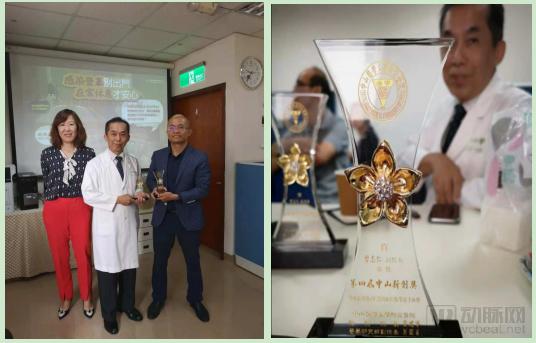
Photo of Duchang Representative with Professor Zeng Zhiren (left)
Subsequently, the representative from Duchang introduced their latest technological product—the mobile electronic medical record (EMR) editor—which migrates the editing functionality from desktop computers to mobile devices. For instance, during ward rounds, physicians can edit and input clinical notes directly on their smartphones, with the data synchronizing in real time to the EMR system. This approach not only eliminates the need for doctors to return to their offices to document encounters but also ensures the accuracy of the records. Additionally, patients can scan a QR code via their mobile devices to view and download their medical records. This solution offers significant convenience for both physicians and patients. Professor Zeng expressed the intention to deploy the system as soon as possible to address current issues in hospitals, such as untimely, inaccurate, and unsynchronized visit documentation.
In addition, the representative from Duchang introduced another product—electronic signatures, a software solution that enables signing specific sections of a document. Reportedly, this software supports embedding multiple signatures within a single document, with each signature responsible only for its designated section. The verification processes for individual signatures are independent and do not interfere with one another, thereby enabling multiple partial signatures. Signature information is stored in XML files, supporting offline verification. Furthermore, any modification to a signed document will immediately invalidate the corresponding electronic signature.
Professor Zeng believes that intelligent electronic signatures are a technology urgently needed at present. Some countries have already introduced standards for single-document records and multi-party signatures. Many critical examinations or diseases require confirmation by multiple physicians before a final diagnosis can be made, thereby enabling whole-person care (team-based care, where multiple physicians manage a single patient). This technology aligns precisely with the current substantive needs of healthcare.
Furthermore, Professor Zeng shared his insights on the timeline control feature in Duchang. He noted that the concept of a timeline is particularly critical in operating rooms, as it provides a comprehensive and visual representation of surgical milestones from preoperative to postoperative stages, thereby helping physicians ensure the smooth progression of surgical procedures. Currently, there is also a significant demand for timeline technology in hospital departments such as intensive care units (ICUs) and emergency rooms.
Professor Zeng also noted that many hospital IT departments frequently create various complex forms, which involves lengthy development-to-implementation cycles and cumbersome procedures.
Yuan Yongfu, representative of Duchang, stated that Duchang Company can provide an existing technology—the rapid form creation feature—which enables hospitals to achieve WYSIWYG (What You See Is What You Get) form interface design. Common numerical calculations in forms are performed using Excel-like formulas, while a small number of particularly complex calculations and logical judgments are implemented using JavaScript scripts.
Once the form design is completed, it can be deployed online after undergoing online testing and review. In this way, the vast majority of forms in hospitals are implemented through this new approach. This significantly improves the work efficiency of hospital information departments. Moreover, as the technical barrier is lowered, frontline physicians can also participate in partial form creation, thereby promoting organization-wide engagement in digital transformation.
Following the visit to Chung Shan Medical University Hospital, representatives from Duchang also visited Dr. Shih-Dien Hsu, Deputy Superintendent of Lishin Hospital (a member of the Union Health International Medical Group) in Zhongli, Taiwan. The Duchang team demonstrated the operational procedures and basic functionalities of their products, including the electronic medical record (EMR) editor, timeline control, enablement framework, and template tools. Dr. Hsu spoke highly of the editor’s application within hospital settings and expressed his intention to help promote the adoption of software products such as the editor and timeline controls among hospitals in Taiwan.
In addition to medical institutions, the Duchang delegation also engaged in exchanges with local companies (subsidiaries of Taiwan’s Inventec Corporation and Taiwan’s Syscom Computer Engineering Co., Ltd.). Both sides shared their views on the current state of development in healthcare informatization.
In recent years, Taiwan’s healthcare informatization has developed rapidly, with its information technology construction gradually adopting a path of independent development. The informatization management system has matured progressively, becoming an indispensable support for medical activities such as hospital information management, internal administration, and clinical decision-making. Duchang Company has established a lasting and stable strategic partnership with the healthcare informatization industry in Taiwan.