

Proteostasis Therapeutics Secures $74.3 Million in New Equity Financing to Advance Protein Homeostasis Therapies for Cystic Fibrosis and Other Protein-Misfolding Disorders
On October 24, 2018, VCBeat (WeChat ID: VCbeat) learned that Proteostasis Therapeutics (Nasdaq: PTI) announced the issuance of 11 million shares of common stock, priced at $6.75 per share. Before deducting underwriting discounts, commissions, and offering expenses, Proteostasis expects to receive gross proceeds of $74.3 million. Proteostasis has granted the underwriters a 30-day option to purchase an additional 1.65 million shares of common stock. Subject to customary closing conditions, the offering is expected to close on or around October 26, 2018. Leerink Partners, Piper Jaffray & Co., and Cantor Fitzgerald & Co. served as joint placement agents for this equity offering, with HC Wainwright & Co. acting as the lead manager.
Proteostasis intends to use the proceeds to advance key pathways for PTI-428, continue the development of the triple-combination therapy involving its Phase III candidates PTI-428, PTI-801, and PTI-808, fund initial materials for pipeline research, provide working capital, and support other general corporate purposes.
Proteostasis completed its IPO in February 2016, raising $50 million. Prior to this, the company had completed three rounds of financing, raising a total of $111 million.
Proteostasis’ proprietary DRT™ platform leverages phenotypic screening based on functionally relevant cellular assays, along with state-of-the-art medicinal chemistry tools, to develop novel therapeutics that modulate protein homeostasis. Using this platform, Proteostasis has developed a new triple-combination therapy for cystic fibrosis (CF). Currently in preclinical development, this triple therapy comprises: PTI-428, a first-in-class CFTR (cystic fibrosis transmembrane conductance regulator) amplifier and advanced clinical candidate that increases in vitro CFTR protein levels across genotypes; PTI-801, an in vitro CFTR corrector that exhibits strong synergistic effects with known correctors; and PTI-808, also in preclinical development, a CFTR potentiator that enhances the function of the mutant F508del CFTR in vitro. When used in combination with PTI-428 and PTI-801, PTI-808 helps restore F508del CFTR function to normal levels.
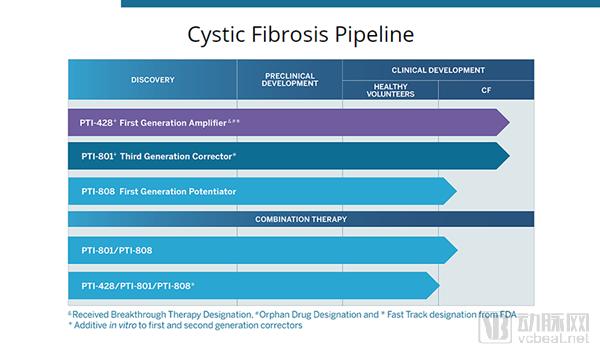
Proteostasis R&D Pipeline
Cystic fibrosis (CF) is an autosomal recessive genetic disorder that poses a serious threat to human life and health, affecting 70,000 individuals worldwide. Although improvements in treatment regimens and the emergence of novel CF therapies have extended patient life expectancy—with some patients now surviving beyond age 40—CF remains an incurable disease leading to premature death.
Studies have identified mutations in the CFTR gene as the cause of cystic fibrosis (CF). Currently, a class of drugs known as CFTR modulators is used to treat specific CFTR gene mutations. In March 2018, the U.S. Food and Drug Administration (FDA) granted Breakthrough Therapy Designation to PTI-428, a CFTR amplifier developed by Proteostasis Therapeutics. This designation will accelerate the development and review of PTI-428. In addition to PTI-428, other CFTR modulators that have received Breakthrough Therapy Designation include Kalydeco® and Orkambi®.
Currently, Proteostasis is collaborating with multiple pharmaceutical companies leveraging its proprietary technology platform: it is working with Astellas Pharma to research and identify therapies targeting the unfolded protein response (UPR) pathway, and with Biogen to research and identify therapeutic candidates for neurodegenerative diseases.
About Proteostasis Therapeutics
Proteostasis Therapeutics is a clinical-stage biopharmaceutical company dedicated to developing small-molecule therapies for the treatment of cystic fibrosis (CF) and other diseases caused by abnormal protein processing. Founded in 2017, the company is headquartered in Boston, Massachusetts, USA.