

MicroPoint Biosciences Leverages Microfluidics to Bring Lab-on-a-Chip Diagnostics Closer to Patients
IVD is a highly specialized sector within the healthcare industry. It is not built upon a single discipline but rather integrates multiple fields, including chemistry, biology, computer science, optics, physics, and engineering. For most startups, this field presents significant challenges, as it is difficult to assemble such a comprehensive core technical team at the outset.
This sector is also a hotspot for failures among medical startups. Without breakthroughs in technology and products, startups struggle to survive long-term and can only capture a small market share. “The barrier to entry for IVD startups is quite high,” Yan Pingyi, founder of Weidian Bio, told VCBeat.

Yan Pingyi’s career has been quite legendary. He successively co-founded successful enterprises such as Mindray and Rayto Life Sciences, with Weidian Bio being the third company he established.
Since graduating with a master’s degree, Yan Pingyi has remained active in the medical device sector. In the summer of 2006, he met his current partner, Zhang Nan, in Silicon Valley, laying the groundwork for the founding of Weidian Bio-tech.
Zhang Nan is an expert in the field of MEMS. She is the inventor of multiple patents for MEMS chips used in mobile phone microphones and participated in the design of these chips. When Yan Pingyi met her, Zhang Nan had just sold this design.
“At that time, domestic technological development was quite strong, but innovation capabilities were relatively weaker, with most companies focusing on ‘me-too’ and ‘me-better’ products,” recalled Yan Pingyi. He told Zhang Nan that they could combine semiconductor technology with biotechnology to pursue further innovation in a new direction. This new direction naturally fell within Yan Pingyi’s area of expertise—medical devices—a sector where Chinese companies were still primarily engaged in follow-on innovation at the time.
Also joining the team is the company’s current COO, Dr. Huang Haitao. An expert in electrochemistry, Dr. Huang worked in R&D at 3M, a Fortune 500 company, before joining Weidian. Coincidentally, after completing his MBA at the Wharton School, Dr. Huang was actively seeking out innovative startups to join. Since 3M is headquartered in Minnesota, USA, he had previously met Zhang Nan, who was also based in Minnesota, through a chance encounter. Thus, it was only natural for Dr. Huang to join the newly established Shenzhen Weidian Bio-tech Co., Ltd.
Based on the team's characteristics, they identified microfluidics technology as their strategic focus.MEMSa branch of. The so-called microfluidic chip, simply put, is to shrink the laboratory in real life to a very small size and carry out biochemical reactions on the chip.“Its advantages include minimal sample volume, rapid detection speed, and the ability to deliver highly accurate quantitative results.”Yan Pingyi introduced that,“It essentially involves miniaturizing laboratory equipment used in real-life settings.”
These features make microfluidic technology highly valuable for testing in emergency and other specialized applications, such as myocardial infarction, stroke, and acute infectious diseases.In many regions of the world todayPopulation aging has become a major trend, and for an aging society, cardiovascular and cerebrovascular diseases and diabetes are common conditions.
“Based on technical characteristics and the social environment, we considered this a key area for development and concentrated our efforts accordingly.”He recalled.
In 2006, Yan Pingyi and Zhang Nan were preparing for the establishment of their company, unaware that a global financial tsunami would strike just a few months later.
In 2007, Weidian Bio was formally registered and established. The company operated synchronously in both China and the United States, with its R&D center in Silicon Valley ensuring the smooth progress of its projects. However, this dual-location strategy also increased operational costs. By hiring numerous scientists and researchers in the U.S., the company faced significant financial pressure.
By this time, the financial crisis had spiraled out of control, China’s healthcare venture capital industry was still in its infancy, and the overall investment climate was far from optimistic. Fortunately, Yan Pingyi’s years of entrepreneurial experience in the healthcare sector had enabled him to build an extensive professional network, allowing his company to secure Series A financing from Shenzhen Capital Group (SCGC) in 2009. Prior to this, he estimated that he had met with dozens of investors.
“We’ve met with all the investors who are capable of investing in healthcare. We were among the earlier ones to secure investment,” Yan Pingyi told VCBeat.
In terms of technological breakthroughs, the team’s journey was fraught with twists and turns. “We were working on something entirely innovative, with no precedents to reference,” he continued. Although in retrospect, many technical barriers proved to be as thin as a sheet of paper—once pierced, all problems were readily resolved—they initially had no idea where to begin given the uncharted territory. “We spent a considerable amount of time and took many detours,” he added.
In 2014, Weidian Bio’s first product was approved by the CFDA and launched on the market. Since then, the company has progressively built a comprehensive portfolio of diagnostic markers for cerebrovascular and cardiovascular diseases. Today, in addition to its cardiovascular product line, the company has developed a series of products for infectious disease testing and veterinary diagnostics for pets.
As of 2017, the company had more than 10 products across its electrochemical and photoimmunology platforms. According to the company’s financial report, it achieved revenue of RMB 115 million in 2017, a year-on-year increase of 41.29%. In the first quarter of 2018, the company recorded revenue of RMB 43.0854 million, up 82.36% year on year, with net profit attributable to shareholders of RMB 1.0727 million, marking a turnaround from loss to profit.
Gordon Moore, one of the founders of Intel, once proposed that when the price remains constant, the number of components that can be accommodated on an integrated circuit will double approximately every 18 to 24 months, and the performance will also double. This Moore's Law, which was proposed in the field of computer science, seems to be equally applicable in the semiconductor chip manufacturing industry.
In 2017, Weidian Bio achieved an annual production capacity of 3 million units, marking the company’s first expansion into the million-unit range. “This scale of protein chip manufacturing is leading globally,” Yan Pingyi told VCBeat.
Following the full commercialization of its technological implementation, enhancing performance and manufacturing scale while reducing costs has become a universal pursuit for enterprises, and Weidian Bio is no exception. It was disclosed that the company’s production capacity was projected to reach the tens of millions in 2018.
When discussing the future development direction of China’s IVD sector, Yan Pingyi told VCBeat, “The development of IVD will take on a dumbbell shape, with one end extending to central laboratories and the other to patients.”
As emerging technologies such as next-generation sequencing (NGS), mass spectrometry, and microfluidic chips increasingly become powerful tools for enabling precision medicine, demand for them within the healthcare sector is set to rise steadily. However, these technologies are not well suited for direct operation and use by hospitals themselves, given their substantial requirements for skilled technical personnel and capital investment in equipment. “It is difficult to achieve optimal cost-effectiveness when these technologies are deployed within hospitals,” he stated.
Therefore, he believes that these devices will increasingly be adopted by third-party laboratories, leading to their continued expansion and further enhancement of automation levels.
On the other hand, as patients become increasingly proactive in their treatment, out-of-hospital disease management is gaining greater importance, driving patient-facing devices to become increasingly miniaturized and closer to the patient.
“A few years ago, everyone considered mobile health a hot trend, but this hype cooled down after a short period,” he told VCBeat. “The reason was that the concept of mobile health at the time was too lightweight, mostly consisting of online consultations.”
Yan Pingyi believes that the lack of effective diagnostic tools is one of the factors constraining the development of mobile healthcare. Only by leveraging technological means to bring tests, previously available exclusively in hospitals, into patients’ homes and to their bedside can mobile healthcare and chronic disease management become truly comprehensive.
“Only when devices are sufficiently close to the patient can early diagnosis and prevention of diseases be achieved, thereby resolving health issues in the shortest possible time,” he added.
Undoubtedly, Weidian Bio belongs to the latter category. The company officially launched its second-generation products in 2019, expanding application scenarios from emergency departments, ICUs, and clinical laboratories to specialist and general practitioners as well as patients themselves, thereby bringing hospital-level testing into the home setting.
It is reported that the company is actively preparing for the registration and approval of its next-generation products.
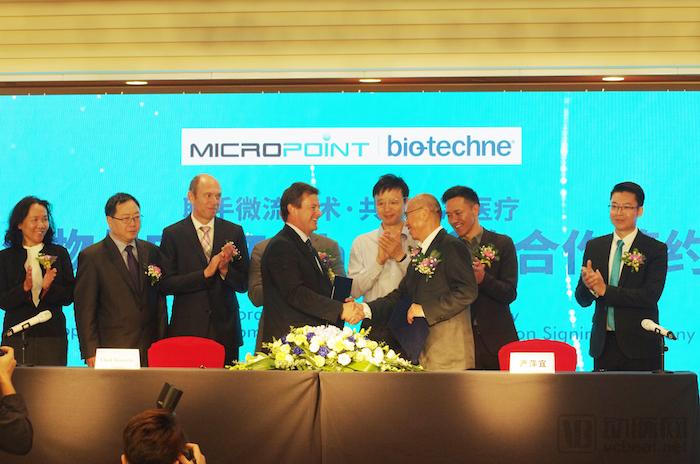
In October 2018, Weidian Bio-tech entered into a strategic partnership with Bio-Techne, a Nasdaq-listed company based in Minnesota, to advance the development of precision medicine in China through microfluidics technology.
Bio-Techne has long been a leader in the field of immunology, maintaining its status as the industry’s gold standard for various assays, and has emerged as a leading provider of molecular diagnostic solutions through its advanced brands in cellular and exosome diagnostics.
This collaboration also marks Weidian Bio’s first step into the field of tumor immunodiagnostics.
“This collaboration has also opened up a new direction for our business. When people discuss precision medicine, many mistakenly believe it relies solely on NGS,” Yan Pingyi told VCBeat.
In Yan Pingyi’s view, precision medicine primarily consists of two components: precision diagnosis and precision treatment. Breakthroughs in biotechnology serve as the starting point for precision medicine.
New technological breakthroughs have opened up many new therapeutic avenues, such as targeted therapy, immunotherapy, and cell therapy. However, these novel treatment regimens are not suitable for all patients; therefore, the emergence of new therapeutic options often necessitates corresponding companion diagnostic technologies.
“These new treatment regimens are all expensive, and they are not effective for everyone,” Yan Pingyi told VCBeat. “Therefore, screening must be conducted prior to treatment.” However, even if patients respond to the therapy, they are highly likely to experience adverse reactions of varying degrees during the course of treatment.
The human immune system is highly complex; when external factors alter its function, the body itself mounts a variety of responses. Among these, the most common is the cytokine storm, which can trigger a cascade of inflammatory reactions and cause harm to the body.
“These injuries progress extremely rapidly, potentially reaching an uncontrollable stage within a matter of hours,” Yan Pingyi revealed to VCBeat. In such scenarios, next-generation sequencing (NGS) technology, which requires prolonged periods for sequencing and analysis, is impractical. “Time is life; NGS technology simply cannot deliver results fast enough,” he added.
In such scenarios, patients require rapid and high-precision detection technologies to promptly identify the underlying issues. This enables medical experts to intervene in a timely manner and suppress the cytokine storm. Undoubtedly, microfluidics is one of the suitable solutions.
“NGS technology imposes relatively high demands on laboratories and researchers, yet the deployment of large-scale equipment and complex analytical systems in hospitals remains challenging. Our product aims to adapt these technologies for clinical use,” said Yan Pingyi. For hospitals, there is a greater need for products that are easy to operate and deliver rapid results.
Under the agreement, Shenzhen Weidian Bio-tech Co., Ltd. and Bio-Techne Corporation, as two leading high-tech enterprises in the field of microfluidics, will leverage their complementary strengths through joint research and development, thereby driving innovative applications of Bio-Techne’s Ella microfluidic system in this field and promoting the localization of its equipment.
“Bio-Techne has extensive experience in cytokine companion diagnostics, while we lead in the mass production of microfluidic chips. This collaboration essentially combines the strengths of both companies,” stated Yan Pingyi.
It is understood that the Ella microfluidic system has been launched in the U.S. market, where it tests approximately 100,000 to 200,000 patients annually. Next, Weidian Bio will expedite the regulatory approval process for its products in China to facilitate their prompt market entry.
“Prior to that, we will collaborate with clinical institutions and third-party laboratories,” he continued. “It is incomplete to practice precision medicine if the companion diagnostic products are not yet available after the drug has been launched.”
Next, Weidian Bio will collaborate with Bio-Techne to facilitate the deployment of the Ella microfluidic system in China, while simultaneously advancing its next-generation biomarker diagnostic technologies for home use. Concurrently, performance upgrades and capacity expansion for existing products will be carried out in parallel.
“At the same time, we also hope to seek cooperation with more leading technology companies to make early strategic moves and secure key positions in the precision medicine sector,” said Yan Pingyi.