

Changhai Hospital Races Against Death: Three Strategies to Build a '60-Minute Golden Stroke Rescue Circle'
October 29, 2018, marked the 13th World Stroke Day, established by the World Stroke Organization. On this day, VCBeat was certainly not idle. At Changhai Hospital, affiliated with Naval Medical University (hereinafter referred to as “Changhai Hospital”), VCBeat witnessed how China’s top-tier stroke center integrated management, technology, and public education to create a “60-minute golden treatment circle for stroke” covering northeastern Shanghai.
Three Major Barriers to Stroke Treatment
In the medical field, shortening the door-to-needle (DTN) time for intravenous thrombolysis and effectively preventing and treating stroke is by no means a task that hospitals can accomplish alone. During VCBeat’s recent visits, Liu Jianmin, Chairman of the Oriental Conference on Interventional Therapy for Cerebrovascular Diseases and Director of the Department of Cerebrovascular Surgery at Changhai Hospital, repeatedly emphasized the importance of public education and information technology.
In fact, the low rate of stroke treatment in China is not due to the level of medical care, but rather to multiple factors.
Currently, the most effective approach for acute stroke management is rapid vascular recanalization (intravenous thrombolysis and mechanical thrombectomy). Following diagnosis, intravenous thrombolysis should be administered immediately after vessel occlusion is confirmed. In cases of large vessel occlusion, endovascular intervention to remove the embolus must be performed as rapidly as possible. These interventions are recognized as the most effective and first-line treatments in both Chinese and international stroke treatment guidelines.
Time is life, especially for stroke patients. Generally, intravenous thrombolysis can only be administered within 4.5 hours of symptom onset. However, currently in China, less than 10% of patients receive intravenous thrombolysis within two hours of onset, and the overall thrombolysis rate is merely 2%-3%. This is closely related to excessively long Door-to-Needle Time (DNT).
According to experts at Changhai Hospital, there are three main reasons for delays in door-to-needle (DTN) time: First, patients may delay seeking medical attention after symptom onset due to lack of awareness or mild symptoms, resulting in pre-hospital delays. Second, upon arrival at the hospital, patients may experience in-hospital delays due to cumbersome consultation processes and long waiting times. Third, stroke care involves multiple disciplines, including neurology, neurosurgery, radiology, and emergency medicine. Currently, within China’s healthcare system, clear boundaries exist between medical specialties, making interdisciplinary collaboration within hospitals highly challenging.
Interconnected Integration Is Key
So, how can DTN time be shortened?
According to Director Liu Jianmin, stroke prevention and control constitute a chain, representing a closed-loop management system that spans from primary prevention, emergency care, and secondary prevention to rehabilitation and subsequent emergency intervention in the event of recurrence. Drawing on the prevention and control experiences of developed countries such as the United States, primary prevention (disease control and lifestyle modifications) typically requires 30 to 50 years. Over the past two decades, these countries have shifted their focus toward the establishment of stroke centers and stroke networks. These efforts have significantly reduced mortality and disability rates among stroke patients.
With mature treatment protocols in place, the priority for enabling more stroke patients to receive timely and effective care is to advance the development of Stroke Centers. The core of building a Stroke Center lies in breaking down departmental barriers, adopting a patient-centered approach, implementing holistic management and planning, and fostering interdepartmental collaboration and integration to save every possible minute in patient treatment.
It is reported that stroke is the only disease for which the country has established a dedicated special-disease prevention and control engineering committee. The primary mission of the “Stroke Prevention and Control Committee” is to promote the development of stroke centers nationwide. Its core objectives are twofold: fostering multidisciplinary collaboration and building a stroke care network, and advancing the informatization of stroke center databases while continuing to develop regional stroke information network platforms.
In an ideal stroke center, not only are multiple stages—including registration and initial consultation, blood tests, imaging examinations, internal medicine medication, endovascular therapy, multidisciplinary consultations, and surgical interventions—fully integrated through the establishment of a “green channel,” but pre-hospital emergency care and post-discharge management are also seamlessly connected, truly forming a closed-loop care system that covers the “full lifecycle.”
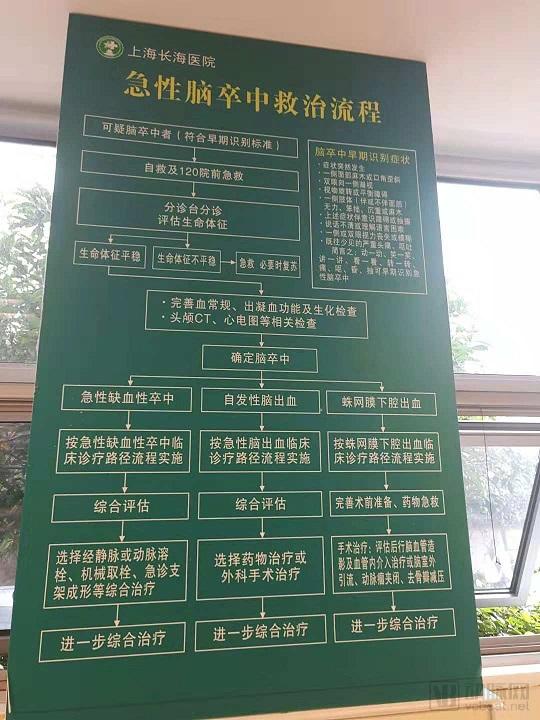
Specifically, personnel, equipment, and data must be interconnected in real time across every stage—from health management and disease early warning, pre-hospital emergency care, and in-hospital green channels, to diagnosis and treatment, neurocritical care, and finally stroke rehabilitation and secondary prevention. Through intelligent connectivity, this approach provides patients with “seamless” care, thereby saving critical time, enabling more precise diagnosis and treatment, and improving post-operative and rehabilitation management.
![RV5%CIZ]8GPT)9O`5AC(OHG.png](https://cdn.vcbeat.top/upload/image/11/10/29/52/1540813940159046.png)
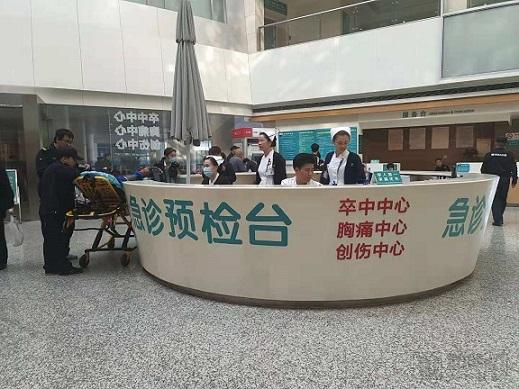
Professor Zhong Haizhong, President of Changhai Hospital, stated, “As early as 2013, Changhai Hospital selected elite personnel from 12 departments across the institution, scientifically reorganized them, and formed a multidisciplinary team comprising more than 60 physicians from neurology, neurosurgery, radiology, vascular surgery, and other specialties to establish a fully independent, interdisciplinary ‘Cerebrovascular Disease Center.’ By breaking down interdepartmental barriers and implementing a ‘one-stop’ stroke emergency care pathway, we achieved a stable door-to-needle (DTN) time of 20 minutes by 2017.”
VCBeat has learned that the multidisciplinary integration initiative at the Stroke Center of Changhai Hospital is a top-priority project led by senior leadership; therefore, the hospital president’s attention and direct oversight are critical to its success.
“We have used management and technical measures to reclaim the time spent on in-hospital treatment, but how can we reduce the time wasted by patients before they arrive at the hospital?” said Director Liu Jianmin, emphasizing that the construction of a stroke network is the second most critical component. In response, Changhai Hospital took the lead in establishing the Stroke Emergency Alliance in Yangpu District, integrating all medical institutions in the area into a coordinated network. Each institution within the network undergoes specialized training, with the goal of ensuring that no stroke patient experiences delays regardless of which hospital they first reach. Institutions with the necessary capabilities provide immediate treatment, while those without promptly refer patients to appropriate facilities, thereby creating a “60-minute golden window for stroke care” covering northeastern Shanghai.
It is reported that after the establishment of the specialty alliance, Changhai Hospital also organized doctors from community hospitals near Yangpu District to supervise, manage, and guide them in conducting stroke high-risk population screening throughout the entire community. After expanding from a single point to the entire district and then the whole city, Changhai Hospital hopes to replicate this model nationwide.
“Now, what I am most proud of is that any stroke patient arriving at the emergency department of Changhai Hospital receives ‘VVIP service’ 24 hours a day, obtaining the most standardized treatment in the fastest possible time,” said Director Liu Jianmin.
According to an expert from Changhai Hospital, the difference between stroke care models abroad and in China lies not in in-hospital treatment, but in pre-hospital emergency care. Overseas emergency medical services are more mature, with clearly defined hospital rating systems and treatment capabilities. Hospitals at different levels have explicit responsibilities regarding whether they can perform thrombectomy or thrombolysis. These two factors ensure that any patient diagnosed with stroke by a physician in an ambulance can be transported to the nearest capable hospital. In China, the coordination between the emergency medical services (120) system and hospitals still needs improvement.
To address this issue, Changhai Hospital established a dedicated pre-hospital emergency care working group under the auspices of the Shanghai Stroke Society. The group is led by the Director of the Shanghai 120 Emergency Medical Services Center, with a physician from Changhai Hospital serving as deputy director. Through coordinated efforts, both parties have established specific and feasible implementation plans.
Currently, both parties have preliminarily finalized the draft of the Shanghai 120 Stroke Diagnosis and Treatment Quality Control Standards.
Stroke Prevention and Treatment Requires More “Partners”
In addition to implementing changes in management and processes, Changhai Hospital established a strategic partnership with Philips (China) Investment Co., Ltd. in 2017, aiming to leverage technological advancements to minimize door-to-needle (DTN) time as much as possible.
It is understood that Philips offers comprehensive solutions covering the “full continuum of care” in the cardiovascular and cerebrovascular fields, including: a multidisciplinary stroke collaboration platform, precise stroke assessment and early screening for high-risk populations, endovascular safety treatment, surgical and critical care information management, stroke big data management, and intelligent post-discharge stroke rehabilitation. These solutions help healthcare systems achieve the goal of “earliness” throughout the diagnosis and treatment of stroke—namely, early diagnosis, early treatment, early prevention of recurrence, and early rehabilitation.
Mr. He Guowei, CEO of Philips Greater China, stated, “Medical technology can create greater value for both patients and healthcare providers only when it is closely integrated into the real-world clinical contexts of China’s healthcare system. Philips is committed to co-creating with a ‘local ecosystem’ that includes hospitals at all levels, professional associations, research institutions, universities, industry leaders, and local innovative enterprises. By leveraging this collaboration, we aim to introduce innovations from our global platform to China more rapidly and appropriately. In response to the needs of Stroke Centers at various levels, we are developing comprehensive, disease-specific solutions for stroke care driven by connected technologies, big data, and artificial intelligence, thereby helping China’s healthcare system enhance its capabilities in the prevention and treatment of stroke.”
In 2018, the two parties further deepened their co-creation partnership, committing to long-term, close collaboration to jointly develop a “Comprehensive Care Solution for Stroke” within real-world clinical settings in China. Key focus areas included the Zhihui Health Platform, pre-hospital emergency care and green channel development, post-discharge management, and stroke rehabilitation. This initiative aimed to elevate Changhai Hospital’s stroke center construction to a new level, establish a world-leading cerebrovascular disease center, and promote the “Changhai Model” and its experience to stroke centers at all levels across China, thereby enhancing the overall prevention and treatment of stroke in the country.
Health education is also essential.
According to a World Health Organization survey, China ranks first globally in stroke incidence, with a rate twice as high as that of the United States. Results from China’s third national survey on causes of death indicate that stroke has become the leading cause of death in the country and the primary cause of disability among adults. Monitoring data over the past two decades show that annual stroke-related deaths exceed 2 million, with an annual growth rate of 8.7%. In addition to its high mortality rate, stroke is characterized by high rates of disability and recurrence, posing a serious threat to the lives, health, and quality of life of the population.
The “Media Publicity Day for Comprehensive Care of Stroke” held at the Clinical Neurology Center of Changhai Hospital aims to leverage the power of media outreach to actively respond to the six key objectives emphasized in the World Stroke Day declaration: fully mobilizing resources from all sectors to prevent stroke; integrating stroke prevention with the prevention of cardiovascular disease and cognitive impairment; establishing multidisciplinary stroke care teams; translating knowledge into action; developing new research methodologies; educating the public to encourage proactive participation; and fostering global collaboration.
During the interview, Director Liu Jianmin repeatedly emphasized the importance of health education. “By performing a single surgery, a doctor saves one patient. However, by conducting one educational session, we may help 300 families understand the importance of stroke prevention and treatment. Therefore, I believe that in the future, health education will be even more important than clinical treatment!”
Health education for young and middle-aged adults is a challenging endeavor, as their busy work schedules leave them with little time to receive stroke-related health education. Therefore, Changhai Hospital has adopted a strategy that targets the two ends of the age spectrum, focusing on the elderly and the young. On one hand, Changhai Hospital collaborates with the Shanghai Municipal Education Commission to deliver educational programs in schools for growing children. On the other hand, the hospital conducts outreach activities in communities to provide health education specifically tailored to the elderly.
Director Liu Jianmin believes that stroke education should be diverse and multi-layered. In addition to the efforts made by hospitals themselves, the media should serve as a core force in stroke education. Meanwhile, large enterprises such as Philips should also contribute to these educational initiatives, driven by their sense of social responsibility.