

VB100 Annual Review: Internet Hospitals Become Standard as Multi-format Integration Competes for Prescription Drug Diversion in Pharmaceutical E-commerce
“2018 Future Healthcare 100 Forum”An annual flagship event curated by VCBeat for innovators in the healthcare and medical sector. Leveraging the announcement of the “Future Healthcare Top 100” list and awards, this forum will host17 SessionsThemed Forum, Inviting Nearly200 peopleIndustry Leaders, Gathering the Most Active Healthcare and Medical Professionals from China and AbroadInnovative Enterprises, Listed Companies, Financial Institutions, Healthcare Institutionsas core industrial forces, promote effective interaction and cooperation across the industry chain, and drive the transformation of the innovative healthcare industry.
As the year draws to a close, it is necessary to review and summarize the pharmaceutical e-commerce industry in 2018.
Over the past few years, amid fluctuating policies and intermittent capital involvement, the pharmaceutical e-commerce sector has advanced along a tortuous path. Fortunately, leading enterprises with clear strategies, excellent teams, and correct directions have emerged, underpinning the “fundamentals” of the industry’s development.
This article will outline the changes in the pharmaceutical e-commerce industry in 2018 from four perspectives:
I. Strategic Layout of Major Companies
II. Policy Changes
III. Investment and Financing
IV. Trend Analysis
(Sorted by time)
Ping An Good Doctor: Rapid IPO to Accelerate Integration with Medical Services, Insurance, and Financial Businesses
Ping An Good Doctor was established in 2014 and launched its mobile platform for online healthcare services in April 2015. Its core offerings primarily include family doctor services, consumer healthcare services, a health e-commerce marketplace, as well as health management and health engagement initiatives. On May 4, 2018, Ping An Good Doctor completed its initial public offering (IPO) on the Main Board of The Stock Exchange of Hong Kong Limited.
Since its IPO, Ping An Good Doctor has taken numerous strategic actions: On August 16, it acquired 100% equity interest in Ping An Wanjia (Wanjia Medical) to accelerate its offline expansion, securing opportunities in family doctor contracting, channel development, and commercial health insurance collaborations. Subsequently, Ping An Good Doctor announced a partnership with Grab, a Southeast Asian O2O platform, to provide users with AI-assisted online consultation, online pharmacy, and appointment registration services.
VCBeat previously analyzed that Ping An Good Doctor’s success unfolded in four steps. Step one: securing initial development capital through capital injection from Ping An Group. Step two: establishing the initial business model for online medical consultations and acquiring seed users via related-party transactions and user referrals from Ping An Group. Step three: achieving substantial user growth through marketing campaigns and cash subsidies. Step four: realizing a significant increase in sales revenue by launching an online marketplace.
The semi-annual report shows that Ping An Good Doctor’s revenue in the first half of the year reached RMB 1.12 billion, a year-on-year increase of 150.3%. Whether in terms of traffic, revenue, or the aggregation of industry resources, Ping An Good Doctor has provided valuable experience for large corporations entering a challenging sector. Backed by Ping An Group, Ping An Good Doctor will continue to integrate resources and synergize with the group’s insurance, finance, and other business units in the future.
Alibaba Health: Continued Injection of Alibaba Ecosystem Traffic and Capital Resources to Strengthen “New Retail”
Alibaba Health is the flagship platform of Alibaba Group’s strategic layout in the healthcare sector and a key implementer of Alibaba’s “Double H” strategy—Happiness & Health. Since its inception, it has attracted significant attention. By leveraging group resources, building internal capabilities, forming partnerships, and making investments, Alibaba Health has diversified its business portfolio, establishing four core business lines: pharmaceutical e-commerce, smart healthcare, product traceability, and health management, thereby creating a closed-loop ecosystem for “Internet + Healthcare.”
On May 29, Alibaba Health announced that it had formally entered into an agreement with Alibaba Group to acquire businesses including Tmall’s medical devices and health products, adult products, and medical and health services, in exchange for approximately 1.828 billion shares of Alibaba Health, valued at HK$10.6 billion.
On June 25–26, Alibaba Health announced two consecutive investments: first, it has formally signed a capital increase agreement with Shuyu Pingmin Pharmacy, with an investment amount of RMB 454 million for a 9.34% equity stake; second, it has entered into a strategic cooperation agreement with Huaren Health to deepen its presence in the regional pharmaceutical retail market.
Official data also show that, as of March 31, 2018, the annual gross merchandise volume (GMV) of Tmall’s medical device business reached RMB 20.561 billion, involving 85.5 million active buyers and more than 3,300 registered merchants, including well-known brands such as Omron, Yuwell, Johnson & Johnson, Bausch + Lomb, and Durex.
The combined gross merchandise value (GMV) of Tmall’s pharmaceutical categories operated by Alibaba Health and the e-commerce platform service business for health food products acquired by Alibaba Health exceeded RMB 30 billion, with e-commerce platform service revenue reaching RMB 171 million, representing a year-on-year increase of 324.1%.
This indicates that Alibaba Health controls the entry point to over RMB 50 billion worth of e-commerce business in pharmaceuticals, medical devices, and health supplements. Coupled with its self-operated pharmacy business, Alibaba Health’s scale is significant in terms of both traffic and transaction volume.
Notably, e-commerce is not the “endgame” for Alibaba Health. Currently, Alibaba Health is still deeply cultivating its healthcare business, including streamlining clinical workflows, investing in medical payment solutions, and laying out its strategy in medical artificial intelligence. Many of Alibaba Group’s investments in the healthcare sector may in the future be driven by Alibaba Health as a “central platform.”
JD Health: Multiple Segments Exert Force in Unison, with Synergy Being the Most Critical Factor
Overall, JD.com’s pharmaceutical business is structured into four segments: B2B (Yaojingcai), B2C (JD Health Pharmacy), O2O (JD Daojia), and JD Internet Hospital. Additionally, other divisions such as JD Finance, JD Cloud, and JD Logistics are also extending their reach into the pharmaceutical industry.
JD Pharmacy was launched in May 2016, evolving from Qingdao Anjitang Pharmacy. In November 2015, Anjitang officially obtained the Class C Certificate for Internet Drug Transaction Services, authorizing it to sell pharmaceuticals directly to end consumers.
The logic behind JD.com’s self-operated pharmaceutical B2C business is primarily to complete its product category offerings, thereby catering to consumers’ preference for “one-stop shopping.” JD.com’s approach to pharmaceutical B2C combines a marketplace model with self-operated B2C. The marketplace B2C model allows other enterprises holding an Internet Drug Transaction Service License (Category C) to establish storefronts on JD’s pharmaceutical platform, similar to Deshengtang Pharmacy, Jianmin Pharmacy, and Yifeng Pharmacy. These third-party sellers mainly offer over-the-counter (OTC) drugs, personal care and health products, nutritional supplements, and adult wellness items. The self-operated segment, known as JD Health Pharmacy, sells both OTC and prescription drugs. The purchasing process for prescription medications involves submitting an order, receiving a callback from a licensed pharmacist for verification, and having the medication delivered by JD Health Pharmacy.
This year, JD.com’s key initiatives in its pharmaceutical business included: In June, JD Logistics upgraded and opened its services to provide integrated solutions for the pharmaceutical supply chain; in September, JD Cloud unveiled its healthcare strategy, leveraging a model of “multi-channel online reach plus offline solution implementation” to partner with professional stakeholders in the healthcare industry and empower the sector through technology.
7LeKang: Synergistic Development of “Doctors, Medicines, and Patients”—The Right Time for Platform Upgrade
On August 1, 2018, Qilekang announced the completion of a new round of strategic financing, led by GTJA Investment. The funds from this round will be used to build a complete online healthcare service loop integrating “medical care, pharmaceuticals, and patients.”
Founded in Guangzhou in 2010, Qilekang is a government-authorized medical institution. Leveraging its leading R&D capabilities in information technology and a comprehensive layout across the medical industry, Qilekang has built an efficient and trustworthy ecosystem service platform for doctors, patients, hospitals, and pharmaceutical companies through its internet healthcare system. After seven years of development, its business now covers four core sectors: internet hospitals, mobile health, pharmaceutical e-commerce, and chain pharmacies.
Regarding its internet hospital operations, official statements indicate that by 2018, Qilekang had become the internet hospital with the largest prescription volume in China. The Qilekang Internet Hospital features a comprehensive data infrastructure, including electronic health record (EHR) systems, electronic medical record (EMR) systems, e-prescribing and online physician order entry systems, telemedicine platforms, prescription review and medication delivery systems, and payment and settlement systems. It provides physicians with an online platform for multi-site practice and promotes the balanced allocation of medical resources by enabling regional interoperability of healthcare information, thereby facilitating greater access to high-quality medical care at the grassroots level.
In terms of doctor-patient engagement, Qilekang leverages its "Qilekang Doctor" app, which features separate interfaces for doctors and patients. The doctor-facing product is positioned for the diagnosis and management of chronic diseases, assisting physicians with patient management, doctor-patient communication, electronic cloud-based medical records, post-consultation follow-ups, medication recommendations, and other services, effectively serving as a portable virtual clinic. The patient-facing interface supports online medical information exchange for hundreds of thousands of users simultaneously, offering a range of medical services including online consultations, intelligent triage, appointment scheduling, medication counseling, health check-up bookings, prescription inquiries, and payment for diagnosis and treatment.
In the pharmaceutical sector, Qilekang was among the first enterprises to obtain qualifications for online drug sales. It operates multiple third-party sales platforms, as well as its own proprietary platforms via its official website and mobile channels. The company has independently developed and implemented several advanced systems, including a Warehouse Management System (WMS), a Supply Chain Management System, an Order Fulfillment Center (OFC) system, and a foundational database management system. These systems enable fully paperless operations and provide comprehensive management of the entire process—from initial vendor approval, goods receipt and inspection, warehousing, outbound order verification, to pharmaceutical transportation and cold-chain logistics—thereby achieving thorough back-end tracking and query capabilities.
Jianke: Strengthening Its Internet Healthcare Layout to Build a Closed-Loop Business Ecosystem
On September 4, Jianke announced that it had secured $130 million in Series B financing. The round was led by GTJA Capital, with participation from funds including HBM, while Kaixin Capital, an investor in its Series A round, continued to follow on. Jianke also stated that it expects to list in the United States next year.
According to public information, Jianke’s valuation will reach $500–600 million following this round of financing. The company plans to conduct another round of financing before its initial public offering (IPO) next year, aiming for a valuation of $1–2 billion at the time of listing.
Jianke was established in 2006. In 2009, it officially obtained the "Certificate for Internet Drug Transaction Services" issued by the China Food and Drug Administration (CFDA), becoming the first legitimate and compliant online pharmacy enterprise in Guangdong Province. It has maintained a leading position in the industry for many years.
Currently, Jianke operates the largest online pharmacy in China, with 680,000 online SKUs and a cumulative user base exceeding 100 million. Meanwhile, Jianke boasts the industry’s largest chronic disease management service center, featuring over 1,000 customer service representatives, along with more than 10,000 contracted physicians across 18 specialties managing over 20 million patients with chronic conditions. As an industry leader, Jianke is also actively advancing its “Internet + Healthcare” strategy, having established multiple physical hospitals and internet hospitals across China.
On October 26, the Jianke Internet Hospital project at Tumxuk City People’s Hospital was officially launched in Tumxuk, Xinjiang. This marks the first medical institution in the Xinjiang Uygur Autonomous Region to obtain a practicing license for an internet hospital, signifying the formal establishment of Xinjiang’s first internet hospital on that day.
1Yao.com: The First Internet Pharmaceutical and Healthcare Company to List in the U.S., with Rapid B2B Business Growth
On September 12, Eastern Time, 111 Group, the parent company of 1 Drug Network (Yi Yao Wang), listed on NASDAQ (stock code: YI). Since then, 111 Group has become the first Chinese internet healthcare company to go public in the United States. Industry insiders say that 1 Drug Network's listing in the U.S. will kick off a wave of IPOs for pharmaceutical e-commerce companies.
1 Drug Network was initially a sub-channel of Yihaodian, launching its operations in 2010 and becoming an independent entity in 2012. In 2016, the 1 Diagnosis Internet Hospital went online, followed by the launch of the B2B pharmaceutical platform, 1 Drug City, in 2017. The name “111 Group” is derived from these three distinct business lines—1 Drug Network, 1 Diagnosis Internet Hospital, and 1 Drug City—which are collectively known within the industry as the “Three Carriages.”
111 Group’s revenue in 2017 was RMB 960 million, a year-on-year increase of 10%. In the first half of 2018, its revenue reached RMB 730 million, including RMB 97.2 million from B2B products and RMB 324.5 million from services.
B2B business is the fastest-growing segment of 111 Group, with B2B gross merchandise value (GMV) reaching RMB 230 million in Q2 2018, up from RMB 160 million in Q1 2018, representing a year-on-year increase of 44.0%.
The pharmaceutical industry is heavily regulated, and even subtle policy shifts can alter its trajectory. Since the successive cancellation of the A, B, and C license approvals for pharmaceutical e-commerce last year, there have been no policies specifically targeting this sector in the current year. Nevertheless, policies related to “Internet + Healthcare,” prescription sharing, and pharmaceutical retail continue to influence the development of pharmaceutical e-commerce; we have selected the most relevant portions for review.
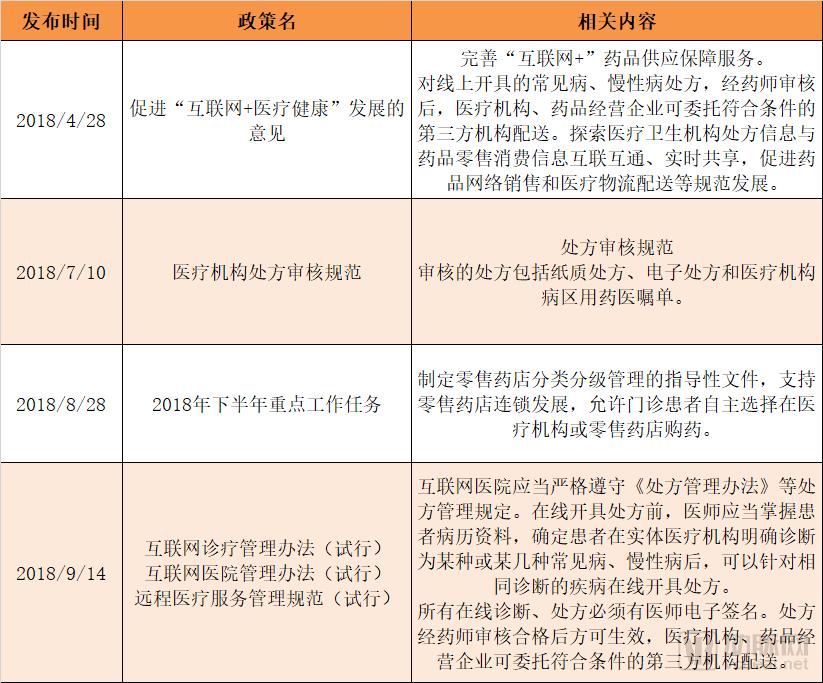
A key takeaway from the above policies is that internet hospitals are permitted to issue electronic prescriptions (limited to common and chronic diseases) and collaborate with third-party providers for medication delivery.
This essentially constitutes a closed-loop service integrating “medical care + pharmaceuticals.” Previously, constrained by restrictions on the online sale of prescription drugs, e-pharmacy platforms primarily offered health supplements, family planning products, and over-the-counter (OTC) medications. With the support of internet hospitals and electronic prescriptions—achieved through collaborations with internet hospitals, hospital acquisitions, or the launch of mobile health apps—the “pharmaceuticals + medical care” model can resolve the issue of prescription sourcing for e-pharmacies, expand their product offerings, enhance user stickiness, secure a loyal customer base, and explore broader business opportunities.
Capital serves as a catalyst for corporate maturity. This year, the pharmaceutical e-commerce sector has witnessed several significant financing rounds and initial public offerings, signaling that the industry is maturing and entering a phase of value realization.
In terms of historical financing, there were 13 financing deals in the pharmaceutical e-commerce sector during the same period of 2017, with a total amount of approximately $127 million, half that of 2016 (when there were 10 financing deals in the pharmaceutical e-commerce sector, totaling approximately $267 million).
This year, the pharmaceutical e-commerce sector recorded eight financing events, with total funding amounting to approximately $1.3 billion. The surge in financing was primarily driven by substantial capital raised through the public listings of Ping An Good Doctor and 111 Group (Yi Yao Wang).
2018 Pharmaceutical E-commerce Financing/IPO Data
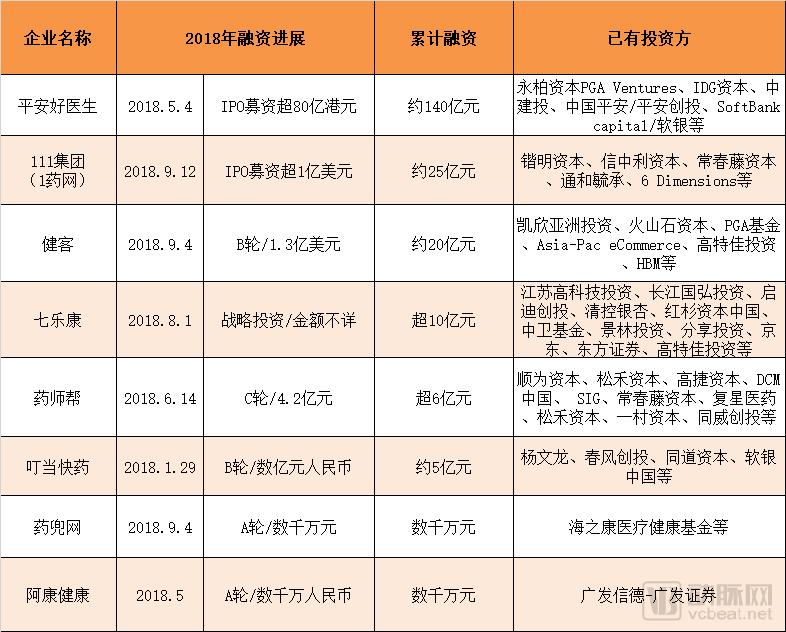
Data source: VCBeat Knowledge Base
With the IPOs of Ping An Good Doctor and 111 Group, the pharmaceutical e-commerce industry is set to usher in a wave of public listings. In the next one to two years, companies such as Jianke and Qilekang may also embark on their IPO journeys.
In fact, the securitization rate of the pharmaceutical e-commerce industry remains relatively high, with leading enterprises such as Kang Aiduo, Haoyaoshi, Renhe Pharmacy Network, Kede Wang, and Guoda Drugstore all affiliated with A-share listed pharmaceutical companies. Additionally, some listed chain pharmacies and distribution companies are actively expanding their e-commerce operations.
“Listed-company-affiliated” pharmaceutical e-commerce firms account for a significant share of the market. This is largely because the pharmaceutical e-commerce sector remains relatively resource-intensive. For instance, obtaining approval for an online pharmacy requires first securing an Information Service Qualification Certificate, and then leveraging an existing offline chain-store network to obtain a Transaction Service Qualification Certificate. This regulatory framework gives companies with established chain-store operations a distinct advantage in entering the market. Furthermore, effective management of pharmaceutical supply chain resources and industry marketing capabilities demands experienced professionals with deep sector expertise. Consequently, early participants in the pharmaceutical e-commerce industry were predominantly players with traditional pharmaceutical backgrounds.
Nevertheless, it should also be noted that non-listed companies and those with internet DNA account for a significant proportion of the pharmaceutical e-commerce industry. Examples include Jianke, 111.com.cn, Qilekang, Yunkai Yamei, 360 Haoyao, and 800 Fang. These companies have entered the pharmaceutical e-commerce sector armed with internet-centric philosophies, introducing new approaches to technology, operations, and marketing within the industry.
Overall, the competitive landscape of the pharmaceutical e-commerce market has gradually become clear, with a tier of leading enterprises emerging. A group of companies with strong capabilities, abundant resources, and deep market understanding has established their brands and secured corresponding market shares. As profit models become increasingly well-defined and revenue stabilizes, pursuing an initial public offering (IPO) is a logical next step.
Internet healthcare is one of the most significant variables in the healthcare industry. Over the past few years, it has experienced a tortuous development path, starting from appointment registration and online consultations and gradually penetrating into the core segments of medical care. It is believed that the industry will usher in a period of robust growth following the introduction of regulations on internet-based diagnosis and treatment.
From the perspective of healthcare supply, the scarcity of high-quality medical resources and the mismatch between supply and demand have long been persistent issues. Policymakers have proposed advancing “Internet + Healthcare” to minimize the need for patients to make physical visits while enabling data to flow more freely, thereby continuously enhancing the equity, inclusiveness, and convenience of public services. Internet-based healthcare is not only what the public desires but also an inevitable trend.
As regulatory frameworks for internet-based diagnosis and treatment become clearer, more capable medical institutions and pharmaceutical companies will join the ranks of those building internet hospitals. This shift will not only transform consultation models and patient healthcare-seeking behaviors but also reshape the landscape of pharmaceutical retail. For pharmaceutical distribution enterprises, collaborating with internet hospitals represents a key opportunity to seize in the future.
The outflow of prescriptions will drive structural adjustments in pharmaceutical distribution channels, representing both a reallocation of existing market share and a new growth engine for the industry. Previously, pharmaceutical e-commerce platforms and online pharmacies were largely absent from the prescription drug market, due not only to regulatory constraints but also to factors related to consumer channels and behavior. As internet hospitals and remote diagnosis and treatment models gain acceptance, the “pharmaceuticals + healthcare” model adopted by pharmaceutical e-commerce will become mainstream. This shift not only prepares the sector to accommodate prescription outflow but also serves as a crucial strategy for the compliant sale of prescription drugs and for capturing incremental market growth.
Furthermore, we have observed the convergent development of business models such as B2B, B2C, and O2O. Represented by Alibaba and JD.com, many enterprises are simultaneously engaged in these areas. Alibaba offers e-commerce services, operates self-run pharmacies, and has established the Pharmacy Pioneer Alliance. JD.com provides services including procurement, online pharmacies, and on-demand home delivery. Other companies, such as Jointown Pharmaceutical Group, Renhe Pharmaceutical, 111.com, and Jianke, are also pursuing diversified strategies characterized by synergy between online and offline channels, coordination of B2B and B2C operations, and integration of medical services with pharmaceutical distribution. These developments are typical manifestations of channel convergence.
The online pharmacy model has matured, with leading players firmly established. B2B pharmaceutical e-commerce is likely to be the segment with the greatest growth potential in the near future. Currently, China’s pharmaceutical distribution sector is characterized by a large number of fragmented players and a complex channel structure. With the support of “Internet+,” market leaders are expected to further increase their market share. Companies such as Sinopharm, China Resources Pharmaceutical, Shanghai Pharmaceuticals, and Jointown Pharmaceutical Group are all actively expanding their online operations.
In addition, we are seeing a cohort of internet-native companies with high potential emerging in the B2B pharmaceutical sector, such as Rongguan E-commerce, Yaoshibang, Drug Terminal Network, and Yaodou Network. Rather than competing directly with large-scale distributors, these companies target the procurement needs of pharmacies, primary healthcare institutions, and private medical facilities. By supplementing their core offerings with SaaS solutions and supply chain finance services, they aggregate fragmented, small-scale demand to gain market leverage.
In summary, we have seven predictions for the future development of the pharmaceutical e-commerce industry:
1. The pharmaceutical e-commerce industry will also see large-scale financing, boosting leading companies to expand their markets and go public;
2. Internet hospitals will become a standard feature for e-commerce platforms, with deployment through investment, self-development, partnerships, and other models;
3. Integration of online and offline channels: E-commerce will expand into retail pharmacies, DTP (Direct-to-Patient) pharmacies, and other sectors;
4. Integration of B2B and B2C businesses, with the same enterprise engaging in multiple business lines;
5. Mergers and acquisitions will occur across industries, driven primarily by capital;
6. B2B e-commerce will become the sector with the greatest growth potential, ushering in a period of rapid development;
7. More new entrants are joining, bringing novel gameplay and business models.