

Pinduoduo Enters Pharmaceutical E-commerce with New Health Channel
Editor’s Note: This article is republished fromChinese Entrepreneurs Magazine(WeChat Official Account: iceo-com-cn), Author: Li Xiuzhi, republished with permission from VCBeat.
Recently, China Entrepreneur noted that an individual claiming to be a Pinduoduo employee was soliciting partnerships in various pharmaceutical e-commerce groups: “Friends in the hospital e-commerce circle, I represent Pinduoduo in inviting enterprises with Internet Drug Transaction Certificates to join the Pinduoduo Medicine and Health Pavilion.” According to this employee, the so-called Pinduoduo “Medicine and Health Pavilion” refers to the Pinduoduo Health Channel.
Pinduoduo’s Health Channel is visible at the very bottom of its product search bar. It currently features three subcategories: Medical and Family Planning Products, Refined Traditional Chinese Medicinal Materials, and Contact Lenses, offering OTC drugs such as Ganmaoling, Zuguang Powder, Shenbao Tablets, and Ejiao.

Source: Screenshot from the Pinduoduo app
According to Chinese Entrepreneur, Pinduoduo has previously recruited numerous talents from the healthcare industry, including Guo Ming, the former head of marketing at Jinxiang.com. Guo oversaw marketing operations at Jinxiang.com for approximately seven years. Launched on June 18, 2007, Jinxiang.com was the second company in China to obtain a license for operating an online pharmacy.
The recruitment platform Lagou also shows that Pinduoduo's Platform Governance Department is hiring Product Management Specialists.
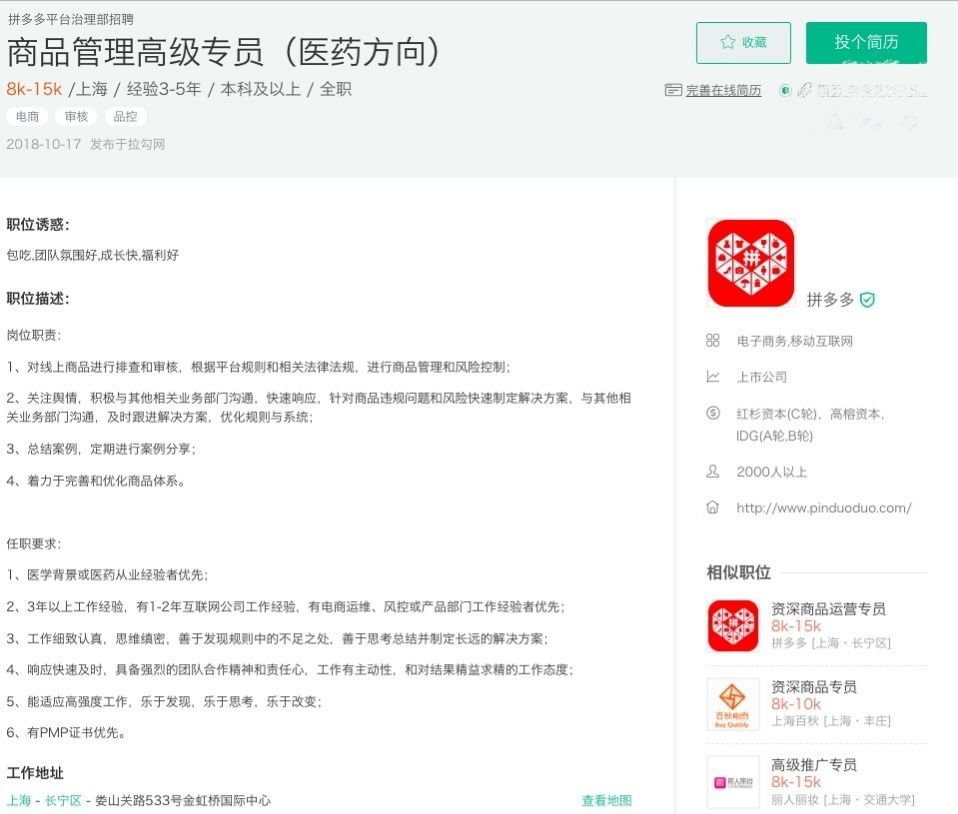
Source: Screenshot of Pinduoduo's recruitment page on Lagou.com
“I know they are preparing to launch this initiative, and they seem highly motivated to do so,” a pharmaceutical e-commerce practitioner revealed to China Entrepreneur. “It is certain that all major traffic platforms will enter the pharmaceutical e-commerce sector. However, it remains difficult to predict exactly how Pinduoduo will approach this.”
A well-known investor told China Entrepreneur that purchasing medications is relatively random and personalized, making it difficult to consolidate.
Previously, in the article “JD.com and Alibaba’s Fierce Battle in Pharmaceutical E-commerce,” Chinese Entrepreneurs noted that the “Internet+” model holds immense potential in the pharmaceutical distribution sector.
Data from the Ministry of Commerce shows that in 2017, the total sales of seven major categories of pharmaceutical products (pharmaceuticals, medical devices, chemical reagents, glass instruments, Chinese patent medicines, traditional Chinese medicinal materials, and others) in China reached RMB 2.0016 trillion, with the pharmaceutical retail market accounting for RMB 400.3 billion. In terms of pharmaceutical e-commerce, the sales volume was only RMB 13.3 billion in 2012, reaching RMB 121.1 billion in 2017, while the proportion of online pharmaceutical purchases remained below 10%.
Since China’s pharmaceutical e-commerce sector entered its exploratory phase in 1999, this emerging market has attracted significant attention from numerous industry giants and entrepreneurs.
Both JD.com and Alibaba began piloting pharmaceutical e-commerce in 2011. A prominent pharmaceutical expert told China Entrepreneur that the two companies collectively account for approximately 70% of China’s online pharmaceutical transaction market.
In the vertical sector, relevant data show that by the end of 2016, more than 800 enterprises held qualifications for online drug transaction services. Notably, in 2018, many companies began to emerge in the capital markets. For example, on September 12 (Beijing time), 111 Group, the parent company of Yihaodian’s spin-off 1 Drug Network (YaoWang), listed on the NASDAQ in the United States, becoming the first publicly traded internet healthcare and pharmaceutical company. In early September, Jianke announced it had secured $130 million in Series B funding and planned to list in the United States in 2019. For Ping An Good Doctor, which had recently gone public on the Hong Kong Stock Exchange, e-pharmacy has become its primary source of revenue in recent years.
Zhang Dingding, Marketing Director at the online pharmacy Haoyaoshi, believes that under the offensive from the two giants, small and medium-sized players in the pharmaceutical e-commerce industry have virtually no chance left, and going public is merely a means for them to engage in capital operations.
However, Pinduoduo may be an exception. In the comprehensive e-commerce sector, just when everyone believed that the market had been fully divided between JD.com and Alibaba, Pinduoduo surged to become the third-largest e-commerce giant in just over three years. It went public on the NASDAQ in the United States in late July this year, earning the title of “the first stock of social e-commerce.”
On the other hand, compared with JD.com and Alibaba, Pinduoduo’s social e-commerce and group-buying model, which formed its foundation, may become a constraint in the pharmaceutical sector.
For instance, regarding its group-buying model, some investors argue that it requires users to have a demand for a specific drug targeting a particular indication within the same time frame. Taking the common cold as an example, there are many types of colds, and patients do not necessarily purchase the same medication. Moreover, pharmaceutical products lack the strong social attributes seen in other consumer goods. “I can treat my colleagues to coffee, but I certainly cannot invite them to take medicine.”
Another investor argued that the biggest difference between pharmaceuticals and ordinary consumer goods is their involvement with medical insurance. While it is relatively straightforward for patients to pay out-of-pocket, navigating medical insurance reimbursement is far more complex. “It is difficult to envisage a scenario where consumers can engage in group-buying of medications to reduce costs while still having the expenses reimbursed by medical insurance.”
Judging from Pinduoduo’s moves, it is adopting a B2C platform model in the pharmaceutical e-commerce sector. In effect, this approach operates in a regulatory gray area, as the relevant oversight policies remain unclear.
China previously piloted the B2C pharmaceutical e-commerce platform model. Between 2013 and 2014, pilot qualifications for third-party online retail of pharmaceuticals were granted to Hebei Huiyan Pharmaceutical Technology, 800 Fang, and Yihaodian, respectively (under which merchants listed on the platforms provided retail pharmaceutical services to individual consumers).
For a long period, the government implemented a licensing system for online drug trading services, issuing three types of licenses: A, B, and C. The eligible applicants for these licenses were third-party pharmaceutical trading platforms, pharmaceutical manufacturers/wholesalers, and chain pharmacies, respectively. These licenses authorized the provision of online pharmaceutical trading platform services, online pharmaceutical wholesale services (B2B), and online pharmaceutical retail services (B2C), respectively.
To secure the license, Alibaba spared no expense. In January 2014, it acquired Hebei Huiyan Pharmaceutical Technology (hereinafter referred to as “Hebei Huiyan”) for RMB 3 million. Following the acquisition, Tmall obtained the “pilot B2C platform license.”
In May 2016, Tmall Pharmacy received a notice from the Hebei Food and Drug Administration that its pilot qualification as a third-party platform for retail drug sales would not be renewed. The same applied to 800 Fang and Yihaodian.
An article on the official website of the China Food and Drug Administration (CFDA), citing media reports, stated that “the pilot program for online retail of pharmaceuticals via third-party internet platforms has concluded.” It further noted that the pilot revealed issues such as unclear primary responsibilities between third-party platforms and brick-and-mortar pharmacies, as well as difficulties in effectively regulating the sale of prescription drugs and ensuring drug quality and safety, which are detrimental to protecting consumer interests and medication safety.
Thereafter, third-party internet platforms are permitted only to display drug information and are prohibited from engaging in online drug transactions. Consumers wishing to purchase drugs via third-party internet platforms must first submit their requests, with orders then transferred to licensed online pharmacies operating on the platform. This means that platform companies can generate revenue only through profit-sharing arrangements based on traffic referral to other e-commerce entities, and cannot achieve genuine platform-based sales.
In 2017, the State Council successively abolished the Class A, B, and C licenses for online drug trading services. Multiple industry insiders told China Entrepreneur that while the entry barriers for pharmaceutical e-commerce appeared to have been lowered, the filing process remained stagnant due to the absence of supporting detailed regulations.
As for the B2C platform model in the pharmaceutical sector, Wei Kai, General Manager of JD Health, stated in an interview with China Entrepreneur, “What we have observed is that third-party internet platforms have not halted online drug transactions, as they hold significant value. Moreover, at that time, the China Food and Drug Administration (CFDA) did not issue any formal document mandating a complete cessation of online drug sales; the published articles were merely intended to strengthen medication safety controls through a phased tightening of policies.”
“E-commerce in the pharmaceutical sector may be one of the few remaining areas in the e-commerce landscape that has not yet been deeply cultivated. We anticipate new changes in national policies. Pinduoduo and other players likely have already factored these expectations into their strategies. This is why I believe competition in the pharmaceutical B2C segment will intensify in the future. Once regulatory restrictions are lifted, tech giants will inevitably enter the market, and smaller players will remain highly sensitive to these developments,” said the aforementioned investor.