

Alibaba's New Play in Pharma New Retail: ATM-Style Smart Vending Machines Pave the Way for a Light-Asset Super Pharmacy Chain
If history serves as a guide, yesterday (October 31, 2018) may well become a date repeatedly cited in the annals of China’s pharmaceutical distribution development.
On that day, at a pharmacy on Chenghe Road—a quiet street lined with French plane trees in Xiaoshan District, Hangzhou, the home base of Alibaba—the unveiling ceremony for “Alibaba Empowering New Retail in Pharmaceuticals: The ‘One Store, One Window’ Project” was held.
Similar to many of Alibaba’s major initiatives, this project also involves collective interaction across all segments of the entire industry chain. Participants include Alibaba Cloud’s IoT Division, Ele.me (an Alibaba subsidiary), Beijing Zhengzhong Technology, Zhejiang Jiajia Health (a local pharmacy chain), as well as nearly 100 pharmaceutical companies.
The ceremony saw the grand unveiling of a “new species” dubbed the “Store-Warehouse Integrated, Separated Self-Service Vending Machine v3.0,” a collaborative product of Zhengzhong Technology and Alibaba. Leveraging this cutting-edge technology, Shao Qing, General Manager of Ele.me Medicine & Health, announced to the audience that the company could finally launch “24-Hour Medication Sales: A Great Upgrade in New Retail for Pharmaceuticals.”
At the event, the 24-hour medication dispensing model was demonstrated: an attendee placed an order via the Ele.me app on their smartphone, then approached the self-service medication vending machine and entered the order number (alternatively, scanning the pickup code or using facial recognition). Within approximately 10 seconds, the purchased medications were delivered to the pickup outlet via a conveyor belt. For those preferring not to leave home, home delivery is also available; Ele.me riders typically deliver medications within an average of 23 minutes.
It is well known that the inability to purchase medications at night has long been a pain point in the market. Among the more than 400 pharmacy chains and over 50,000 individual pharmacies nationwide partnering with Ele.me, only 1% offer 24-hour medication sales. Such a low proportion is virtually meaningless to the vast majority of users.
In response to this situation, Alibaba Cloud’s IoT Division, Ele.me, and Zhengzhong Technology have joined forces in a collaborative initiative to install these self-service medication vending machines in 10,000 pharmacies within one year, making 24/7 medication access readily available to the general public.
Shao Qing believes that the 24-hour unmanned pharmacy model based on the O2O model will be the most important retail innovation in the next 1-2 years.
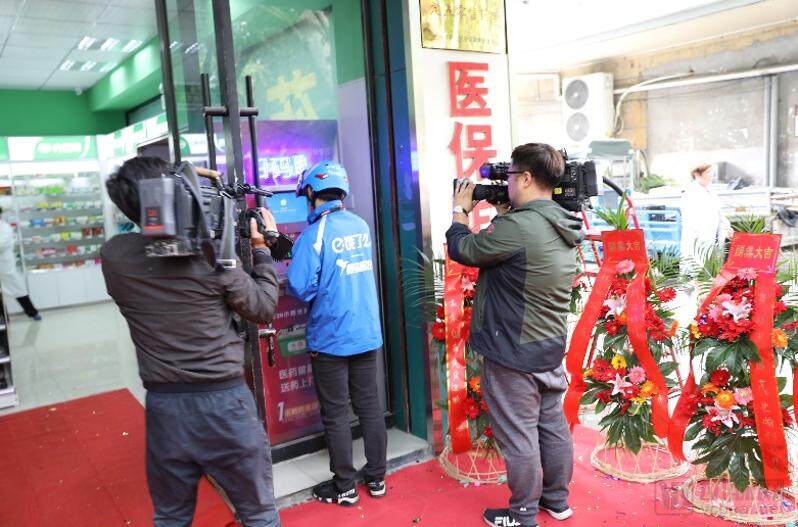
ATM-style vending machines and Ele.me riders
Following Jack Ma’s formal proposal of the “New Retail” strategy in October 2016, Alibaba has been accelerating its expansion in the retail sector. Key initiatives include the full-scale launch of new businesses such as Freshippo (Hema Xiansheng) and Lingshoutong; strategic equity investments in offline retailers Sanjiang Shopping Club, Lianhua Supermarket, and New Huadu; and a joint $400 million capital injection into Ele.me alongside Ant Financial, making Alibaba its largest shareholder and bolstering its competitive position against Meituan in the battle for market share.
According to reporters from VCBeat (WeChat ID: vcbeat), Alibaba, which advocates a “multi-pronged” strategy, has nine business lines engaged in new retail operations, each expanding into different areas and ultimately converging toward shared success.
The same holds true in the new retail pharmaceutical sector. Within the Alibaba ecosystem, Alibaba Health launched the “Super Pharmacy,” and Alipay introduced the “Future Pharmacy.” The “Super Pharmacy” emphasizes the features of “comprehensiveness and safety,” while the “Future Pharmacy” is characterized by “24-hour medication sales” and “smart pharmacy” services.
What is the strategic rationale behind the “One Store, One Window” initiative jointly launched by Alibaba Cloud’s IoT Division and Ele.me, and what disruptive potential does it hold for the new retail pharmaceutical sector?
To this end, VCBeat conducted in-depth interviews from various perspectives.
Within Alibaba’s entire New Retail ecosystem, Ele.me, with 14 million daily orders, serves as the largest traffic gateway. Millions of delivery riders are stationed across more than 2,000 cities of varying sizes throughout China, delivering fast food, flowers, fruits, and a wide array of daily necessities to customers around the clock.
Regrettably, medications rarely appeared in the delivery boxes of night-shift riders. Although pharmaceuticals account for a relatively small proportion of total sales, Shao Qing considers them a “product with warmth,” holding significant meaning. He noted that on Amap, another Alibaba-owned platform, more than one million people use the map to locate pharmacies every night!
Extending pharmacy operating hours to enable nighttime medication purchases has proven unfeasible.
There was once a national policy explicitly stipulating that pharmacies must operate 24 hours a day to dispense medications. However, due to the prohibitively high operating costs at night and negligible sales revenue, pharmacies had little incentive to comply. Following subsequent policy revisions, this requirement was ultimately abolished.
Automated medication dispensers seem to offer a solution to this problem. In recent years, such machines have gradually appeared in some cities, but their development has been less than ideal.
Hu Shaozhu, President of Beijing Zhengzhong Technology, provided reporters with a detailed explanation of the underlying reasons. Since pharmacies close at night, automated medication vending machines must be placed outdoors, which has led to a series of issues. First, their placement often obstructs traffic or detracts from the city’s appearance, prompting intervention by urban management and fire safety authorities. Second, certain medications require storage under controlled conditions, such as constant temperature, constant humidity, and light protection; drug regulatory authorities are concerned that these conditions cannot be reliably maintained. Furthermore, automated medication vending machines contain numerous sensitive sensors that are prone to malfunction and damage when exposed to outdoor environments over extended periods, thereby causing financial losses for operators.
It is precisely for these reasons that, although automated medication dispensing machines have been in existence for over a decade, their development has remained sluggish.
Shao Qing and Hu Shaozhu are friends. On one occasion, Shao Qing asked Hu Shaozhu, “Can you develop an outdoor vending machine for medications that is exempt from urban management enforcement and ensures distortion-free sensor performance?”
At that time, Hu Shaozhu was thriving in the new retail sector of the alcohol industry with his “Zhongzhong Cloud Wine Cabinet” and had not yet ventured into the automatic medicine vending machine market. In response to Shao Qing’s question, he pondered deeply but ultimately shook his head, knowing that, among other challenges, the technology hurdle posed by sensors alone could not be overcome at the time.
However, he offered Shao Qing a suggestion: “If we could move the automated medication vending machines from outdoors to indoors, wouldn’t all the difficulties be readily resolved?”
"That’s a great idea. If you can turn it into a product, I’ll treat you to Maotai every day for a whole month!"
Putting words into action, Hu Shaozhu led his team in round-the-clock R&D, delivering a prototype within just a few months. Over the past year-plus, and after several design iterations, the product rapidly matured. The third-generation model unveiled today in Hangzhou is the latest offering, named “Integrated Store-Warehouse Separated Self-Service Medication Vending Machine v3.0.”
It adopts the latest AI control technology and acoustic-optic sensing technology, featuring a multi-joint, multi-finger pneumatic robotic arm that mimics human manual operations. Designed for integration with existing shelving systems, it offers strong versatility, scalable expansion, a compact footprint, interchangeability with current shelves, and high efficiency. At the event, it attracted significant attention from over 100 peers in the pharmaceutical retail industry.
In an era where business models are receiving increasing attention, we must not overlook the pivotal role that breakthroughs in key technologies and hardware play in driving industry development. Consider this: within Focus Media’s current market capitalization of RMB 88 billion, how significant a contribution has been made by those display screens installed in elevators and buildings!
It is this very machine that has brought together Alibaba Cloud’s IoT Division, Ele.me, and Zhengzhong Technology, enabling them to join forces and reshape the landscape of pharmaceutical retail.
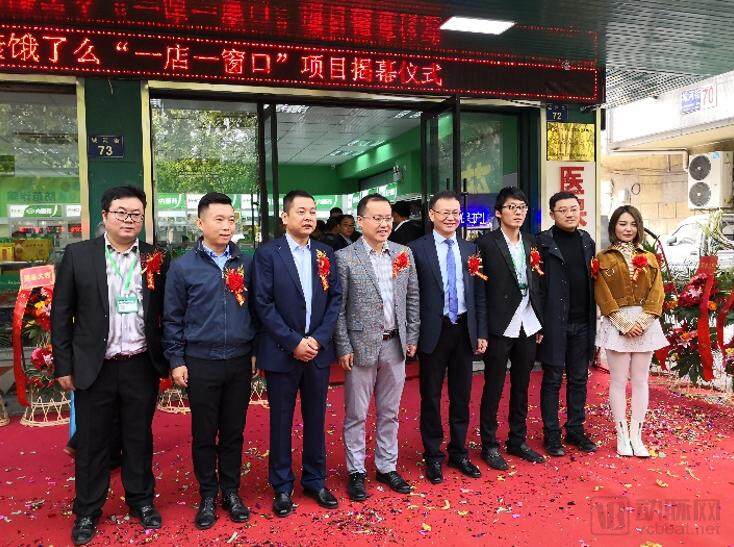
Shao Qing (fourth from left) and Hu Shaozhu (fifth from left)
Unlike previous automated medication dispensers, this generation of products from Zhengzhong Technology is referred to as a “new species” primarily because, like bank ATMs, it is designed for indoor placement, thereby avoiding issues such as encroachment on public roadways and susceptibility to sensor damage.
Secondly, its medication dispensing outlet is separate from the shelving units, with the two connected by a conveyor belt. The dispensing outlet occupies only a small footprint in the storefront, while the shelving units can be installed in concealed locations such as attics or storage rooms. The system accommodates 100–300 stock-keeping units (SKUs), which basically meets the needs of a medium-sized pharmacy, and is affordably priced at only RMB 20,000–30,000.
Additionally, it is simple to install and requires no civil engineering work; only a new glass window needs to be cut. Installation can be completed within one day, causing minimal disruption to the pharmacy’s normal operations.
Most critically, it benefits from long-term customer acquisition driven by Alibaba-affiliated platforms such as Alibaba Cloud IoT Division, Ele.me, Amap, Ant Financial, Alipay, and Taobao Mobile, along with offline delivery support provided by Ele.me riders.
It is reported that since its launch in June this year, Zhengzhong Technology’s “new species” self-service medicine vending machines have been deployed in thousands of chain pharmacy stores across more than 30 cities in China.
Following its collaboration with Alibaba, Zhengzhong plans to strategically partner with capable chain pharmacies across China in the short term, deploying 10,000 units.
Sun Jingen, General Manager of Medical Operations at Jiajia Health, told reporters that the company has installed four automated medication dispensers. Over the past month, revenue from these machines has grown steadily, currently boosting sales at the affiliated pharmacies by more than 20%. Beyond economic benefits, the greatest advantage lies in providing convenience to nearby residents and enhancing the company’s public image.
The partnership between Jiajia Health and Alibaba was driven not only by the acumen of the group’s management but also by the diligent efforts of Yan Gang, the head of its new retail division. Upon learning of the opportunity, he leveraged various resources to secure the chance for Alibaba to establish its first collaborative presence in Hangzhou at Jiajia Health. In fact, as part of the ceremony, the unveiling of the new machines took place at a Jiajia Health store.
From Yan Gang’s perspective, the benefits of this collaboration for pharmacies are clear: with minimal investment, a pharmacy can become the sole provider of nighttime medication pickup and sales in its vicinity, supported by Amap, Alibaba Cloud’s IoT Division, and Ele.me, thereby boosting store sales. Furthermore, the AI services offered by the cloud platform enable pharmacies to make effective use of fragmented downtime and lay the groundwork for future telemedicine initiatives.
Qin Gang, General Manager of Renwoxing Qianfang Baiji Software Co., Ltd., also made a special trip from Chengdu. He believes that this demand genuinely exists among pharmacies across various regions, and once users find the product effective, sales of the medication dispensing machines will soon experience explosive growth. To this end, Qianfang Baiji Software has already achieved integration with the medication dispensing machine.
Alibaba believes that, driven by the continuous advancement of intelligence and new retail concepts, a new generation of vending machines for pharmaceuticals—simple and user-friendly like bank ATMs—will become standard equipment in pharmacies, much like ATMs. This is an almost irreversible trend in the pharmaceutical retail industry.
In the realm of new retail in the pharmaceutical industry, this is undoubtedly a newly explored track. Alibaba hopes to leverage its advantages in platforms, devices, and more to seize the initiative and complete its nationwide layout first.
Ele.me, Zhengzhong Technology, and other partners concur that once tens of thousands of next-generation automated medication vending machines are deployed across China, they will inevitably form an “asset-light super chain.”
First, it will be the first truly nationwide chain channel. Currently, chain pharmacies are predominantly regional, with no nationwide players having emerged yet. For major pharmaceutical manufacturers, a genuine nationwide chain channel offers irreplaceable collaborative value, particularly as this channel is cloud-based, enabling the precise provision of sales data for each city, each product, and every second.
It is reported that many industrial enterprises have now proactively sought collaboration, willing to lease product slots at an annual rent of 1,000 yuan per slot to exclusively sell their own products.
Secondly, it also serves as a massive pharmaceutical advertising platform. Each vending machine is equipped with a 55-inch display screen, and tens of thousands of such machines together form a precise pharmaceutical advertising network. Take Focus Media as an example: while Focus Media can only deliver advertisements, this platform enables simultaneous advertising and sales. It is worth noting that many pharmacies are located in prime areas of first- and second-tier cities.
Not long ago, a major pharmaceutical company paid RMB 100,000 to run its own designated advertisements on ten vending machines for two weeks.
Conversely, slot leasing and revenue sharing from advertising will attract new pharmacies to join the network.
According to reports, several industry giants and major investment institutions have expressed their willingness to join.
At first glance, a high-growth business loop seems to be right before our eyes.