

How This Clinical Risk Management System Enhances Hospital-Acquired Infection Control—Endorsed by Top-Tier Hospitals
Hospitals, dedicated to saving lives and healing the wounded, are in fact fraught with risks. Healthcare professionals engage daily in highly complex and high-risk health service activities, such as disease diagnosis, treatment, and nursing care. These services mean that once patients enter a hospital, they face a range of clinical risks.
The 2000 monograph published by the U.S. National Academies of Sciences, Engineering, and Medicine’s Institute of Medicine pointed out that medical errors in the United States have become the fifth leading cause of death. The annual cost incurred in the United States due to patient harm caused by medical errors ranges from $17 billion to $29 billion. Data released by the World Health Organization show that approximately 10% of hospitalized patients in developed countries suffer harm resulting from various clinical errors or adverse events.
It is precisely for this reason that reducing medical risks and improving patient safety can yield substantial economic and social benefits. In this context, the necessity and urgency for hospitals to establish systematic, specialized, and sustainable clinical risk management mechanisms are beyond doubt.
In recent years, national healthcare regulatory authorities have placed increasing emphasis on patient safety, requiring healthcare institutions to fully recognize the significance of patient safety management and prioritize safety assurance as a core component of medical administration. Guided by the principles of “prevention first, system optimization, full participation, and continuous improvement,” these institutions are vigorously advancing initiatives to continually enhance the level of patient safety management.
However, constrained by management philosophies and technological limitations, the current clinical risk management model in healthcare institutions primarily relies on reporting and statistical analysis after adverse events have occurred. This retrospective reporting approach presents a series of issues, necessitating urgent improvement.
At present, reporting typically focuses on risk events after they have occurred, meaning that management is outcome-based and thus reactive. Risk events are generally reported voluntarily by physicians, which inevitably leads to omissions or underreporting. Furthermore, hospital risk management channels are fragmented; adverse events and safety incidents such as nosocomial infections, patient falls, adverse drug reactions, and deep vein thrombosis are reported via separate forms. This has led to the proliferation of multiple information systems for incident reporting, increasing the administrative burden on clinical staff and resulting in suboptimal risk management outcomes.
In response to this current situation, Shanghai Lilian Information Technology Co., Ltd. (hereinafter referred to as “Lilian Cognition”), leveraging technologies such as medical big data analytics and cognitive computing, has collaborated with renowned hospitals in China. By establishing clinical risk monitoring and early warning models based on high-quality clinical data, the company provides comprehensive solutions for clinical risk management. These solutions enable healthcare professionals to promptly detect clinical risks and even predict them based on patients’ specific conditions, thereby driving more efficient and accurate clinical decision-making, reducing the incidence of clinical risks, and minimizing the loss of life and economic damages caused by clinical risk events.
It is reported that Niu Yaojun, founder of Lilian Cognitive, formerly served as General Manager of the Healthcare Solutions Lab team at IBM Greater China. He was involved in the development and promotion in China of IBM Watson for Oncology. The company’s core team comprises chief healthcare industry consultants, top-tier big data analytics experts, and technical specialists who previously held positions at Fortune 500 technology companies such as IBM, HP, Teradata, and Baidu.
High-Dimensional Feature Extraction to Enhance the Accuracy and Timeliness of Risk Event Identification
Hospital-acquired infections refer to infections contracted by healthcare providers and patients within a hospital setting. They represent a significant clinical risk, accounting for a high proportion of adverse events and causing substantial losses. A 2014 study by the Department of Infection Management and Disease Prevention and Control at Peking University First Hospital revealed that there are 4 million cases of hospital-acquired infections in China annually, with an average economic loss of RMB 29,846 per patient and an average prolongation of hospital stay by 13 days.
Typically, intensive care units (ICUs), neonatal wards, and departments such as hematology and oncology carry the highest risk of hospital-acquired infections. Patients in these units often have compromised immune systems, and the frequent use of invasive and open procedures—such as catheterization and mechanical ventilation—contributes to a higher incidence of nosocomial infections.
Sun Shumei, Director of the Department of Infection Prevention and Control at Nanfang Hospital, Southern Medical University, once offered a vivid analogy. She likened high-risk departments to road sections prone to traffic accidents: even with standardized medical procedures, adverse events can still occur. In contrast, she compared general departments to normal road sections, where accidents are mostly attributable to violations of operational protocols by healthcare personnel.
Therefore, enhancing healthcare workers' perception of infection risks and ensuring timely, proactive, and standardized implementation of infection prevention and response to infection incidents have become key to hospital-acquired infection risk management.
Ensuring the timely and accurate identification and determination of healthcare-associated infection (HAI) risk events is the first step in improving the quality of HAI risk management. Objectively speaking, there is currently no unified gold standard for diagnosing hospital-acquired infections; such determinations often rely primarily on physicians’ clinical experience.
Underreporting of infections occurs because some physicians lack accurate identification capabilities or are unwilling to report adverse data. Such voluntary reporting fails to reflect the true infection status within hospitals, necessitating that specialized management departments, such as the Infection Prevention and Control (IPC) Department, make judgments based on experience. This imposes a significant workload burden on IPC departments. Consequently, IPC departments often rely on spot checks to monitor reporting compliance, making comprehensive and effective management difficult to achieve.
In such cases, some hospitals also employ infection control software that utilizes rules manually curated and designed based on expert experience to identify and assess healthcare-associated infections (HAIs), thereby helping infection control departments improve work quality and efficiency. However, due to methodological limitations inherent in the expert-driven rule development approach, the feature dimensions covered by these rules are very limited, often numbering only from a dozen to several dozen. This results in low granularity and accuracy of the risk assessment models, leading to suboptimal performance in identifying and judging HAI events.
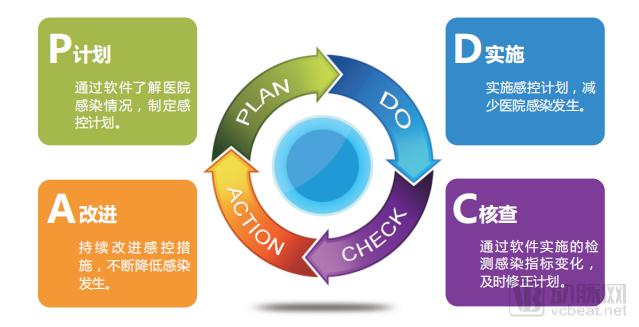
To address this issue, Lilian Cognitive has launched a clinical risk management system featuring intelligent and digital solutions. It is the first in China to be designed based on the PDCA (Plan-Do-Check-Act) methodology, enabling closed-loop control of clinical risks. The system was initially deployed in hospital-acquired infection (HAI) risk management scenarios, with an AI-based risk monitoring model serving as its core component.
Lilian’s AI Risk Monitoring Model is built on extensive clinical data, employing inductive supervised learning and ensemble learning algorithms to construct an auxiliary diagnostic model for hospital risks. Taking healthcare-associated infections (HAIs) as an example, the rules incorporated in this model mainly consist of two parts: one derived from learning patterns across large volumes of hospital infection data, and the other summarized from the empirical knowledge and expertise of HAI control departments at multiple hospitals.
The model features continuous learning capabilities, enabling it to be optimized according to the specific circumstances of different hospitals. A major advantage of employing ensemble learning algorithms in the AI risk monitoring model is its interpretability, which facilitates “evidence-based” analysis and “retrospective studies” of the results.
Meanwhile, the “new evidence” and “new rules” derived from the analysis and study of results can be incorporated into the model for further optimization, ultimately enabling sustainable learning and continuous improvement of the AI-based risk monitoring model. This model serves as an effective adjunct in hospital infection surveillance, capable of real-time identification of patients at risk of infection for prompt clinical intervention and treatment by physicians. Ultimately, it aims to reduce clinicians’ workload and prevent the onset and progression of infections.
Compared with the manual curation of infection feature values under the expert-driven development model, the Lilian AI Risk Monitoring Model is built on a large volume of real-world electronic medical record data. By leveraging feature engineering to explore and analyze infection-related features, it has identified numerous new prognostic variables, encompassing more than 300 feature values. This significantly enhances the model’s granularity and accuracy, enabling its sensitivity and specificity in infection identification to far surpass those of manual rules.
Lilian Cognitive’s Chief Medical Advisor, Cai Meiping, revealed: “In the future, in addition to continuously optimizing the AI-driven infection risk monitoring model to enhance the system’s accuracy in detecting infection events, Lilian Cognitive will also expand horizontally into the field of clinical risk monitoring by developing risk monitoring models for conditions such as deep vein thrombosis and sepsis.”
Clinical Risk Management Focuses on Prevention
In hospital clinical risk management, there is a frequently mentioned concept known as “shifting the threshold forward.” As the term implies, it involves providing early risk warnings before clinical risk events occur. However, few hospitals in China are currently capable of achieving this. This is primarily due to a lack of relevant management data, as well as insufficient analytical models and tools.
Cai Meiping believes that risk control should not be a reactive measure; rather, risk identification and prediction should commence from the initial assessment of the patient’s symptoms. By leveraging risk prediction and early warning models to promptly detect emerging signs of clinical risk events, and complementing these insights with standardized and effective preventive clinical recommendations, physicians can take timely preventive actions to minimize the probability of such events occurring.
It is reported that Lilian Cognition is currently developing a clinical risk prediction and early warning model. The AI-powered clinical risk management assistant, built upon this model, can predict the likelihood of adverse clinical events by continuously collecting and analyzing patient data before such events occur. It provides early warnings for high-risk scenarios and offers specific prevention and control recommendations to physicians, enabling them to implement effective preventive measures and reduce the incidence of adverse clinical events.
Cai Meiping stated, “This AI assistant system will serve as a supplement to the clinical risk management system, bringing new expansion opportunities to the company’s product portfolio and enabling broader adoption across more clinical departments.”
What Do Doctors Think?
The Department of Infection Control at Zhongshan Hospital, Fudan University in Shanghai, introduced products from Lilian Cognitive Science this year. Gao Xiaodong, Director of the Department of Infection Control, told VCBeat: “The main reason for purchasing this system is that hospital physicians want to understand the incidence rate of healthcare-associated infections and determine whether patients have developed infections.”
According to reports, the Infection Prevention and Control Department at Zhongshan Hospital previously relied on dedicated staff to monitor the status of each discharged patient. However, as the patient volume has increased, physicians are no longer able to individually assess every case. By leveraging Lian Cognitive’s system, doctors can rapidly and timely obtain key infection indicators and assess the likelihood of infection, thereby identifying high-risk populations.
Furthermore, hospitals need to ascertain whether clinicians adhere to established protocols when performing various diagnostic or interventional procedures, and whether appropriate tests are conducted in the event of infection. By surveying physicians, hospitals can obtain current data on test submission rates and subsequently implement regulatory oversight. Previously, such investigations were primarily conducted by doctors or nurses directly interviewing patients. With the implementation of Lilian’s system, however, healthcare facilities can leverage its integrated clinical data to rapidly identify and filter the target patient population.
In terms of prevention and early warning, the Infection Control Department can alert clinicians to implement appropriate protective measures in advance based on risk alerts generated by the system, thereby preventing healthcare-associated infections before they occur.
Taking Zhongshan Hospital of Fudan University in Shanghai as an example, the hospital currently discharges approximately 8,000 patients per month. With the implementation of the early warning system, physicians in the Infection Prevention and Control Department can reduce their workload by 60%–70%. Commenting on this, Director Gao stated, “Previously, we conducted investigations after patient discharge, which constituted a lagging management approach. Now, through the system provided by Lilian Cognitive, we have shifted infection control management to a proactive stage; as soon as clinical test results are available, the system generates early warnings.”
Hospital Infection Outbreak Early Warning: A Broader Application of the System. The Department of Infection Control at Zhongshan Hospital sets target values through the Lian Cognitive system to identify conditions under which early signs of a large-scale hospital infection outbreak may emerge, thereby preventing major adverse incidents. “This is a comprehensive system-level warning for an entire department or hospital, built upon individual patient alerts,” said Director Gao.
The Department of Infection Prevention and Control at Nanfang Hospital, Southern Medical University, is also a client of Lilian Cognitive’s products. Sun Shumei, Director of the Department of Infection Prevention and Control, commented on Lilian Cognitive’s system as follows: “Lilian’s system serves as a monitoring and intervention tool that provides real-time insights into hospital-acquired infections and high-risk factors. It enables physicians to promptly detect even subtle changes in patients’ conditions, thereby preventing the occurrence of cluster incidents.”
Furthermore, Lilian’s system is capable of dynamically identifying patterns. When patients present with multiple risk factors, physicians can leverage real-time big data monitoring and early warning systems to implement timely interventions, thereby preventing the progression into infection events.
To truly achieve refined hospital management, quantification through big data is essential. On one hand, this approach should not impose additional burdens on clinicians. As physicians’ primary responsibility remains patient care, the Infection Prevention and Control Department should not passively wait for clinicians to report incidents or rely on reactive notifications. Instead, it should leverage information technology to proactively collect data and actively support clinical practice.
According to Director Sun, current national regulations stipulate one infection control staff member per 250 hospital beds. Nanfang Hospital of Southern Medical University has 2,250 authorized beds and a total of 12 physicians in its Infection Control Management Department. “In the past, we could only conduct spot checks and were unable to achieve comprehensive monitoring. With this system, we can now leverage precise data to enable comprehensive monitoring of hospital risks,” said Director Sun.
“If I were to give a score out of 100, I would rate it 90!” Director Sun spoke highly of the Lilian Cognitive System. On one hand, she hopes that the system’s intelligent early-warning capabilities can be made more precise, further reducing the probability of false negatives or false positives. On the other hand, she expects the system’s output interface to be more concise, presenting complex information in a simplified manner to facilitate easier operation for physicians.