

Celularity Files IPO Prospectus: Unlocking Longevity Through Placental Stem Cells
“Longevity is a complex race,” said Dr. Robert Hariri, founder of Celularity. “The first step toward achieving human longevity is to eliminate the causes of premature death, and then to rejuvenate long-established bodily systems to extend human lifespan.”
Celularity is a U.S.-based biotechnology company that develops placental stem cells. The company extracts stem cells from human placentas remaining after childbirth, utilizing them to treat intractable conditions such as autoimmune and degenerative diseases, with the aim of enhancing human immunity and extending lifespan.
Pilot Leads Star Team to Take Off
Robert Hariri is the founder and CEO of Celularity. A renowned scholar in the field of regenerative medicine, he co-founded Human Longevity, Inc. with genomics pioneer Craig Venter prior to establishing Celularity.
Twelve years ago, Robert Hariri met Dr. Peter Diamandis while piloting his own jet on a 2,000-mile flight in Las Cruces, New Mexico. Dr. Diamandis is the founder of the X Prize Foundation, which awards prizes for outstanding achievements in private spaceflight. Their conversation began with aircraft propulsion and gradually shifted to biological placentas, laying the groundwork for their eventual co-founding of Celularity.
Dr. Robert Hariri was the founder and chairman of the global biopharmaceutical company Celgene, where he oversaw its cell therapy programs. In 2016, Celgene spun off its placental stem cell business, prompting Dr. Hariri to partner with Dr. Peter Diamandis to establish the spin-off company Celularity. Dedicated to leveraging placental stem cells to delay human aging, the company has adopted the slogan “extending lifespan.”

Celularity Board of Directors (Image source: official website)
In February 2018, Celularity secured $250 million in funding from Celgene, achieving unicorn status. In addition to CEO Dr. Robert Hariri and Vice Chairman of the Board Dr. Peter Diamandis, the company’s star-studded management team includes Mr. Bill Maris, former CEO of Google Ventures; Mr. John Sculley, former CEO of Apple Inc.; and Dr. Andrew Von Eschenbach, former Commissioner of the U.S. FDA.
Unlocking the Secrets of Longevity from the Placenta
Tracing back to the 1980s, when Robert Hariri was a young neurosurgeon at Cornell University, he observed during his eldest daughter’s prenatal ultrasound that the placenta was developing at a rate far exceeding that of the fetus. This led him to hypothesize that the placenta contained primitive cells capable of dividing and differentiating into other cell types: stem cells. This hypothesis was later proven correct; the placenta is indeed a stem cell factory.
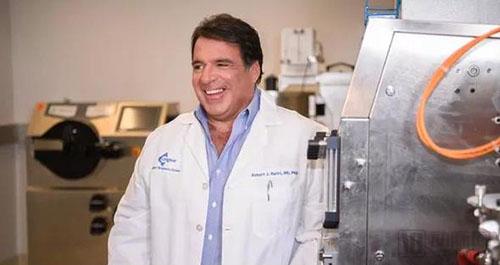
Dr. Robert Hariri (Image source: Forbes)
At the time, stem cells used for medical research were mostly derived from newborns’ umbilical cord blood, and extracting stem cells from fetal placentas faced significant ethical pressures. In 1997, Robert Hariri left Cornell University and began quietly collecting placentas to extract and reprogram their stem cells for regenerative applications. It was precisely this technology that later attracted the attention of Celgene, a pharmaceutical giant specializing in oncology. Celgene acquired the technology for $45 million, and Robert Hariri subsequently became one of Celgene’s leaders.
It has been confirmed that the efficacy of stem cells in the placenta is identical to that of stem cells in umbilical cord blood, and the quantity of stem cells in the placenta is ten times that in umbilical cord blood. However, to date, the only FDA-approved stem cell-based product utilizes stem cells derived exclusively from umbilical cord blood.
Over the next decade at Celgene, Robert Hariri leveraged placenta-derived stem cells to develop therapeutic solutions for complex diseases such as Crohn’s disease, arthritis, and stroke. Of the nine clinical trials registered for treating human diseases, four have been completed to date.
After studying these diseases, Robert Hariri discovered that many modern ailments—such as cancer, Crohn’s disease, arthritis, and Alzheimer’s disease—are in fact manifestations of a single underlying condition:Aging! And the approach to treating aging is through the use of stem cells.
Stem cells are a class of multipotent cells capable of differentiating into various functional cell types. Currently, stem cell transplantation is considered the standard of care for more than 80 diseases; for instance, the treatment of leukemia and certain rare diseases relies heavily on stem cells.
Analysis of cancer clinical data from Celgene reveals that the stem cell clusters in the bone marrow of most patients decline exponentially with age, dropping from 1 in 20,000 during infancy to 1 in 20,000,000 by the age of 80. Robert Hariri thus envisioned using stem cell injections to rejuvenate human muscle and remodel bodily organs, ultimately aiming to extend lifespan.
Clinical data also support this hypothesis: sexually mature mice that received monthly stem cell injections exhibited a 30%–40% increase in lifespan. Although murine data cannot be directly extrapolated to humans, these findings do indicate that stem cells indeed have life-extending effects, offering new possibilities for achieving human longevity in the future. Robert Hariri stated that one of the company’s goals is to make 100 years of age the new 60, and discussions centered on longevity will always remain mainstream.
Making the Most of It: These Are the Medical Uses of the Placenta
Celularity currently has more than a dozen cell therapies in the preclinical and IND-enabling stages. In addition to employing cell therapies for the treatment of various degenerative diseases, Celularity leverages placental biomaterials to manufacture transplantable and regenerative products that hold promise for restoring injured tissues. Two of its products, BIOVANCE and INTERFYL, are already on the market for the treatment of severe skin wounds and burns, demonstrating significant value in surgical and plastic surgery procedures.
Celularity is a pioneer in developing the method of regenerating entire organs and organoids from placental tissue, partnering with industry giants such as United Therapeutics to bring its organ regeneration programs to market.
Furthermore, Celularity possesses the most comprehensive umbilical cord blood and placental blood banks, providing patients with the stem cells required for daily therapeutic interventions.
These practices give the placenta a practical purpose, ensuring it is neither discarded nor consumed. Statistics show that approximately 4 million placentas are disposed of annually in U.S. hospitals. Celularity, however, maximizes their utility by purchasing these otherwise wasted placentas to fully realize their medical value.
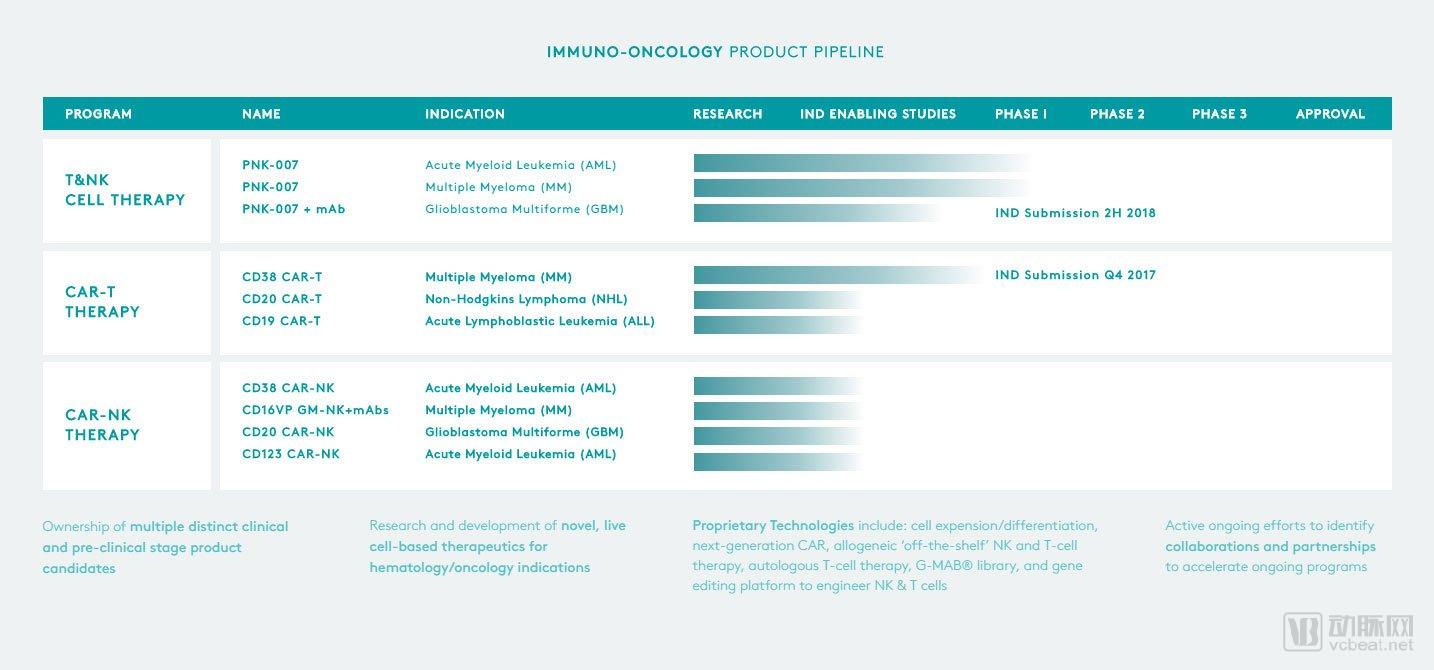
Celularity’s Cell Immunotherapy Product Pipeline (Image sourced from the official website)
It is worth noting that Celularity is attempting to combine embryonic stem cells with the currently popular CAR-T technology by replacing the immune cells used in CAR-T therapy with those differentiated from placental stem cells. This means that such CAR-T cells can be applied to all patients requiring the same type of cell line without causing immune rejection, thereby becoming an allogeneic CAR-T therapy.
Moreover, this allogeneic CAR-T cell immunotherapy holds promise as one of the approaches to reducing the cost of this technology. Currently, CAR-T therapy starts at $373,000 per patient, while Celularity is developing the world’s first off-the-shelf allogeneic CAR-T cell receptor product. The universal CAR-T cells derived from placental cells will enable the creation of standardized products that, in theory, will not trigger attacks by the patient’s own immune system. This product is awaiting FDA approval, and its post-launch treatment costs are expected to be more affordable than those of autologous CAR-T therapies.
Celularity has secured a license from Sorrento Therapeutics, a California-based biotechnology company, for 50 potential CAR-T constructs. This enables the design of cells for a broad range of immunotherapy applications, including proprietary antibodies and chimeric antigen receptor (CAR) constructs, positioning Celularity as the world’s first company to offer a portfolio of immunotherapy products targeting novel antigens in cancer and immune diseases.
In addition, Celularity has identified a type of natural killer cell derived from the placenta and is actively developing it for therapeutic applications.
However, stem cell therapy has not yet been approved in the United States, and internationally, it remains costly. In China, prices generally hover around $40,000, while placental stem cell therapy in India costs approximately $25,000, with similar costs of around $25,000 in Mexico.
Celularity’s Exclusive Advantage: Mitigating Immune Responses to Allogeneic CAR-T
In the currently booming field of cellular immunotherapy, China’s representative isNanjing Legend Biotech, the company is the first Chinese company to have its CAR-T product accepted by the CDE under the application category of "Class 1 New Drug for Therapeutic Biological Products."
Legend Biotech has opted for a CAR-T cell therapy targeting BDMA, thereby sidestepping the intense competition in the market centered on CD19 as the predominant target. However, in contrast to Celularity’s placental stem cell-derived CAR-T approach, Legend Biotech employs conventional autologous CAR-T cells, which entails substantial research and development costs. As the sole company utilizing an allogeneic placental platform, Celularity can extract stem cells from any placenta and administer them to any patient population, with theoretically no risk of immune rejection. This broadens the sources of cell supply, reduces R&D expenses, and makes treatment more affordable and readily accessible.
And a foreign company namedCellectisa biotechnology company that is a global pioneer in the adoption of allogeneic CAR-T therapy. The company has had three products approved by the FDA for clinical trials.
The most urgent challenge in using allogeneic CAR-T therapy is immune rejection. Cellectis eliminates allogeneic immune rejection by knocking out genes responsible for triggering such responses. This approach differs from Celularity’s strategy, which directly utilizes off-the-shelf allogeneic CAR-T cells derived from stem cells. Specifically, Celularity employs embryonic-derived mesenchymal stem cells (MSCs). These cells possess all the common characteristics of stem cells, and neither autologous nor allogeneic MSCs typically provoke an immune response in the host. This obviates the need for gene-knockout procedures while still achieving effective allogeneic therapeutic outcomes.
In addition to applying placental stem cells in the field of CAR-T immunotherapy, Celularity also holds a certain market share in medical aesthetics, particularly in burn treatment and cosmetic surgery. Among similar companies, those in China...Meiyin BiotechnologyFor example, the company uses genetic testing data as its foundation to provide users with advisory recommendations for beauty and fitness. This model of offering medical aesthetics services based on genetic insights is the approach adopted by most medical aesthetics institutions today.
While abroad, such as in the United States,Syneron CandelaThe company is a global leader in non-surgical aesthetic devices, offering services to improve skin appearance, including body contouring, hair removal, and wrinkle reduction. In contrast, Celularity’s placental stem cell-based aesthetic medicine services feature higher technical barriers, broader future application prospects, and are more focused on major surgical applications such as burn treatment and reconstructive surgery.
Studies have shown that throughout a person’s lifetime, stem cells are damaged by environmental exposures, leading to a gradual decline in their quantity and efficacy. This deterioration impairs the body’s self-repair capabilities and affects longevity. If we could continuously replenish our stem cell reserves, it would offer the potential to enhance immune function and extend lifespan. Notably, the placenta at birth has been recognized as the most effective tissue for stem cell extraction. Why let this valuable resource go to waste?
Although the use of placentas for medical research was once highly controversial, with societal progress, an increasing number of ethicists and physicians now consider placental stem cells to be ethically acceptable, as they are no longer needed by the newborn and have traditionally been discarded after birth. Stem cells can provide the body with a renewable source of new cells to treat many medical conditions, and effective placental stem cell therapies have been proven to significantly improve numerous health issues. Therefore, there is broad medical potential for the utilization of placental stem cells.