

JianzuBao: An Integrated Professional Platform for Rental and Sales of Rehabilitation and Assistive Devices under the Shared Economy Model of Active Aging
The “Report on the Development of China’s Medical Device Industry (2017),” released by the Chinese Society for Drug and Regulatory Science, shows that the market size of home-use medical devices reached approximately RMB 142.9 billion in 2017 and is expected to accelerate its growth in the coming years.
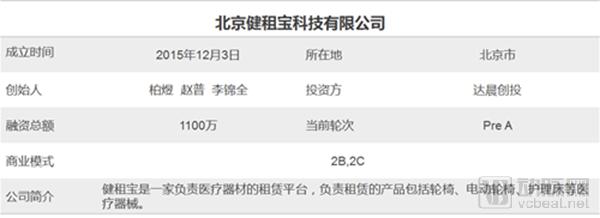
Li Jinquan, then Secretary-General of the China Medical Pharmaceutical Materials Association, identified an industry issue through extensive research. The problem was that certain products had high per-customer purchase volumes but short actual usage periods, a challenge particularly pronounced in the elderly care supplies sector. In 2015, Li Jinquan founded Jianzubao, a medical device leasing platform.
Jianzubao provides customers with comprehensive solutions linked to its products. Its core business is divided into two segments: B2C, which focuses on the professional rental and sales of rehabilitation assistive devices, along with maintenance, disinfection, and age-friendly home modifications; and B2B, which offers elderly care institutions with product supply solutions, as well as related training and consulting services.
VCBeat (WeChat: vcbeat) has learned that, to date, Jianzubao offers more than 60 types of leased equipment and nearly 1,000 products for sale, serving over 100,000 clients. Since its promotion in hospitals began this August, Jianzubao’s shared wheelchair service has expanded to more than 20 cities, partnering with over 50 hospitals.
Shared Models in the Context of Active Aging
Li Jinquan stated that leasing is not merely sales, but a series of services provided before, during, and after the lease. Customers are purchasing not just a product, but an integrated solution associated with the product.
From the initial need for assistive devices to end-of-life care, an elderly individual undergoes a gradual process of aging and frailty. During this period, it is essential to match them with appropriate devices, with specific equipment reasonably configured based on the individual’s condition. Taking wheelchairs as an example, 80–90% require proper fitting, taking into account the user’s height, weight, hip width, leg length, and seat cushion, as well as the needs for assistance and nursing care. Furthermore, the use of assistive devices requires coordinated integration; for instance, hospital beds, ventilators, and patient lifts must work in concert to provide comprehensive supportive care.
In reality, family members often purchase assistive devices arbitrarily due to a lack of professional knowledge. Given the high cost of medical devices and the prolonged use of the same product by elderly individuals, there is frequently a low degree of fit between the device and the user, coupled with a lack of follow-up maintenance and servicing. Consequently, these products are often left wasted and idle after the passing of the elderly user.
Jianzubao has selected over 20 models from hundreds of wheelchairs produced by more than 100 manufacturers, and a dozen bed models, to better meet the needs of the elderly. Additionally, the company offers customization services tailored to the specific conditions of individual seniors.
Jianzubao offers a flexible model, supporting daily rentals, monthly rentals, and outright purchases. Upon receiving an order, Jianzubao provides assessment, fitting, home delivery, and usage training, with ongoing consultation available for any issues during use. After use, assistive devices are collected from the user’s home, then cleaned, disinfected, sterilized, inspected, and maintained before being stored in the warehouse for future reuse.
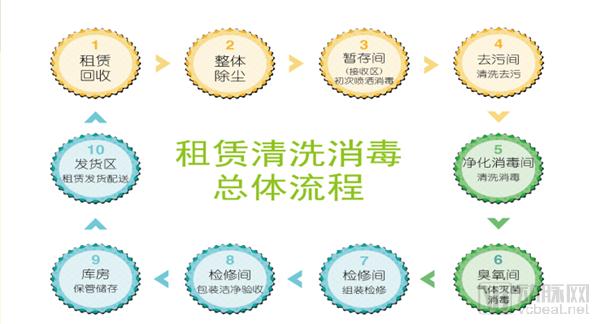
Overall Cleaning and Disinfection Process (Image source: Provided by the enterprise)
At the institutional level, a report released by the National Bureau of Statistics this September, titled “Study on Factors Influencing Occupancy Rates in Elderly Care Institutions in Beijing—Based on Census Data of Elderly Care Service Facilities in Beijing,” shows that the average occupancy rate of elderly care institutions in Beijing remains below 50%. The substantial upfront investment required for purchasing medical equipment, coupled with inadequate follow-up maintenance and repair services, has resulted in significant waste.
Jianzubao’s extensive exposure to medical devices and in-depth product knowledge enable it to assist elderly care institutions in selecting appropriate products, providing equipment based on occupancy rates, and dynamically adjusting allocations according to each resident’s specific needs. This approach not only helps care facilities reduce costs but also ensures proper cleaning and disinfection, thereby preventing cross-infection.
Notably, this August, Jianzubao launched a shared wheelchair program in hospitals. Fixed docking stations prevent disorderly placement and maintain cleanliness. Users can scan a QR code via Alipay to rent a wheelchair within 10 seconds without a deposit, leveraging their credit score. The first two hours are free, with a maximum daily rate of 30 yuan. Jianzubao provides usage guidance, regular cleaning, and maintenance to ensure the service is simple, convenient, safe, and hygienic.
Furthermore, Jianzubao also undertakes certain government-led projects, such as age-friendly home modifications.
Optimize Services, Sustain Development
Li Jinquan told reporters that, from the perspective of the entire medical device leasing sector, there are three major challenges:
First, there are conceptual issues, such as the Chinese mindset of “ownership,” filial piety, and traditional superstitions deeming certain practices “inauspicious.”
Second is the issue of cleaning and disinfection; Chinese people tend to be more “squeamish” about it, fearing that items used by others may not be clean.
Third, there are issues with the payment system (policy). It is understood that China has not yet introduced policies and regulations specifically targeting the leasing of home-use medical devices.
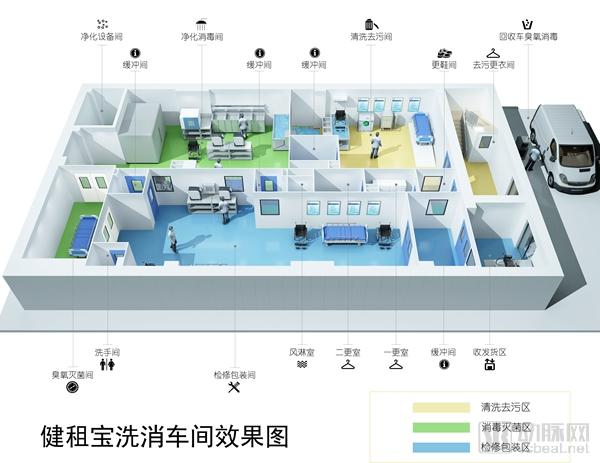
Rendering of the Decontamination Workshop (Image source: Provided by the enterprise)
In response to the aforementioned issues, Li Jinquan stated that the priority is to excel in areas within their control. Jianzubao has established large-scale centers for disassembly, cleaning, disinfection, and maintenance, each exceeding 1,000 square meters, in both Beijing and Shanghai. By introducing advanced equipment and comprehensive management protocols from Japan, and by regularly organizing visits for seniors and their family members, the company aims to ensure customer peace of mind.
In terms of policy, the State Council issued documents in 2016 to promote the development of medical equipment leasing. Regarding the payment system, several of the 15 pilot cities for long-term care insurance have already included this service within their long-term care insurance coverage. Li Jinquan stated that Jianzubao is further optimizing its services while awaiting greater consumer maturity and the introduction of more favorable policies.
Regarding market expansion, Li Jinquan stated that the consumer-facing (C-end) business primarily operates through internet channels. Jianzubao maintains dedicated storefronts on JD.com and Taobao, and has partnered with Alipay to facilitate on-demand rentals. For the business-facing (B-end) sector, Jianzubao employs a specialized sales team responsible for business promotion and expansion.
Currently, the project is undergoing Series A financing.