

Yizhun Intelligence Secures RMB 45 Million Series A Funding to Advance AI-Powered Medical Imaging Solutions

MEDICAL AI
AI-Assisted Medical Imaging Diagnosis System Developer
VCBeat (WeChat ID: vcbeat) has learned that Beijing Medical Standard Intelligent Technology Co., Ltd. (hereinafter referred to as “MEDICAL AI”) completed a RMB 45 million Series A financing round in just one and a half months, despite the increasingly cooling capital market. This round was led by Hengneng Venture Capital, with Duowei Haituo serving as the financial advisor.
Founder Lü Chenchong told reporters that after completing its Series A financing, MEDICAL AI will accelerate the research and development of new multi-disease AI imaging products, expand sales and channel partnerships, and further speed up the commercial deployment of its AI systems in hospitals. Meanwhile, MEDICAL AI is committed to leveraging artificial intelligence as a technological tool to assist physicians in reducing work pressure and improving diagnostic efficiency and quality, thereby contributing modestly to addressing issues such as the uneven distribution of medical resources and the limited accessibility of high-quality medical care in China.
During Pink October, breast cancer—the most prevalent malignancy among women—has garnered widespread societal attention. However, due to the dense glandular tissue characteristic of Asian women, X-ray imaging inherently suffers from poor contrast. Consequently, the lesion detection rate for mammography among the majority of primary care physicians is below 80%. In light of the vast patient population requiring screening and the massive volume of imaging data generated, an AI-powered solution capable of assisting physicians in enhancing the quality and efficiency of mammographic diagnosis holds significant value.
However, the development of AI products for breast imaging has not been smooth. Due to numerous technical challenges—such as deformation of glandular and lesion tissues under compression, the wide variety of lesion types, and the broad range of lesion sizes—there has yet to be a mature commercial deployment of AI for mammography.
In particular, the technical challenge of spatial registration between the craniocaudal (CC) view and the mediolateral oblique (MLO) view remains an unresolved global issue; to date, no published study has proposed an effective solution. Clinicians typically evaluate both CC and MLO images simultaneously to assess lesions and determine their benign or malignant nature, whereas AI lacks this human capacity for associative reasoning.
MEDICAL AI has deployed 12 top-tier machine learning algorithm engineers, achieving original innovations and breakthroughs in 11 algorithmic and engineering technologies. The company pioneered the globally first “dual-channel neural network model,” which successfully resolved the spatial matching problem between axial and oblique lateral views. This advancement has significantly reduced false-positive rates in detection results, with an accuracy of 94% in differentiating benign from malignant cases, reaching the level of top-tier physicians. This achievement has attracted significant attention from leading international AI research institutions, and the R&D team has been repeatedly invited to deliver keynote speeches at overseas conferences.
In addition, MEDICAL AI has collaborated extensively with top-tier experts in mammography interpretation to independently develop the “Focused Neural Network Model,” which applies a single algorithmic model to detect multiple types of lesions. Compared with single-disease, single-model approaches, this model achieves higher detection rates, lower false-positive rates, and faster processing speeds.
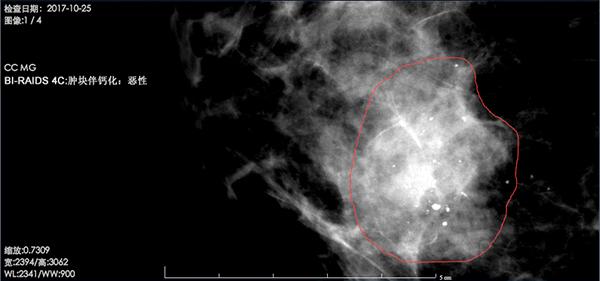
MEDICAL AI Mammography Computer-Aided Diagnosis System
In June 2018, MEDICAL AI’s first AI-based mammography detection system was installed and put into use at Peking University Cancer Hospital. Subsequently, its AI products were deployed at the Cancer Hospital of the Chinese Academy of Medical Sciences. To date, MEDICAL AI’s AI-based mammography detection system has been installed in dozens of medical institutions, receiving positive evaluations from physicians.
Currently, MEDICAL AI has achieved full-spectrum coverage of breast diseases. Its features—including a lesion detection rate exceeding 93%, BI-RADS categorization, glandular tissue type analysis, calcification count statistics, benign-malignant assessment, and calculation of lesion major/minor axes and area—are highly favored by physicians.
AI-based ultrasound detection for breast, thyroid, and other conditions also holds significant clinical value and a broad market. Currently, many ultrasound AI products extract static images from dynamic video clips for recognition and lesion detection. However, this approach does not align with the workflow of sonographers, who are accustomed to identifying lesions in real-time on the video display while maneuvering the ultrasound probe.
MEDICAL AI has assembled its most theoretically robust R&D personnel from domestic and international laboratories to conduct novel algorithmic theoretical research, employing dynamic recognition methods to accelerate the clinical implementation of AI-based breast ultrasound detection.
Meanwhile, MEDICAL AI has obtained a Class II registration certificate from the CFDA for its intelligent lung detection product.
MEDICAL AI’s intelligent pulmonary nodule detection system is highly favored by users, particularly for maintaining a low false-positive rate of fewer than two nodules per patient while achieving a high detection rate. Its exceptional performance in detecting ground-glass nodules has garnered widespread acclaim from several top-tier clients. Currently, more than ten institutions have opted to purchase the intelligent detection service on a paid basis.
In mid-November, MEDICAL AI will release the highly anticipated “Multi-Timepoint Pulmonary Nodule Follow-up Comparison Feature.” This feature leverages AI to automatically search for and extract pulmonary nodules from CT scans taken at different time points, performing extraction, comparison, and analysis of nodules in the same anatomical location. It ultimately generates volume doubling curves and density change curves for pulmonary nodules, thereby assisting physicians in monitoring morphological changes in the nodules.
Mr. Wang Wei, Managing Partner at Hanneng Venture Capital, told VCBeat: “The core algorithm team of MEDICAL AI graduated from the Department of Intelligent Science at Peking University and formed the first Asian team to win the global LUNA16 lung nodule detection challenge. They developed two AI products with excellent user reputations within just one year. Furthermore, founder Lü Chenchong worked at GE and Siemens Healthineers for over 11 years. His extensive experience in the healthcare industry has provided him with profound insights into AI medical imaging and accumulated substantial industry resources, which are key to the rapid commercialization of their products. Over the past year, MEDICAL AI made the right choices in several critical decisions and achieved remarkable overtaking maneuvers, which is precisely what attracted us to the company.”
Cheng Miaoqi, Founding Partner of AA Capital and angel investor in MEDICAL AI, has witnessed the company’s growth and rapid product breakthroughs over the past year. “AI + healthcare is one of our key focus areas. Identifying high-quality companies among the myriad of artificial intelligence enterprises is akin to finding a needle in a haystack. We dedicated more than a year to in-depth industry research before discovering MEDICAL AI. The company perfectly aligns with our criteria for ‘unicorn’ projects in the AI + healthcare sector, namely fulfilling three closed loops: algorithmic, data, and commercial. I am confident that MEDICAL AI will stand out from the competition in the coming years.”
MEDICAL AI relies on its top-tier artificial intelligence algorithm team and sales team with over a decade of deep expertise in the healthcare industry to achieve the commercial deployment of medical AI through independent innovation. The company will launch its Series B financing round in the first half of next year.