

Surgical Robots: When the Yitian Sword Remains Sheathed, Who Can Challenge for Supremacy?
Editor’s Note: The authors of this article are Zhang Ying and Zhou Weisi from the Healthcare Investment Department of GF Xinde Capital (contact information is provided at the end of the article). Republished with authorization from VCBeat.
As mechanical engineering technologies advance and the concept of precision medicine matures, surgical robots, as a key application, are attracting increasing attention from various stakeholders. The da Vinci surgical robot series, invented by Intuitive Surgical, the industry giant, has been used in over 5 million procedures worldwide, with its medical and economic value widely recognized. In China, leading universities such as Tianjin University, Harbin Institute of Technology, and Beihang University, along with their affiliated teams, have also made highly valuable attempts. After conducting in-depth due diligence on the industry and interviewing numerous experts and entrepreneurs, the author has compiled some insights and hopes to share these observations and reflections with others who are equally interested in this field.
This article mainly presents the following viewpoints:
1. China's surgical robot market has enormous potential;
2. Single-port robots and flexible robots will become important directions for research in the industry;
3. The differentiated advantages of single-port robots represent a more practical development path for the next stage of the industry.
Medical robots refer to robots used for medical procedures or assistance in healthcare institutions. Based on their applications, they can be categorized into surgical robots, medical teaching robots, nursing robots, rehabilitation assistance robots, patient transfer robots, rescue robots, pharmaceutical transport robots, and capsule robots, among others. According to data from Grand View Research, surgical robots account for the largest share of revenue in the medical robotics sector, exceeding 65%. As a paradigm of robotic applications outside the manufacturing sector, surgical robots have become a focal point of research in medicine, mechanics, automation, communications, and computer science.
Surgical robots can be categorized into two major types based on differences in their operational targets and functions: one type is designed for soft tissues (such as the heart, stomach, gallbladder, prostate, etc.), primarily addressing manipulation challenges in endoscopic minimally invasive surgeries; representative products include laparoscopic surgical robots, which are clinically applied mainly in gynecology, urology, cardiothoracic surgery, and general surgery. The other type is designed for hard tissues (long bones, pelvis, spine, cranium, etc.), primarily addressing positioning issues in minimally invasive surgeries; representative products include orthopedic surgical robots and neurosurgical robots tailored for specific specialties.
According to a survey by the authoritative research firm WinterGreen Research, the global market size for surgical robots reached $3.2 billion in 2014 and is projected to reach $20 billion by 2021, with a compound annual growth rate of approximately 30%. Although North America currently remains the largest market, emerging markets such as Asia are gradually becoming the new focal point in the future.
Taking the da Vinci Surgical System, manufactured by Intuitive Surgical, as an example, the company’s annual report indicates that a total of 4,409 units had been sold worldwide by the end of 2017, with the vast majority distributed across Europe and North America. Specifically, there were 2,862 units in the United States, 742 in Europe, and 579 in Asia. Among these, only 69 units were installed in mainland China (increasing to 73 by the end of September 2018), primarily located in top-tier tertiary hospitals such as the Chinese PLA General Hospital, Peking Union Medical College Hospital, Shanghai Changhai Hospital, and Sun Yat-sen University Cancer Center in Guangzhou.
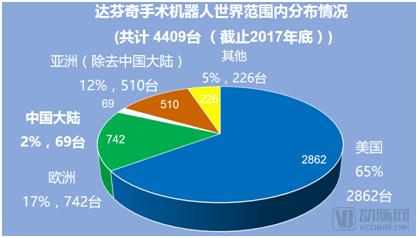
Data source: Intuitive Surgical, Inc. 2017 Annual Report
According to Intuitive Surgical’s corporate announcement, among countries where certification has been obtained, there are 4 million potential surgeries annually worldwide that can be performed using the da Vinci system (with over 5 million procedures cumulatively performed to date). Based on an estimate of 200 procedures per robot per year and a material and service fee of $1,000 per procedure, the global demand for devices would reach 20,000 units, creating a $4 billion annual market for complementary consumables and services, indicating that the market is far from saturated.
Among these, China has only one surgical robot per 20 million people, compared to 147 in the United States and 34 in Japan. In 2017, the average annual number of procedures performed per da Vinci Surgical System in China reached as high as 388, whereas the global average during the same period was only 198. From 2008 to 2016, the total volume of surgeries in China grew at a compound annual growth rate (CAGR) of 10.55% over eight years, while the number of da Vinci-assisted procedures increased by 84.48% year-over-year during the same period. This indicates that China’s surgical robot market holds substantial growth potential.
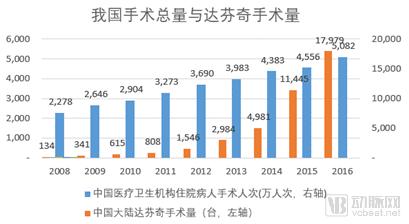
Data sources: China Health Statistics Yearbook, National Bureau of Statistics, Intuitive Surgical Annual Report
Amid rapid development, domestically produced laparoscopic surgical robots remain in the R&D phase, leaving the da Vinci system as the only option currently available for procurement in China, albeit at a prohibitively high cost. According to interviews with industry experts and data from the Chinese Government Procurement Network, the domestic price of a complete da Vinci Surgical System is approximately RMB 20 million. The robotic arms are classified as consumables, each limited to ten uses, with the replacement of a single arm costing tens of thousands of yuan. Consequently, the cost of a single da Vinci-assisted surgery in China ranges from at least RMB 50,000 to 100,000. Nevertheless, the compelling advantages of surgical robots—including 10x magnified visualization, precision and stability surpassing human manual capabilities, significantly reduced blood loss and complications, and markedly shortened postoperative recovery times—make their widespread adoption imperative. The emergence of surgical robotics enables top-tier surgeons to fully leverage their exceptional skills, performing procedures more quickly and effectively to save patients, while also empowering less experienced physicians with advanced tools that substantially enhance their operational capabilities.
Domestication of surgical robots is the optimal solution to resolve the aforementioned contradictions. On one hand, the government has introduced regulatory frameworks such as the "Special Approval Procedures for Innovative Medical Devices (Trial)" and the "Measures for Expedited Review of Medical Devices," facilitating the rapid registration of surgical robots. On the other hand, multiple national policies have promoted the research and development, manufacturing, and end-user application of surgical robots. These include the "Made in China 2025" initiative issued by the General Office of the State Council; the "13th Five-Year Plan for the Development of the Robotics Industry (2016–2020)" jointly released by the Ministry of Industry and Information Technology, the National Development and Reform Commission, and the Ministry of Finance; the "Three-Year Action Plan for Enhancing the Core Competitiveness of the Manufacturing Sector (2018–2020)" issued by the National Development and Reform Commission; and the "Notice on Issuing the Configuration Plan for Large-Scale Medical Equipment (2018–2020)" published on the official website of the National Health Commission.
Surgical robots integrate the latest advancements in medical imaging, kinematic modeling, medical device mechanism design, robotics, artificial intelligence safety algorithms, and human-computer interaction. Product development spans multiple disciplines, including electronics, robotics, precision mechanics, computer science, sensor technology, signal processing, biochemistry, clinical medicine, optics, automatic control, and ergonomics. Consequently, the development of surgical robots requires substantial capital investment and a high level of technical expertise; without sufficient technological accumulation and sustained, significant R&D expenditure, it is impossible to establish a foothold in this industry. According to Intuitive Surgical’s annual reports, its R&D expenses have consistently accounted for approximately 8% of revenue over the years, reaching as high as 10.5% in 2017.
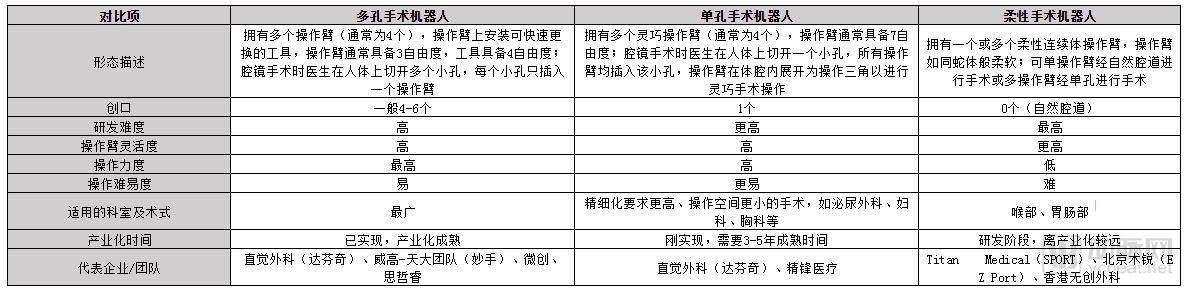
From a technical perspective, multi-port surgical robots are currently the most mature and widely applied systems. These robots leverage the principle of the "remote center of motion" to perform surgical procedures via four incisions using robotic arms. Furthermore, single-port and flexible surgical robots have also become key areas of research within the industry. A comparison of these three types of surgical robots is presented in the table below:
Compared with multi-port robots, single-port robots offer the following differentiated advantages, making them a more practical direction for the next phase of industry development:
Single-port surgical robots can further reduce surgical trauma and intraoperative blood loss, thereby decreasing the risk of surgical infections and other complications. This enhances procedural safety, shortens hospital stays, and accelerates postoperative recovery.
Compared with the complex preoperative positioning of multiple robotic arms in multi-port surgery, single-port robotic systems feature a simplified preoperative preparation process, thereby reducing anesthesia time for patients.
The operating arm of the single-port surgical robot can achieve 7 degrees of freedom for flexible manipulation in tighter spaces, enabling more precise surgical procedures;
Single-port surgical robots eliminate intraoperative collisions and interference among robotic arms, thereby enhancing surgical safety.
According to the announcement on the FDA’s official website, Intuitive Surgical received approval for its first single-port surgical robot on May 31, 2018. It is worth noting that single-port procedures impose higher requirements on the dexterity and force control of robotic arms, and there are very few principal investigators (PIs) with relevant surgical experience, which significantly increases the overall R&D difficulty. This is the primary reason why domestic developers have focused more on multi-port robots. Achieving breakthroughs in this field would undoubtedly confer a stronger competitive advantage in the market.
According to Intuitive Surgical’s prospectus and announcements, the da Vinci system initially received European CE certification in January 1999 and obtained U.S. FDA approval in July 2000. To date, Intuitive Surgical has been developing the laparoscopic surgical robot market for nearly 20 years, and it has been 12 years since the first da Vinci system entered China in 2006. The medical value of surgical robots has gained widespread recognition. However, no domestically produced laparoscopic surgical robot has yet obtained a registration certificate in China. In other fields, only surgical navigation robots, such as Tinavi’s orthopedic surgical robot (initially approved in 2010) and Huiwei Kangning’s neurosurgical surgical robot (approved in April 2018), have secured registration certificates.
At the regulatory level, domestic clinical trial protocols and product registration principles remain unclear. Based on expert interviews and publicly available data collected by the author, the following information is provided for reference:
(1) Regarding the clinical trial protocol: According to the information registered by the Miaoshou team on ClinicalTrials.gov, the U.S. clinical trial registry, their clinical trial conducted at the Third Xiangya Hospital will enroll participants into three groups: 30 cases in the Miaoshou-assisted surgery group, 30 cases in the conventional laparoscopic surgery group, and 30 cases in the da Vinci-assisted surgery group. This represents the earliest clinical protocol disclosed by a domestic company through public channels. Based on site visits, companies such as Jingfeng Medical are currently in the animal testing phase, while many other enterprises remain in the prototype design and manufacturing stage.
(2) Regarding Product Registration and Nomenclature: As terms such as “medical robot” are broadly defined and lack clarity, the National Medical Products Administration (NMPA) released on July 30 this year the draft for comments entitled “Terminology and Classification of Medical Electrical Equipment Incorporating Robotic Technology” along with the “Explanatory Notes on the Development of the Industry Standard for ‘Terminology and Classification of Medical Electrical Equipment Incorporating Robotic Technology’.” These documents provide a scientific classification and nomenclature for medical robots to regulate the market and promote industry development. The draft is expected to complete the approval process by the end of 2018, after which domestically produced laparoscopic surgical robots will have reference standards for registration and nomenclature.
(3) Regarding registration certificates for the complete system or its components: According to the 510(k) registration records of the da Vinci Surgical System, it has been registered both as an entire system (including master-slave devices, consumables, and accessories) and with consumables and accessories registered separately. The domestic product registration approach for Tinavi’s orthopedic surgical robot is very similar. Therefore, it can be inferred that laparoscopic surgical robots in China will most likely follow a parallel registration strategy involving both “complete system” and “component-based” submissions in the future.
(4) Applicable Departments: When registering surgical robots, the intended clinical departments must be specified. According to Intuitive Surgical’s annual report, urology is undoubtedly the primary choice. The rapid growth in this sector is mainly driven by the increasing volume of urological surgeries worldwide. For instance, more than two-thirds of da Vinci procedures performed outside the United States are urological surgeries, and in China, urological procedures account for as high as 45% of all da Vinci surgeries. Furthermore, the da Vinci Single-Port Surgical Robot, which recently received FDA clearance, was first approved for use in urological procedures. General surgery is another department with significant potential; currently, general surgical procedures rank second in the number of da Vinci surgeries, accounting for 29% of the total.
In practical applications, surgical robots have already demonstrated significant medical value. With the accelerating aging of the population and shifts in disease patterns, the volume of tumor-related and other surgical procedures is expected to rise further. Under the trend of tiered diagnosis and treatment, Tier 3B and Tier 2 hospitals will become the primary arenas for future surgical care, where surgical robots will serve as precise tools in surgeons’ hands, delivering higher-quality medical services to a broader patient population.
It is foreseeable that surgical robots will continue to be a focal point for technological R&D and equity investment both domestically and internationally over the next decade, entering a phase of leapfrog development.
Author:

Zhang Ying
Investment Director, Healthcare Investment Department, GF Xinde; Director, GF Capital (Hong Kong) Limited. Graduated from The Chinese University of Hong Kong and City University of Hong Kong, with eight years of experience in investment banking and private equity.
Contact: zhangyin@gf.com.cn

Zhou Weisi
Investment Manager, Healthcare Investment Department, GF Xinde; possesses two years of investment experience in the healthcare sector; graduated from the University of Illinois at Urbana-Champaign.
Contact: zhouweisi@gf.com.cn
Source:
Public Information of Intuitive Surgical and Other Related Companies
Official Website of the National Medical Products Administration, China Government Procurement Network, Official Website of the U.S. FDA, and U.S. ClinicalTrials.gov
China Health Statistical Yearbook, National Bureau of Statistics Data
Industry Enterprise Visits and Expert Interviews