

Beyond NIPT: Birth Defect Prevention Market Shifts from a Crowded Midstream to Blue-Ocean Opportunities at Both Ends
Editor’s Note: NIPT was the earliest commercially deployed gene sequencing technology. Since its inception in 2008, this sector has become a highly competitive “red ocean” market. However, only a limited number of companies have applied genetic technologies to primary and tertiary prevention. By comparison, this remains a “blue ocean” market with substantial untapped potential.
According to World Health Organization estimates, the incidence of birth defects is 6.42% in low-income countries, 5.57% in middle-income countries, and 4.72% in high-income countries worldwide. China’s incidence of birth defects is close to the average level of middle-income countries globally; however, due to its large population base, the total number of new birth defect cases each year remains substantial.
Recently, the 2018 Annual Pediatric Conference was held as scheduled, with prevention and control of birth defects being frequently discussed during the event. In China, the prevention and control of birth defects can be divided into three levels of defense: the first level is pre-conception genetic carrier screening; the second level involves a series of prenatal screenings, including serological, imaging, and genomic tests; and the third level is newborn screening.
Despite the implementation of a three-tiered defense system, approximately 900,000 newborns in China are born with birth defects each year, among which hereditary birth defects account for about 30% of the total.
Furthermore, during the neonatal period, the phenotypic features of many genetic disorders are often atypical and may not be directly observable. Although seemingly healthy, ordinary infants may still be potential carriers of genetic diseases, with phenotypes that gradually manifest during growth and development. Once the disease onset occurs, it can cause severe harm to the child’s health and impose significant suffering and burden on the family.
China’s birth defect incidence rate is close to the average level of middle-income countries worldwide; however, due to its large population base, the total number of new birth defect cases each year remains substantial.
According to data from the Sixth Conference on Birth Defect Prevention and Control, as reported by leaders of the Department of Maternal and Child Health under the National Health and Family Planning Commission in their report “Progress in Birth Defect Prevention and Control in China,” statistics from the national mortality surveillance system for children under five years of age indicate that approximately one in every five infant deaths is attributable to birth defects, with three infants dying from birth defects every hour. Birth defects have become the leading cause of infant mortality in China.
The “National Comprehensive Prevention and Control Plan for Birth Defects,” released in August 2018, stated that the prevention and control of birth defects would be integrated into all health policies. Adhering to the combination of prevention and control, a full-process service system encompassing prevention, screening, diagnosis, treatment, and rehabilitation will be improved.
Specific objectives: By 2022, the awareness rate of knowledge on prevention and control of birth defects shall reach 80%; the rate of premarital medical examinations shall reach 65%; the rate of preconception eugenic health examinations shall reach 80%; the rate of prenatal screening shall reach 70%; the screening rate for neonatal genetic metabolic diseases shall reach 98%; the neonatal hearing screening rate shall reach 90%; and the treatment rate for confirmed cases shall reach 80%.
As genetic testing can be used for the detection of hereditary diseases, it holds significant importance for the prevention of birth defects. The tertiary prevention of birth defects should prioritize key areas, promote comprehensive prevention and control measures, and advance the scientific application of genetic testing technologies in this field.
NIPT is a landmark application of genetic technology in the prevention and control of birth defects. Beyond secondary prevention, genetic technology companies are also expanding into primary and tertiary prevention.
NIPT was the earliest commercially available gene sequencing technology. Since its inception in 2008, this sector has become a highly competitive “red ocean” market. However, relatively few companies have applied genetic technologies to Tier 1 and Tier 3 prevention, making this a largely untapped “blue ocean” market by comparison.
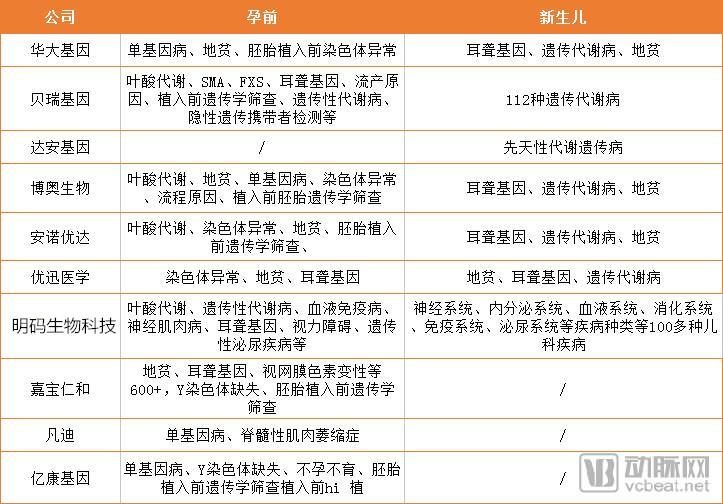
As can be seen from the table above, apart from NIPT, several industry giants have established their presence, to varying degrees, in the preconception and newborn screening sectors.
Berry Genomics first launched its chromosomal aberration detection product, Kenuoan, in 2013. In addition to prenatal testing, this product can also be used for preconception screening in individuals with a family history of chromosomal genetic disorders.
In August 2016, Berry Genomics’ “Kit for Detection of Preimplantation Embryonic Chromosomal Aneuploidy” received special approval for innovative medical devices from the China Food and Drug Administration (CFDA). The launch of this product marked Berry Genomics’ completion of its service and product portfolio for birth defect prevention and control, covering premarital and preconception care, preimplantation genetic testing, prenatal screening, and the neonatal period.
In fact, as early as 2014, Berry Genomics collaborated with the Chinese PLA General Hospital to successfully develop whole-genome testing technology for preimplantation embryos at the single-cell level, and published the findings in the Journal of Genetics and Genomics.
In 2016, Konuoan’s comprehensive solution for chromosomal disorders was fully launched, encompassing a full suite of supporting products from DNA extraction to report generation. In addition to prenatal applications, it can be used for chromosomal disorder testing in scenarios such as ruling out causes of miscarriage, investigating causes of infertility, and evaluating patients with suspected chromosomal disorders.
In addition, there are screening products such as Beicong’an and Xiexin’an (for SMA and FXS screening).
One year after the launch of NIFTY, BGI Genomics introduced a hearing loss gene screening product. By collecting a micro blood sample, this test can detect the risk of congenital, late-onset, and drug-induced deafness in newborns 5–15 days after birth. In the following years, products such as AnYunKe, AnXinKe, and thalassemia gene testing kits were successively launched, enabling BGI Genomics to progressively refine its product portfolio spanning from the preconception period to the neonatal stage.
In 2009, BioCapital developed the world’s first genetic testing kit for hereditary deafness, providing effective support for the prevention of this condition. As early as 2011, the company launched a screening program for deafness-causing genes among high-risk populations in Beijing. Subsequently, the company expanded its initiatives to Chengdu, Changzhi, Nantong, Zhengzhou, and Changchun, and further extended its reach to Shanghai, Fujian, Shandong, Yunnan, Jiangsu, Hunan, Jilin, Zhejiang, Guangdong, Anhui, Gansu, Guizhou, and Xinjiang.
It is reported that the total number of people screened nationwide using deafness gene detection chips has long exceeded 1 million.
Annoroad Gene Technology is a rising star in the field of next-generation sequencing (NGS), with scientific research services constituting a significant part of its business. In terms of product portfolio for birth defect prevention and control, in addition to non-invasive prenatal testing (NIPT), the company has launched a series of diagnostic products in recent years covering folate metabolism, deafness genes, and thalassemia, which address both pre-conception and neonatal stages. This has enabled Annoroad to establish a diversified ecosystem spanning upstream and downstream operations, integrating research and clinical applications, and extending from birth defect screening to oncology.
Uxun Medicine focuses more on clinical oncology and the prevention and control of birth defects. In addition to high-frequency tests for folate metabolism, thalassemia, and deafness genes, it has also launched prenatal checkup products, covering stages from preconception to the neonatal period, and even extending into routine prenatal examinations.
BGI Genomics is dedicated to improving human health through the application of big data in precision medicine. Previously, BGI Genomics primarily provided data services in the field of gene sequencing, collaborating with Huawei Cloud and Alibaba Cloud. Starting in 2016, the company began launching tangible products, beginning with birth defect prevention and control.
In December 2016, Mingma Biotechnology officially launched its preconception carrier screening product, “Fuma.” Fuma is a non-invasive preconception genetic screening product pioneered by Mingma Biotechnology, capable of screening for the 135 most common severe recessive genetic disorders among the Chinese population.
After nearly two years, Mingma Biotechnology has once again partnered with Shanghai Children's Hospital of Fudan University to launch "Xinma," a newborn genetic screening product. Both parties stated that the product can cover hundreds of common genetic disorders in newborns, holding promise for advancing precision medicine in China, particularly the development of tertiary prevention for neonatal genetic diseases.
From the perspectives of national strategy and market demand, these companies are riding the wave of genetic technology, aligning their efforts with the trends of the times. However, as with all high-tech industries, the journey from early-stage technology to productization and commercialization is inseparable from market support.
So, how does capital view this sector?
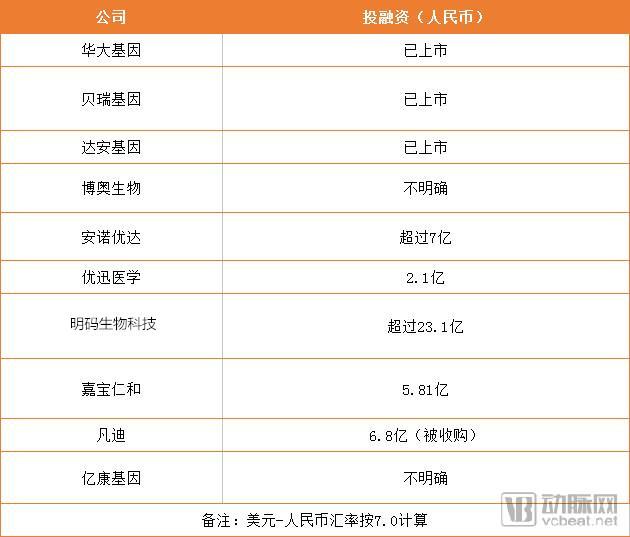
From the data, there are three listed companies here, and CapitalBio is even a Tsinghua-affiliated enterprise. The majority of BGI Genomics' revenue actually comes from products for birth defects, while Berry Genomics' early business also focused on birth defect prevention and control. Prenatal screening alone has given rise to two listed companies.
Turning to non-listed companies, Anoroad and Youxun Medical are both enterprises that have established a presence across the three-tiered defense line for birth defect prevention and control. The total financing raised by the two companies has exceeded RMB 700 million and RMB 200 million, respectively, with Anoroad’s valuation surpassing RMB 4 billion.
In contrast, Mingma Biotechnology has chosen not to compete in the crowded prenatal testing market, instead focusing on the preconception and neonatal stages. The company plans to leverage big data to support the prevention and control of birth defects. Since its establishment three years ago, it has raised $330 million in funding. Notably, in 2017 alone, the company completed two financing rounds totaling $315 million, with prominent investors including Sequoia Capital, Temasek, and Yunfeng Capital.
Additionally, Fandi Bio was acquired by Sanpower Group for RMB 680 million, setting a record at the time.
“NIPT products have made significant contributions to the prevention and control of birth defects in China,” stated Professor Zhou Wenhao, Vice President of Children’s Hospital of Fudan University. “However, given the current situation in China, relying solely on a single preventive measure is insufficient.”
Primary prevention involves carrier screening from a genetic perspective, while secondary prevention occurs during the prenatal period. Nevertheless, approximately 900,000 newborns are born with birth defects each year. Currently, certain tertiary prevention testing methods are available in clinical practice, such as tandem mass spectrometry. “However, if the issue lies at the genetic level, genetic testing technologies are required to obtain a clear diagnosis,” he added.
Professor Zhou Wenhao revealed that in developed countries, genetic factors account for 40% of deaths among children under the age of five. The more economically developed a country is, the more prominent the weight of genetics as a cause of death becomes. “This is because other issues have been overcome, while genetic problems remain,” he stated.
In August 2016, Children's Hospital of Fudan University and Genetron Health jointly established a collaborative laboratory. Two years later, the two parties jointly launched "Xinma," a neonatal genetic screening product, aiming to strengthen the final link in the prevention and control of birth defects.
“We need a positioning system to pinpoint the coordinates of diseases, so that doctors can find solutions,” he said.
But is it enough to simply have a product on the market? Although the cost of gene sequencing has dropped to sufficiently low levels, tumor detection products currently available on the market commonly carry price tags of tens of thousands of yuan or more.
“As physicians, we hope that products can be clinically helpful—rapid, precise, and affordable.” When asked what types of products are needed in clinical practice, Professor Zhou Wenhao responded in this manner. He believes that diagnostic products must be sufficiently rapid to meet the demands of clinical decision-making; meanwhile, they must be sufficiently precise, yielding unambiguous results. Equally important is that a product should have broad applicability and be priced low enough.
“We hope to develop a product akin to a complete blood count (CBC) test, enabling patients to achieve effective outcomes at minimal cost,” he continued.
Indeed, from a technical standpoint, the application of genetic testing in clinical diagnostics is already quite mature. However, to achieve widespread clinical adoption, factors such as cost, accuracy, operational feasibility, and scalability will determine whether a product and its company can stand out.
How can this be achieved? We further reviewed the recent developments of several leading enterprises and found that big data may offer a viable pathway.
Yuan Jianzhong, General Manager of Mingma Biotechnology, told VCBeat that the prototype of Xinma’s first-generation product required testing of more than 3,000 loci. After large-scale clinical validation, they reduced the number of tested loci to 300, while still covering more than 100 diseases. “By avoiding unnecessary tests, costs are naturally reduced,” he said.
In addition to Mingma Biotechnology, other companies are also pursuing big data initiatives. Since 2016, Berry Genomics has launched the Shenzhou Data Cloud project, completing the construction of the world’s first genomic database for the Chinese population, thereby filling the gap in international genetic databases regarding population-specific genomic data from China. In 2017, after its initial public offering, Berry Genomics further invested in building a big data industrial park in Fujian Province. Centered on a big data repository of pathogenic gene information specific to the Chinese population, this industrial park leverages technologies such as cloud computing, gene sequencing, gene editing, and artificial intelligence to establish an ecosystem encompassing four key sectors: industry, academia, research, and capital.
“This is a market that we believe is emerging.” This was Zhou Daixing’s assessment of the big data industry in an interview. He believes that current genetic big data remains fragmented and has not yet become an integral part of the industrial chain. However, he emphasized that, judging by current trends, enhanced data processing and storage capabilities will become essential foundations for the next stage of competition in the industry.
For Mingma Biotechnology, in addition to the iterative upgrades of its testing products, another important application of genetic big data lies in new drug development.
Not all diseases can be resolved even after their etiologies are identified. For unmet medical needs, the accumulated data can provide critical guidance for pharmaceutical companies in new drug development. Mingma Biotech itself offers a wide range of data solutions.
Yuan Jianzhong told VCBeat that during clinical trials of drugs, it is common for clinical outcomes to fall short of expectations. This is actually due to patient sample selection; clinical enrollment has considered only phenotypic characteristics, while overlooking genetic differences among patients with the same disease. The incorporation of genomic big data enables reclassification of patients at the genetic level, and when combined with proteomics and clinical phenotypes, can enhance the effectiveness of new drug development.
Similarly, the development of drug targets relies primarily on molecular diagnostic technologies, and a large volume of clinical samples can provide direction for pharmaceutical companies in new drug development.
We often say that children are the flowers of our nation, yet for some of these “flowers,” their growth is accompanied by the torment of illness. “Eugenics and better childrearing” is a fundamental national policy in China, and to improve population quality, both the state and enterprises have made tremendous efforts.
However, as Professor Zhou Wenhao pointed out, once other issues are addressed, genetic factors come to the forefront. In future efforts to prevent and control birth defects, addressing genetic defects may become the top priority.