

Galimedix Therapeutics Files IPO Prospectus for GAL-101 Ophthalmic Solution Targeting Glaucoma and Dry AMD
New in vitro studies demonstrate that MRZ-99030, a small molecule developed by Galimedix Therapeutics, can inhibit the regeneration of misfolded Aβ, thereby reducing neurosynaptic toxicity.
Public data from international ophthalmology NGOs reveal that in 2020, there were approximately 80 million glaucoma patients and around 170 million patients with dry age-related macular degeneration (AMD) worldwide, representing a market size worth tens of billions of dollars. Currently, the only available treatments for glaucoma are therapies and medications aimed at lowering intraocular pressure (IOP), while no approved effective treatments exist for dry AMD.
Galimedix Therapeutics (hereinafter referred to as “Galimedix”) is developing a product that delivers the small-molecule compound MRZ-99030 directly to the retina via eye drops, potentially protecting the optic nerve to treat degenerative diseases such as glaucoma and dry age-related macular degeneration (AMD).
At the recent Global Neuroscience Conference held in San Diego, USA, Galimedix announced its latest research findings: the compound under investigation, MRZ-99030 (also known as GAL-101), can sustainably prevent the aggregation of misfolded amyloid-beta molecules into toxic species in vitro and inhibit their neurotoxicity.
Christopher Parsons, Ph.D. in Neuropharmacology and Co-founder of Galimedix, stated: Although the toxic oligomers of beta-amyloid have long been proven to play a significant role in the progression of ophthalmic diseases, including glaucoma and dry age-related macular degeneration, the research findings presented at this neuroscience conference indicate that:
Even at a thousand-fold dilution below the predicted therapeutic level, MRZ-99030 can inhibit the formation of these toxic oligomers and even reverse their toxic effects by rapidly capturing misfolded proteins and converting them into harmless “speckles,” continuing to work even after drug levels drop below the minimum threshold. In clinical applications, this could prevent or reverse disease progression, representing a groundbreaking advancement.
In this study, MRZ-99030 was shown to rapidly clear toxic molecules into harmless “spots,” preventing further cytotoxic effects and ameliorating neurological deficits caused by toxic levels of misfolded amyloid-beta. It was also demonstrated to be safe in animal and in vitro models, as well as in 70 patients enrolled in a Phase I clinical trial.
The “spots” were collected and resuspended in solution to maintain the original concentration of misfolded amyloid-beta. MRZ-99030 was diluted 10-fold and was still found to block cellular toxicity and reverse the deficits. After four serial dilutions, reaching a 1,000-fold dilution, misfolded amyloid-beta retained its original level of toxicity. Currently, GAL-101 is being prepared for Phase 2 studies in glaucoma and dry age-related macular degeneration (AMD).
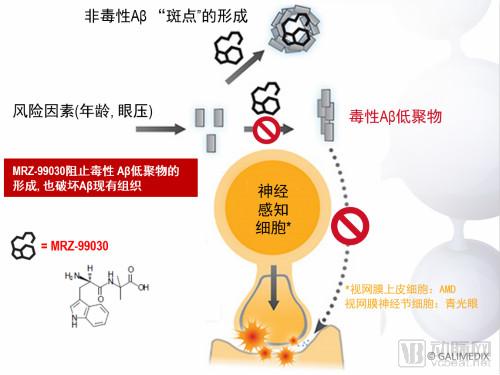
Dr. Andrew Pearlman, CEO and Founder of Galimedix, added, “GAL-101 eye drops help to continuously prevent the formation of toxic amyloid-beta oligomers and gradually clear the pathogen. These results have been demonstrated in animal studies. As indicated by the ‘Hot Topic Poster’ at this neuroscience conference, GAL-101 may reduce neurological deficits and improve function.”
About MRZ-99030/GAL-101
MRZ-99030 (now GAL-101) is a patented compound designed to prevent the formation of various toxic amyloid-beta oligomers. By binding with high affinity to misfolded (but not normally folded) amyloid-beta monomers before they form toxic soluble oligomers, it rapidly aggregates them into amorphous, non-beta-sheet structures known as “speckles.” These “speckles” are harmless and are believed to be cleared via circulation.
“Spots,” once formed, recruit additional misfolded amyloid-beta monomers through a self-propagating mechanism, even in the absence of extra GAL-101 molecules. This novel “trigger effect,” protected by Galimedix’s patent portfolio, results in a duration of drug action that far exceeds the retention time of the active ingredient in the retina after a single administration, thereby enabling convenient, sustained dosing intervals for patients.
About Galimedix
Headquartered in the United States and Israel, Galimedix is a Phase II clinical-stage ophthalmic pharmaceutical company. It has developed a novel patented small-molecule drug with a new mechanism of action (MOA) for treating glaucoma and dry age-related macular degeneration (AMD). Administered as eye drops, this therapy offers significant advantages in safety and patient compliance compared to conventional intravitreal injections. Eye drops are commonly used to deliver steroids and other small molecules, such as GAL-101, for retinal diseases.
Studies using Galimedix eye drops in monkeys (a model more closely resembling humans) demonstrated that drug molecule delivery to the retina was 30 times higher than the predicted therapeutic dose. Efficacy data from relevant animal models of GAL-101 eye drops show a reduction in ganglion cell death by over 90%. The compound has garnered support from leading experts in the fields of glaucoma and dry age-related macular degeneration (AMD), who also endorse the company’s proposed Phase II clinical trial protocol.
Due to changes in the management of the German pharmaceutical company Merz and its exit strategy from neuroscience, Merz returned the patent to Tel Aviv University in Israel, and the Galimedix team subsequently obtained an exclusive license from Tel Aviv University. Meanwhile, core members of Merz’s team who developed the compound joined Galimedix (or collaborated with it). The patent license also covers the treatment of retinal and other central nervous system (CNS) diseases.
Note: This article is authorized by the company and was first published in China.