

Soyoung Releases 2018 Double 11 Medical Aesthetics Consumption City Rankings: Chengdu Leads in Growth, Beijing Tops in Liposuction and Hair Transplant Spending
In recent years, the book *Danshari* (The Life-Changing Magic of Tidying Up) became a bestseller, and platforms like Xianyu emerged, leading some to worry that China is entering a low-desire society and that its economy will lose vitality.
In fact, consumers who refrain from purchasing appliances, clothing, and decorative items may simply wish to avoid further cluttering their homes with material goods, opting instead for experiential consumption such as gaming equipment, travel and vacations, medical aesthetics, and sports and wellness. While material possessions do not increase, their physical and mental well-being is enriched.
Addressing the widespread interest in what consumers upgrading their spending habits purchased during the Double 11 shopping festival, SoYoung, the world’s leading internet-based medical aesthetics platform, released the “2018 Double 11 Medical Aesthetics Consumption City Ranking” on November 12, 2018.
It is reported that during the Double 11 shopping festival, thousands of medical aesthetic institutions participated in SoYoung’s Double 11 campaign, offering discounts and cashback on tens of thousands of medical aesthetic procedures. The event attracted nearly ten million users to “spectate” and “stock up,” further highlighting the trend of medical aesthetics becoming an integral part of everyday lifestyle.
The list highlights five major trends in medical aesthetics consumption:
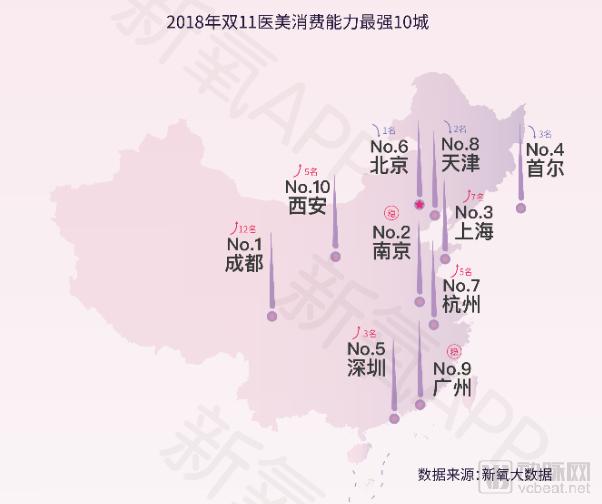
First, Beijing, Shanghai, Guangzhou, Shenzhen, and Chengdu are relatively mature markets for medical aesthetics, with Chengdu exhibiting rapid growth and strong momentum.
Chengdu is a special case. This year, Chengdu leaped from being off last year’s list to taking the top spot, surpassing Seoul, thanks to strong support from the Chengdu municipal government. The Chengdu government has high hopes for the development of the medical aesthetics industry and has proposed a strategic plan to establish Chengdu as the “Capital of Medical Aesthetics,” aiming to make medical aesthetics the city’s second name card (the first being pandas). In 2018, it introduced a series of supportive policies to attract talent and investment.
As is well known, high-end medical aesthetic procedures are tied to authoritative physicians and accredited institutions, meaning that such resources are limited. The investments made by the Chengdu municipal government are beginning to yield results.
The development of the medical aesthetics industry in Beijing, Shanghai, Guangzhou, and Shenzhen follows an inevitable trajectory: externally aligning with global trends, while internally driven by rising incomes and greater acceptance of emerging innovations.
Second, the post-90s generation is beginning to enter early aging, spending more on anti-aging treatments. This trend is led by users in first-tier cities and is showing signs of spreading.
According to New Oxygen’s big data, during the Double 11 shopping festival, accredited medical institutions across China sold a total of 60,000 early anti-aging treatments, including picosecond laser, Thermage, and Ultherapy. Assuming a physician performs one treatment every 30 minutes around the clock, it would take 1,253 days to complete this volume.
This phenomenon is driven by the fact that individuals born in the 1990s constitute the primary demographic for cosmetic and plastic surgery. As this cohort enters their thirties, they possess greater financial capacity and exhibit a stronger demand for anti-aging treatments.
Third, three of the top ten most expensive medical aesthetic procedures are related to fat. Users in cities with the highest preference for liposuction are distributed across Beijing, Shanghai, and Guangzhou, with Beijing recording the highest expenditure.
Obesity is positively correlated with stress; therefore, a map showing the proportion of liposuction consumption across cities could also be interpreted as a map of urban stress distribution, with Beijing, Shanghai, and Guangzhou undoubtedly emerging as high-stress zones.
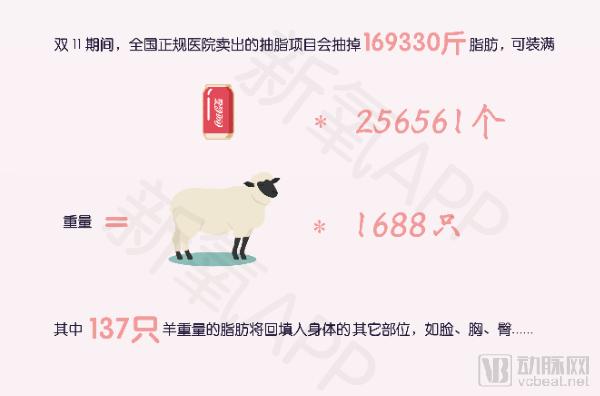
According to New Oxygen’s big data, during the Double 11 shopping festival, liposuction procedures performed at certified hospitals across China removed a total of 84,665 kilograms of fat—enough to fill 256,561 soda cans and equivalent in weight to 1,688 sheep.
Then, the fat harvested from 137 sheep was reinjected into other areas of the body, such as the face, chest, and buttocks.
The cities with the highest repurchase rates are Shenzhen, Nanjing, Shanghai, and Guangzhou.
Fourth, hair transplantation has become the most popular high-cost medical aesthetic procedure, with the highest expenditures evenly split between Beijing in the north and Guangzhou in the south.
According to New Oxygen’s big data, during the Double 11 shopping festival, accredited hospitals across China sold 13,300 hair transplant procedures. If each hair follicle is likened to a rice seedling, the total number of grafts would be sufficient to plant a rice paddy covering an area equivalent to 124 standard football fields.
Fifth, medical aesthetics transforms lives; consumers generally experience an outward-to-inward transformation after undergoing cosmetic procedures, leading to increased self-confidence.
According to the “2018 Report on Chinese Women’s Self-Confidence,” jointly released by Southern Weekly and So-Young, Chinese women tend to lack self-confidence, Chinese men exhibit an enigmatic overconfidence, and Chinese women who undergo cosmetic procedures are more confident. Cosmetic surgery has become one of the eight major ways for Chinese women to boost their self-confidence, with other methods including reading, exercise, and fashion.
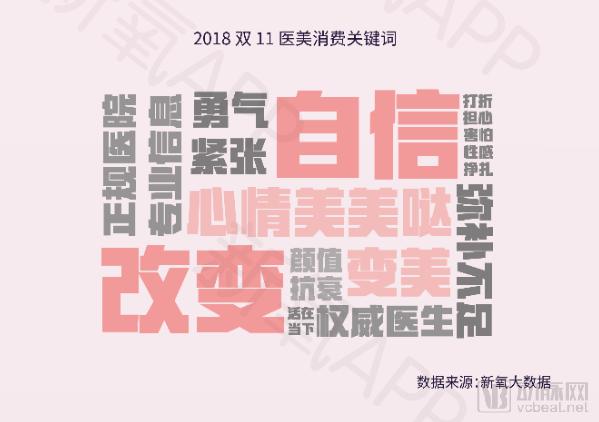
The “2018 Double 11 Medical Aesthetics Consumption City Ranking” presents a typical user profile that can be depicted as follows:
A girl born in 1991 moved to Beijing or Guangzhou for work upon graduating from university. Having only herself to rely on, she approached life with great seriousness. She worked hard, saved money methodically, and consistently pursued self-improvement. Staying up late became a routine, mostly for work, sometimes for reading, and occasionally for socializing with friends at bars or nightclubs.
On a typical workday, she often spends 12 hours in the office, with 10 of those hours seated at her desk. Her mind reaches out to various people and places through the internet. Meals are frequently sourced from convenience stores or food delivery services. To save on rent, she lives far from her workplace, commuting two hours daily by subway. By the time she returns home, she is usually exhausted.
And so, by 2018, as she approached the age of 30, despite having a stable income, she was still drifting alone in a city. Was this the life she truly wanted? With no time for exercise, she began to gain weight.
Due to staying up late and anxiety, her hair volume has dwindled to two-thirds of what it was at graduation. Looking at herself in the mirror, she was startled to find the word “greasy” coming to mind. Determined to change, she aimed to erase the fine lines on her face and restore her receding hairline. She decided to dip into her savings of over 100,000 yuan to undergo liposuction, hair transplantation, and thread lifting.
She has long been interested in medical aesthetics, having previously tried mesotherapy injections and botulinum toxin. However, these treatments can no longer preserve her youth, and she now looks forward to the transformed version of herself shaped by a physician.

These post-90s young adults in first-tier cities have become the main force driving medical aesthetics consumption. They earn a lot and spend a lot; one can’t help but feel for these urban dwellers in top-tier cities.
Yet, in cities with less life pressure, is there no demand for medical aesthetic consumption? People everywhere age, and the pursuit of eternal youth has been a universal aspiration for millennia. According to public reports, China’s beauty industry has become the fifth largest consumer hotspot, following real estate, automobiles, tourism, and electronics and communications.
Note: VCBeat will continue to provide in-depth analysis of New Oxygen’s “2018 Double 11 Medical Aesthetics Consumption City Ranking.”