

AI Empowers Millions of Grassroots Doctors: WeDoctor, Harvard, and Zhejiang University Launch '21st Century Barefoot Doctor' Platform
China’s Million Primary-Care Physicians Gain an AI Assistant.
On November 9, at the press conference of the 5th World Internet Conference, WeDoctor, in collaboration with the Harvard T.H. Chan School of Public Health (hereinafter referred to as “Harvard Chan School”) and the Zhejiang University Ruiyi Artificial Intelligence Research Center, unveiled the “21st Century Barefoot Doctors” strategy and platform.
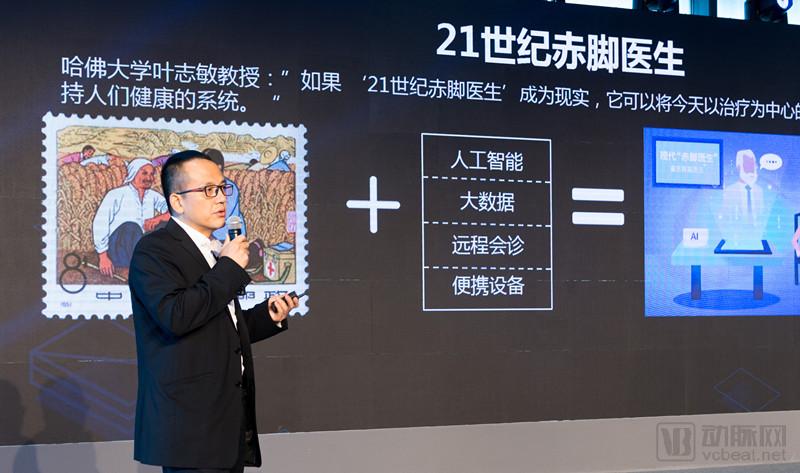
“The 21st-Century Barefoot Doctor” Strategy and Platform Unveiled at the 5th World Internet Conference; Mr. He Yaoping of WeDoctor Cloud’s Intelligent Cloud Division Delivers Keynote Address
Establishing a tiered diagnosis and treatment system is a crucial component of deepening healthcare reform, with enhancing the capacity of primary care services being key. Primary care physicians, exemplified by the "barefoot doctors," represent a universal healthcare model that is deeply rooted in and trusted by local communities. Data shows that by the end of 2017, China had 1.8 general practitioners per 10,000 people, whereas the international standard ranges from 5 to 6. Meanwhile, physicians at tertiary hospitals handled an average of 7.9 patient visits per day, compared to only 5.7 for those at primary hospitals. In this context, there is an urgent need to increase both the number and service capabilities of primary care physicians.
Recently, the ninth collective study session of the Political Bureau of the Communist Party of China Central Committee emphasized the need to strengthen the in-depth application of artificial intelligence (AI) in fields such as education and healthcare, and to innovate intelligent service systems. Leveraging new technologies like AI to effectively support primary-care physicians and improve service quality has become a key means of promoting the tiered diagnosis and treatment model characterized by “initial consultation at the primary level, two-way referral, separate management of acute and chronic conditions, and coordination between upper- and lower-level medical institutions.”
How to Address the Challenges of Weak Primary Care and Health Management in China: Professor Ye Zhimin from the Harvard T.H. Chan School of Public Health Proposes the “21st Century Barefoot Doctor” Model, Which Integrates the Low-Cost, High-Impact, Practical, and China-Appropriate “Barefoot Doctor Model” with Information Technologies Represented by Artificial Intelligence, Big Data, and Portable Medical Devices.
“The Barefoot Doctors of the 21st Century” Have Five Major Functions:
First is the initial consultation, which can effectively fulfill the role of a gatekeeper;
Second is triage, ensuring reasonable and timely triage arrangements;
Third is definitive diagnosis, enabling accurate diagnostic determination;
Fourth, high-quality treatment can be provided based on a confirmed diagnosis;
Fifth is health and rehabilitation management, which can manage common diseases among the general public and provide rehabilitation management for patients referred down from higher-level hospitals. “If the ‘21st-century barefoot doctors’ concept can be realized, it can facilitate a shift in the healthcare model from disease treatment to prevention, maintenance, and improvement of population health,” said Professor Ye.
“The greatest value of artificial intelligence lies not in learning from and replacing top experts, but in transmitting their expertise ‘across the network’ to primary care settings, thereby improving the quality of grassroots healthcare services and benefiting a broader population,” said Liao Jieyuan, Founder and CEO of WeDoctor. He noted that the most significant application scenario for intelligent healthcare in China is at the primary care level. The “21st-Century Barefoot Doctors” initiative will be based on family doctor contract services, innovating primary care service models to comprehensively empower grassroots facilities. This will enable primary care physicians to leverage technological conveniences, effectively enhance their service capabilities and standards, and promote the establishment of a tiered diagnosis and treatment system.
The Harvard T.H. Chan School of Public Health has long been committed to educational, research, and knowledge exchanges with China, boasting extensive experience in health policy and China’s healthcare reform. The Ruiyi AI Research Center at Zhejiang University leverages the university’s technological strengths in medical artificial intelligence (AI) and serves as an open-service platform for medical AI with independent Chinese intellectual property rights. WeDoctor is a globally leading healthcare technology platform. Together, these three parties will jointly promote the implementation of the “21st-Century Barefoot Doctor” model at the grassroots level in China, thereby supporting the achievement of the goal of “universal access to basic medical services” under China’s healthcare reform.