

Scarless Circular mRNA Emerges as Core Pillar of Next-Generation RNA Therapeutics: Fudan Team’s Breakthrough Platform Attracts Global Interest

Byterna therapeutics
CAR-T Cell Therapy Researcher

December 29, 2025
eMedClub News

Scarless Design:
Cracking the Core Bottleneck of In Vivo CAR-T
In the field of CAR-T cell therapy, balancing safety and durability has always been a major challenge. Addressing this issue, the research team focused on the natural advantages of circular RNA—its closed-loop structure lacks free ends, making it resistant to nuclease degradation and exhibiting lower immunogenicity.
However, traditional circular mRNA synthesis often leaves residual linear fragments or extra sequences.("Scar"), these additional sequences may induce unpredictable immune responses while increasing the complexity of large-scale production.
To this end, the team developed the PIE cyclization technology by optimizing the arrangement order of introns-exons.Enables RNA to spontaneously circularize post-transcriptionally by utilizing the cell's own splicing machinery., achieving precise splicing while alsoWill not introduce any extra bases. The advantage of this design is that it maintains the high cyclization efficiency of the PIE system(Nearly 90%), and has truly achieved"Zero Scars"cmRNA。
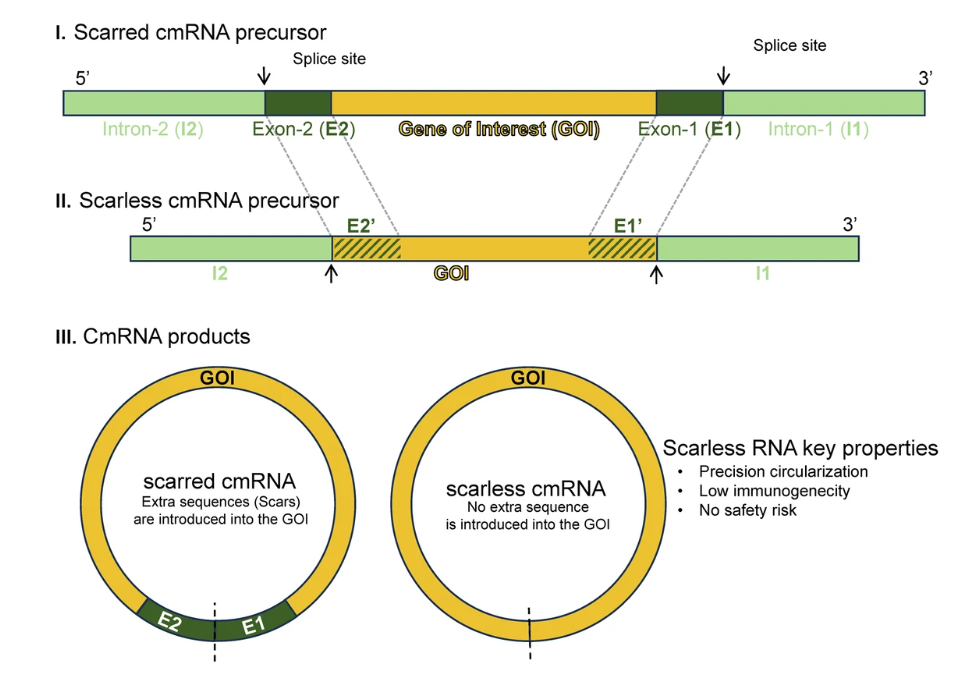
▲ Efficient Synthesis of "Traceless" cmRNA through PIE-Based Engineering Strategies
In vitro study results show that, compared with linear mRNA, scarless cmRNA exhibits more persistent protein expression and CAR-driven efficacy.
Stability:In HEK-293T cells, the half-life of cmRNA protein expression is approximately 4.5 days.(Linear mRNA is 2.5 days); In primary human T cells, cmRNA-driven CAR expression peaked one day after transfection, remained stable for two days, and then gradually decreased.Total expression window approximately 7 days(Linear group peaks at 6 hours and then rapidly decreases, undetectable within 4 days)。
Functional Activity:cmRNA CAR-T Exhibits Superior In Vitro Antitumor Activity —— Three to four days post-transfection, the cytotoxicity of the linear group significantly decreased, while the cmRNA group maintained potent cytotoxicity with higher clearance rates for tumor cells such as NALM-6, Raji, and MM.1S; the levels of effector cytokines like interferon γ, tumor necrosis factor α, and interleukin 2 released during co-culture were significantly higher in the cmRNA group compared to the linear group.
In vivo experiments, via lipid nanoparticles(LNP)The scarless cmRNA expression in the package can last for 14 days, andThe expression level was significantly higher on the 3rd day after injection compared to cmRNA with scars.。
Efficacy Advantages:In B-cell lymphoma and multiple myeloma mouse xenograft models, the peripheral blood persistence of cmRNA CAR-T was significantly longer than that of the linear group, significantly reducing tumor burden, prolonging survival, and maintaining stable body weight. Under multi-dose administration, its tumor clearance effect was comparable to that of lentivirus-transduced CAR-T.
Safety Advantages:In the lentivirus group, serum interleukin-6 and granulocyte colony-stimulating factor levels significantly increased 3-7 days after infusion, while no such phenomenon was observed in the cmRNA group, suggesting a reduction in inflammatory toxicity; in a single infusion, the efficacy of cmRNA CAR-T was superior to that of the linear group and the scarred cmRNA group.Higher 35-day survival rate(Lentivirus group persists longer, but cmRNA group shows significant advantages)。
Overall, this study constructs a high-yield and seamless cmRNA synthesis platform and demonstrates through proof-of-concept that cmRNA CAR-T cell therapy based on this technology has potentially better anti-tumor effects, providing a new strategy for the development of next-generation CAR-T therapies.
Global Core Player Progress
In the past year, circular RNA technology has rapidly moved from the laboratory to clinical applications. From tumor vaccines to in vivo CAR, from dry mouth syndrome to heart disease, cancer, and autoimmune diseases, circular RNA technology has now fully entered the clinical validation phase.
Biotech companies in and out of China have engaged in fierce competition on this track. Among them,RiboX(Transcript Biologics)、Huanma Biotech、Yuanmi Biotech、Orna、OrbitalPioneering companies like Byterna Therapeutics have advanced relevant pipelines to early clinical stages or are about to enter clinical trials.Xianbo Biotech, Giselle BiotechNumerous companies such as these have also begun to make their mark. The technological approaches and indications of these key players exhibit significant differentiation in their strategic layouts.
Orna By MIT(MIT)Founded by scientists Alex Wesselhoeft, Daneil Anderson, and others, it is one of the leading companies in the circular RNA field and has received strategic investments from several companies, including Kite (a subsidiary of Gilead), BMS, Novartis, and Merck.
Orna's core innovation in circular RNA technology lies in the "self-circularizing RNA" platform, effectively addressing the issue of circularization purity. This technology achieves this throughBionic Cyclase Enables Closed-loop Without Exogenous Sequence Residues, capable of generating ultra-long RNA(>5,000 nt), with cyclization efficiency >90%, significantly enhancing translation stability(Half-life extended more than 10 times)Based on this circular RNA technology and LNP platform, Orna has established multiple preclinical pipelines. Among them, the CD19 panCAR project is the most advanced, with plans to enter clinical trials in 2026. This project can simultaneously reprogram T cells, NK cells, and Mac cells into CAR-T, CAR-NK, and CAR-Mac within the body.
In addition, Orna has an in vivo panCAR targeting BCMA/CD19, and Simcere Pharmaceutical/Simbiology has the rights to this program in China.
RingCode BioThe two founders, Professor Wang Zefeng and Dr. Yang Yun, are the earliest discoverers of the translation function of circular RNA globally. Based on this achievement, Huanma Bio was established in 2018 and becameThe First in ChinaStartups Securing Funding with Circular RNA Technology。
The circular RNA technology of Byterna Therapeutics achieves a core breakthrough in cyclization preparation without exogenous sequence residues, throughBionic Ribozyme Self-Cleavage Strategy Enables Efficient and Pure Long-Chain RNA Cyclization(Support 500bp and above), significantly enhancing stability and prolonging protein expression. HM2002 is a circular RNA drug specifically designed for the treatment of ischemic heart disease. It received clinical trial approval from the NMPA in January and from the FDA in May this year. This product is alsoThe world's first to receive dual approval from China and the U.S.Circular RNA Drugs Entering Clinical Trials.
CircleBioIt was founded by Professor Weiwensheng from Peking University. Professor Wei's team has developed two novel RNA in vitro cyclization technologies—PIET and CIRC. Among them, PIET is a two-component RNA cyclization system that can control cyclization efficiency by adjusting the component ratio; while the CIRC method completely eliminates the need for intron splitting and modification, allowing for direct...Circularization Using Multiple Natural Full-Length Introns, and this method breaks through the loading capacity limitation of the circular RNA platform,First Successful Cyclization of 12,206 nt RNA Encoding 427 kDa Full-Length Dystrophin, and achieved the expression of the full-length protein in cells.
Based on the company's circular RNA technology, Byterna Therapeutics has developed a therapeutic cancer vaccine for treating HPV16-positive advanced recurrent or metastatic solid tumors. This vaccine is also the world’s first circular RNA drug to enter clinical research in the field of cancer treatment.
Conclusion
From the "scarless" cmRNA platform developed by Fudai University and Byterna Therapeutics, to the clinical/preclinical progress of multiple companies in China and abroad, and to the multi-billion-dollar acquisition deals by MNCs such as BMS, circular RNA technology is attracting increasing attention and investment.
With the deepening of basic research and continuous breakthroughs in technical bottlenecks, circular RNA is expected to play a significant role in multiple disease areas. Its technological value will be more comprehensively validated in real-world applications, with the potential to truly become a core pillar of the next generation of RNA therapies.
Editor-in-Chief | Xuan Xiao
Proofread by | Xuan Xiao
References:
1.https://www.nature.com/articles/s41392-025-02512-4

Exciting Live Broadcast Preview
Press and hold to scan the QR code to participate immediately ↓
Recommendation 1
December 30, 15:00-16:00
New Breakthrough in Tumor Immunology: Automation Technology Advances the Industrialization of DC Cells


DianDian "Share”、“Like" and "In View”
Give me a recharge~