

Google Makes a Big Move in Healthcare: Launches Google Health, Integrates DeepMind Health, and Appoints Industry Veteran David Feinberg

DeepMind
Artificial Intelligence Enterprises
Yesterday (November 14), Google made a major move in the healthcare sector by establishing Google Health and integrating DeepMind’s health division—the team behind AlphaGo, which defeated multiple world Go champions—into the new entity.
Last week, Google recruited David Feinberg from Geisinger as the new head of its Healthcare Strategy division.
With the addition of top-tier talent and the integration of the world’s most powerful AI capabilities yesterday, Google appears poised to go all-out in the healthcare sector.
VCBeat (WeChat: vcbeat)It has been reported that on November 14 (Beijing Time), DeepMind announced that its health division, DeepMind Health, along with the team responsible for advancing “Streams” (a mobile app designed to help physicians more rapidly identify and diagnose patient conditions), would be reorganized and merged into Google’s newly established “Google Health” division. The former subsidiary, DeepMind Health, will no longer exist as an independent brand; however, other divisions of DeepMind will remain independent.
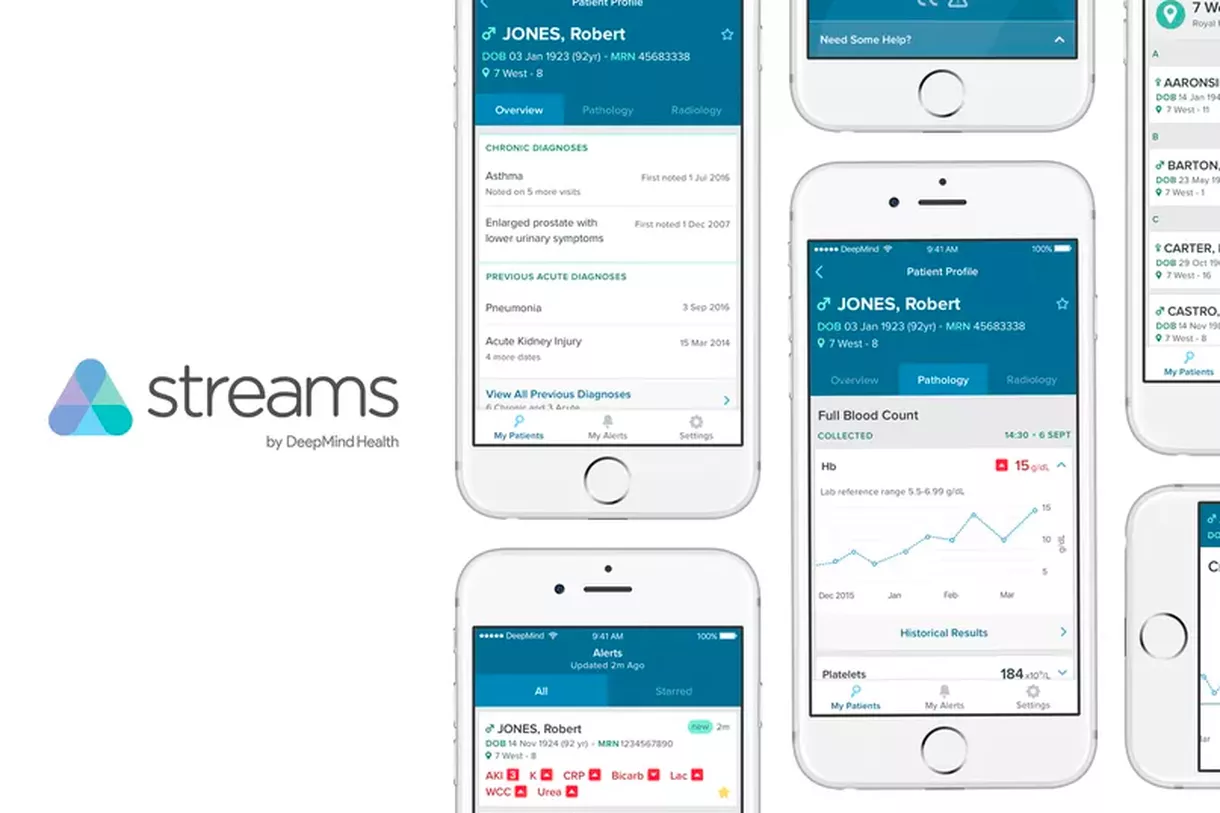
Streams Application
DeepMind’s founders stated that this would be an “important milestone” for the company, helping to transform its Streams application into an “AI assistant nurse and aide.” Physicians “combine optimal algorithms with intuitive design.” Currently, the Streams application is being piloted in the UK to assist healthcare professionals in managing patient care.
What does it mean for DeepMind Health, which possesses leading algorithms in the AI field, to be integrated into Google Health? How will new leadership and the merger of DeepMind Health influence Google’s next steps in healthcare development?
In this article, we will present to you:
1. How Impressive Is DeepMind, and Its Ties to Google
2. DeepMind’s Work in the Healthcare Sector
3. Why Google Chose Medical Luminary David Feinberg
4. Potential Changes in Google’s Healthcare Strategy
The No. 1 Tier in the Field of AI Research
For those unfamiliar with AI, “DeepMind” may be an obscure term, but “AlphaGo” is widely recognized. AlphaGo’s historic victory over world-class Go player Lee Sedol in 2016 has become virtually synonymous with the dawn of the AI revolution. Developed by the DeepMind team, AlphaGo propelled DeepMind to prominence in the field of artificial intelligence.
DeepMind, founded in 2010 and headquartered in London, UK, employs over 700 staff members. Its research focuses on developing general-purpose self-learning algorithms. In 2014, it was acquired by Google at a lightning-fast pace for £400 million. Facebook was also a competitor in the bidding for this deal.
As the engine of artificial intelligence technology, algorithms are primarily used for computation, data analysis, and automated reasoning. According to the China Artificial Intelligence Industry White Paper published by Deloitte, the United States currently boasts the most advanced level of AI algorithm development. From academic research at universities to corporate algorithm R&D, the U.S. holds an absolute advantage.
According to an analysis compiled by New Zhiyuan at the beginning of last year, which assessed the AI capabilities of tech giants such as Google, Microsoft, Facebook, and IBM, a research engineer from Google Brain ranked these companies’ AI strengths in a Quora response, citing recent examples (such as ICLR paper acceptances). This assessment aligns with Yann LeCun’s earlier comments on which company possesses the strongest AI. DeepMind is regarded as the No. 1 player in AI research among technology companies, owing to its leadership in the volume and breadth of published papers, as well as its talent pipeline.
The reason given in the text is that,DeepMind’s published papers are highly regarded in the research community, covering a broad range of fields including deep reinforcement learning, Bayesian neural networks, robotics, and transfer learning.. Within a team of 700, members weekly update academic papers detailing their work progress and latest achievements.
Furthermore,DeepMind boasts a top-tier AI research team, having recruited extensively from the University of Oxford and the University of Cambridge, the two leading institutions for ML research in Europe.Meanwhile, a diverse team is dedicated to general AI research, including software engineers who specialize in building infrastructure and tools, UX designers who help design research tools, and even ecologists such as Drew Purves, who focus on other domains, such as the relationship between ecology and intelligence.
Generally, the weakness of technical teams lies in marketing and market outreach. However, DeepMind’s public relations efforts during AlphaGo’s victory and its influence on news websites are considered second to none. Whenever DeepMind publishes a paper, its latest research findings appear at the top of the machine learning section of Reddit, the fourth-most-visited news site globally by traffic, as well as on Hacker News, which tracks the latest technological developments. This demonstrates the high level of recognition it enjoys within the technical community.
The “Monetization Woes” of Star Projects
In the field of AI, there is a widespread gap between research achievements and commercialization.,Not even DeepMind, with its leading algorithms, is an exception.Although it was a flagship project, prior to its integration, DeepMind faced severe losses, staff attrition, and an existential crisis of potentially being abandoned by Google, despite its glamorous exterior.
According to data released by the UK government in October 2017, DeepMind incurred a loss of £123.5 million (approximately $162 million) in 2016. Although its parent company, Alphabet, reported a total profit of $19 billion in the same year, $162 million is still a substantial amount.
DeepMind also incurred £41.1 million in “management service fees,” covering real estate and the operation and maintenance of computer systems. The largest expenditure, however, was on “employee salaries and other related costs.” DeepMind spent £104.7 million ($137 million) on salaries, travel, and office hardware and software, more than double the previous year’s £44.2 million.
Moreover, DeepMind’s legal costs have also surged, rising from £144,881 in 2015 to £658,144. Foreign media speculate that this sharp increase may be linked to the revelation that DeepMind had illegally held health data of UK residents.
According to the latest financial report submitted in 2018, DeepMind’s losses continued to widen in 2017.
In 2017, DeepMind incurred a loss of £302 million, equivalent to RMB 2.7 billion. This figure represented a year-on-year increase of 221%.During the same period, DeepMind’s employee costs surged significantly. A rough estimate puts the company’s average annual salary per employee at RMB 2.5 million.
DeepMind and Google’s “Reconciliation”
In 2014, after Google acquired DeepMind for £400 million, it held ownership of the then-little-known company for only one year.
According to details reported by Zhidx, after the acquisition was completed, DeepMind prominently displayed on its website in large font: “DeepMind is happy to be part of Google.” By 2015, however, this slogan had been changed to “DeepMind is happy to join the Google team.”
In 2016, the new DeepMind website went live, with all traces of the “Google” branding removed. On its “About Us” page, DeepMind merely stated that it was part of Alphabet, Google’s parent company. According to a report published by the Financial Times this June, Alphabet has begun to question the rationale behind DeepMind’s heavy cash burn and is urging the company to clarify its business model as soon as possible.
This may be why DeepMind is willing to integrate its health business under Google Health: after all, it can develop research for commercial use. It is also because of this that, after the relationship with Google weakened in recent years, this merger can be seen as a return to Google's embrace.
DeepMind, an AI-focused company, entered the healthcare sector in 2016. On February 24, 2016, DeepMind announced the establishment of its DeepMind Health division, which would collaborate with the UK’s National Health Service (NHS). Its long-term goal is to provide tools for clinical nurses, physicians, and specialist consultants to help them deliver world-class medical care, support clinical decision-making, and improve efficiency by saving time.
In addition to the Streams application, DeepMind’s medical research achievements over the past three years have also included AI-based detection of eye diseases, scanning for head and neck cancers, and prediction of kidney injury.
AI Detection of Ocular Diseases
According to a report by New Zhiyuan, DeepMind published a landmark medical AI research study in Nature Medicine in August. Its AI system can rapidly diagnose results from eye scans in routine clinical practice, identifying more than 50 types of eye diseases with accuracy comparable to, or even surpassing, that of ophthalmology experts.
In tests conducted on scan images from 997 patients, DeepMind’s algorithm outperformed eight retinal specialists at Moorfields Eye Hospital in the accuracy of referral recommendations. The error rate for DeepMind’s algorithm was 5.5%, whereas the error rates for the eight human specialists ranged from 6.7% to 24.1%. When provided with patients’ background information, the human specialists’ error rates decreased to a range of 5.5% to 13.1%, yielding results comparable to or slightly inferior to those of the AI.
Assisting Physicians in Developing Treatment Plans for Head and Neck Cancer
In August 2016, DeepMind collaborated with researchers from University College London’s Institute of Ophthalmology to conduct joint research. Prior to this, Google’s DeepMind had been granted access to the medical data of approximately 1.6 million patients within the UK’s National Health Service (NHS).
Physicians typically spend considerable time devising appropriate treatment plans for head and neck cancers, as these involve critical anatomical structures. Prior to radiotherapy, clinicians must meticulously prepare the treatment plan to avoid damaging surrounding tissues during delivery. DeepMind states that physicians require at least four hours for this preparation, and it aims to leverage machine learning to automate portions of the process, reducing the preparation time to one hour.
Dr. Yen-Ching Chang of UCL Medical School stated that this technology will help free up more time for doctors, allowing them to focus on other areas such as patient care, scientific research, and teaching. DeepMind hopes that radiotherapy algorithms will gradually be applied to other cancer treatments.
Research on AI Diagnosis of Breast Cancer
In November 2017, DeepMind announced a new collaborative research initiative aimed at using AI to diagnose breast cancer. For this project, DeepMind will partner with multiple medical research institutions led by Cancer Research UK. The primary objective is to apply machine learning to mammography, a routine screening method for breast cancer, in order to enhance its sensitivity and accuracy. DeepMind aims to develop machine learning models capable of rapidly and accurately identifying cancerous features in X-ray images, thereby assisting physicians in achieving early diagnosis and initiating treatment promptly.
Predicting Kidney Injury
In February 2018, DeepMind established a medical research partnership with the U.S. Department of Veterans Affairs (VA). DeepMind will analyze approximately 700,000 anonymized medical records to identify patterns that could be used to detect cases of acute kidney injury, determine common clinical indicators, and assess whether machine learning can accurately identify risk factors for patient deterioration and correctly predict its onset.
DeepMind's Investment
Furthermore, DeepMind acquired the UK healthcare startup Hark, which had previously developed task management applications for clinicians. By leveraging its proprietary deep learning algorithms, Hark replaced traditional paper medical records, sticky notes, and fax machines, thereby improving efficiency by 37%. Following the acquisition, Hark was integrated into the DeepMind Health division.
In September 2016, DeepMind participated in the Series A funding round of the London-based startup Babylon Health. Babylon Health has developed an AI-powered diagnostic platform that interacts with users to understand their specific symptoms and provides health assessments along with recommendations for healthy behaviors. For instance, when users describe their symptoms or physical condition to the system, the artificial intelligence generates personalized health assessments based on its analysis and offers advice on whether to seek hospital care or purchase over-the-counter medication. Currently, the company serves more than 1.4 million users across Europe, Asia, Africa, and other regions.
In both investments, DeepMind targeted companies capable of enhancing the experience of patients or physicians, further affirming its vision to serve patients and clinicians worldwide.
The original DeepMind blog post stated, “We are delighted to play our part in this journey at DeepMind and Google, serving patients and clinicians around the world.”
Furthermore, regarding its integration into Google, DeepMind also provided some outlooks on the direction of artificial intelligence research and applications:
“As a research institution, DeepMind will continue to conduct fundamental health research in collaboration with academia, the NHS, and other partners. When we achieve promising results with the potential for scalable impact, we will work closely with Google’s Streams and translational research teams to explore how these research insights can be applied in clinical settings.”
“In the coming years, we expect artificial intelligence to help scientists achieve transformative advances in a wide range of areas, from protein folding to image analysis, thereby potentially improving medical diagnosis, drug discovery, and more.”
As indicated in the DeepMind blog, DeepMind may leverage its leading algorithms to assist Google in the research, development, and application of AI in frontier areas of healthcare, such as assisted diagnosis and drug discovery.
“He is the only person qualified to lead Google’s healthcare initiatives.”
Google Welcomes Medical Experts: News First Reported by The Wall Street Journal on November 9According to The Wall Street Journal, David Feinberg, CEO and President of Geisinger Health System, headquartered in Danville, Pennsylvania, will head Google’s newly established healthcare division, Google Health, reporting directly to Jeff Dean, Google’s head of AI.
Several months ago, Google had already begun the search and interview process for candidates in its healthcare division, with Jeff Dean serving as a key advisor. At that time, Dr. Feinberg’s competitors also included leaders from Google Health Consulting, hospital management, and health insurance companies.

Dr. David Feinberg
Since 1994, David Feinberg has been deeply engaged in neuropsychiatry and has made significant achievements in hospital management, healthcare, and patient safety. Additionally, during his tenure, he launched Springboard Health, a population health initiative aimed at improving the health status of the entire community. Among his notable accomplishments, the most renowned is likely the introduction of Geisinger’s ProvenExperience program, which allows patients to request a refund if they are dissatisfied with Geisinger’s services.
It is precisely the ProvenExperience program that has improved the overall care process. Historically, Geisinger’s reputation has been built on transforming the way healthcare is delivered. Therefore, this initiative is also regarded as a move that will reshape the healthcare industry.
David Feinberg was named one of the Most Influential People in Healthcare, Most Influential Physician Executives and Leaders by Modern Healthcare for two consecutive years. (In 2018, Modern Healthcare was widely recognized across the United States as the leading business publication in the healthcare sector.) Since 2012, he has also been listed among the “Physician Leaders” by Becker’s Hospital Review.
Scott Becker, publisher of Becker’s Healthcare and a partner at McGuireWoods, described him as “a highly talented leader and physician” and stated that “he is the only person qualified to lead Google’s healthcare initiatives.”
Some argue that, compared with other divisions of the company, DeepMind Health has pursued more direct and practical applications, which may explain why it was the first initiative targeted by Dr. Feinberg upon assuming office.
According to CNBC, insiders say that Google is expected to leverage David Feinberg’s expertise to guide its entry into the healthcare sector. Compared with other divisions at DeepMind, the work already undertaken by DeepMind Health is more direct and practical, which may have been what attracted David Feinberg, who became the new CEO of Google Health last week.
Newly Established Google Health Integrates Healthcare Projects
Following the establishment of Google Health, Feinberg’s new mandate is to reorganize Google’s fragmented internal healthcare and medical projects.such as the core Search division, Cloud business unit, AI research division Google Brain, Nest home automation division, and Google Fit wearable devices division, and potentially even Alphabet’s healthcare segment.
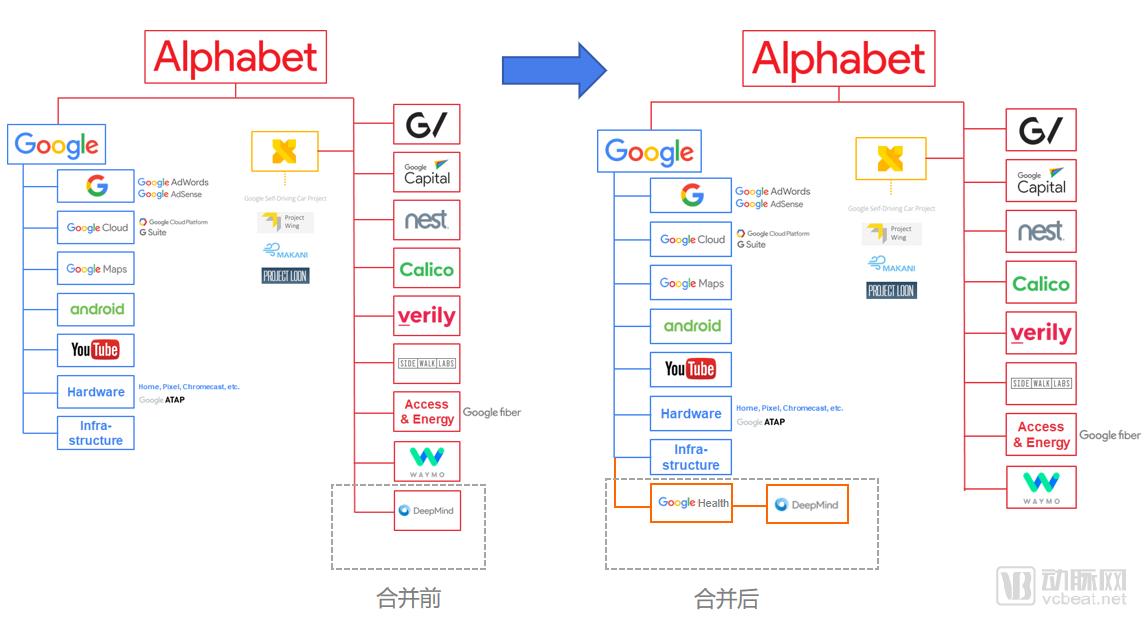
Google’s Segment Changes Before and After the DeepMind Merger (Data Source: CB Insights; Graphic by VCBeat)
Within Alphabet’s various divisions, Verily, DeepMind, and Google Ventures are the three primary units focused on healthcare businesses.
Verily
Verily is the Alphabet subsidiary that houses most of its healthcare operations. The company focuses on improving healthcare through data-driven analytics, interventions, and research.
Verily was founded by Andrew Conrad, who is also the founder of the National Human Genome Research Institute. This subsidiary primarily focuses on collaborating with existing healthcare institutions to identify areas for AI application. Its Study Watch—a wearable device that captures biometric data and is currently awaiting FDA approval—has become central to many of the research initiatives discussed below.
Verily has recently increased its investments in startups by establishing a laboratory space for companies such as Fronome and Culture Robotics. Verily also announced its international expansion through an $800 million investment from Temasek Holdings, Singapore’s sovereign wealth fund, leveraging this capital to invest as a limited partner in the European investment firm Medixci Ventures.
Calico
Calico focuses on researching and combating aging and age-related diseases. The subsidiary uses AI to understand large datasets while automating laboratory processes. Calico is led by former Genentech CEO Arthur Levinson.
Google Ventures(GV)
GV invests across various sectors, including consumer, health, data and AI, robotics and hardware, but has been accelerating its investment pace in healthcare companies in recent years.
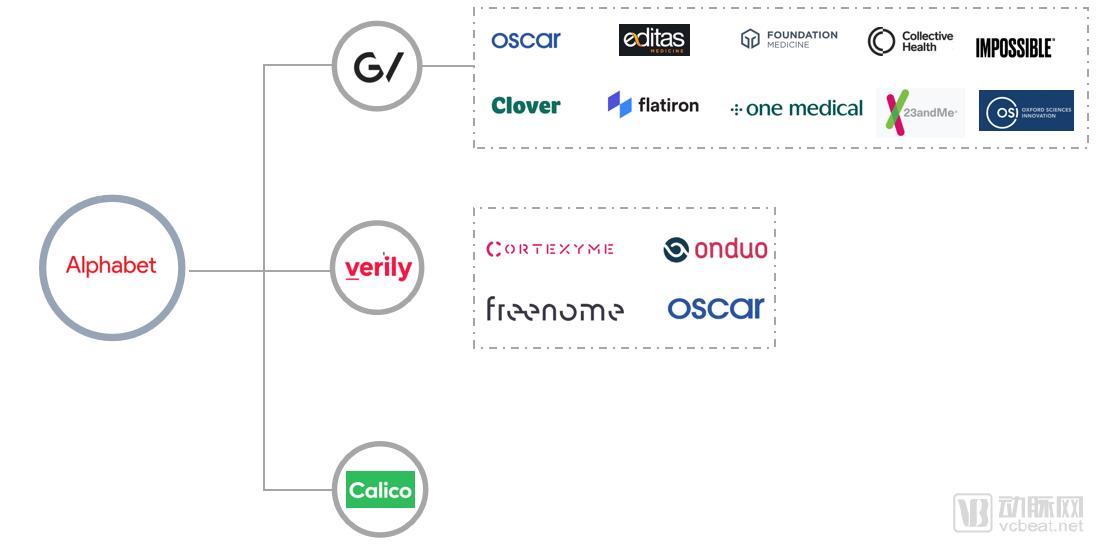
DeepMind’s Return to Google: Alphabet’s Healthcare Segment (Data Source: Public Information; Graphic by VCBeat)
With Google’s AI chief Jeff Dean handpicking Dr. Feinberg to head its healthcare division and the merger with DeepMind Health, it is evident that Google aims to more closely integrate its healthcare operations with its technology.
With Feinberg’s appointment at Google, this high-profile leadership change has raised a common industry question: Where might Google head in the healthcare sector?
In the article “Why Did Google Hire Geisinger CEO Dr. David Feinberg?” published on the Forbes website on November 10, it was boldly predicted thatNext, Google is likely to seize the following five opportunities in the healthcare sector:
1. Promoting Family Health
Before joining Geisinger, Dr. Feinberg served as CEO of UCLA Hospital and has long been an advocate for bringing healthcare facilities into the home. Additionally, CNBC previously reported that Nest had established an internal health team to help manage users’ health conditions at home and monitor seniors who choose to live independently. The Nest home automation product line, ranging from digital doorbells to thermostats and home security systems, is designed to place Google at the center of American households and power daily life.
2. Addressing Healthcare Challenges Through Transportation
Google was an early innovator in autonomous vehicles. While there have been latecomers that have surpassed it, healthcare may represent an intriguing avenue for the company to re-enter this space. Dr. Feinberg once pointed out, “20% of life-or-death outcomes depend on access to excellent physicians and high-quality hospitals. A larger proportion of health is determined by social environments, clean food, and transportation...”
3. Leveraging Big Data to Combat Diseases
An increasing number of U.S. healthcare providers are leveraging big data to improve patient health outcomes. Meanwhile, patients are relying on the internet. Today, 43% of consumers report that the internet is their preferred source for health-related information (with only 14% citing physicians). Google’s applications—from Maps and Drive to Gmail and Chrome—connect people to vital sources of information. Each application learns through algorithmic data and, increasingly, through machine learning.
At Geisinger Health System, technology enables close monitoring of every patient within its 3-million-person service area. Google, with its advantages in data and information services, can also draw lessons from this approach.
4. Invent the Next Generation of Wearable Devices and Trackers
Through Google Fit, the company is striving to expand its market share in the lucrative fitness and health wearables market, but it still lags behind competitors such as Fitbit.
As a former health system CEO, Dr. Feinberg has established connections with medical experts across China who can develop these algorithms, help address regulatory issues, and create such products. If these devices enable patients to receive timely treatment with fewer visits, insurers may be willing to pay for this technology—a benefit that few wearable devices on the market currently offer.
5. Become the World Leader in AI
In the healthcare sector, Google has made significant strides in developing software capable of diagnosing radiological images and skin lesions, often with greater accuracy than human clinicians.
Google has launched dozens of partnerships to expand the use of AI in hospitals and diagnostic facilities.
There are three challenges to introducing AI into healthcare. First, relatively few patients have all their medical information stored in a single, comprehensive EHR system. Second, most EHRs are structured for billing and administrative purposes rather than for healthcare delivery, which is why EHR data are rarely used to correlate clinical outcomes. Third, even organizations that maintain such data are reluctant to share it with companies like Google. With his extensive experience in physician operations and strong relationships with health systems, Dr. Feinberg may once again be able to facilitate this process.
In April this year, VCBeat previously compiled CB Insights’ report on Google’s AI strategy in healthcare (see “A Comprehensive Analysis of the Current State and Trends in Google’s Medical AI: Three Subsidiaries Under Its Umbrella, Primarily Targeting Five Categories of Diseases》)。
Currently, Google’s medical initiatives primarily target ophthalmic diseases, diabetes, heart disease, Parkinson’s disease, and multiple sclerosis (MS). These efforts encompass data generation, disease detection, and disease/lifestyle management, with the majority of these projects being carried out by Verily, another subsidiary of Alphabet.
CB Insights believes that Google’s most promising areas for success lie in enhancing capabilities for detection, classification, and disease management planning, particularly in surgical applications involving imaging technologies for conditions such as ophthalmic diseases and cancer. This aligns with DeepMind’s research findings. Furthermore, following the integration of the Streams app team, Google’s next steps will involve closer collaboration with physicians and nurses.
For tech companies, it is evident that opportunities in the healthcare sector are growing. In the UK, where Streams and DeepMind Health operate, Health Secretary Matt Hancock has openly expressed his enthusiasm for digital health applications—from briefings to portfolio investments—and almost immediately prioritized technology within his agenda for the NHS. This presents a commercialization opportunity for DeepMind Health.
Furthermore, one concern raised by foreign media regarding this merger is that handing over the Streams app team to Google appears to contradict statements DeepMind made in July 2016, after it was found to have illegally held UK patients’ health information: “DeepMind operates independently from Google, and we have made clear from the outset that patient data will not be linked or associated with Google accounts, products, or services at any stage.”
Perhaps the key issue Google needs to focus on next is data privacy. After all, for a company whose search engine constitutes a major business segment, consumer trust in Google’s ability to safeguard personal data privacy is paramount.
References:
https://deepmind.com/blog/scaling-streams-google/
https://www.forbes.com/sites/robertpearl/2018/11/10/google/#5462579e42c0
https://www.cnbc.com/2018/11/08/google-hires-geisinger-ceo-david-feinberg-to-oversee-health.html
http://www.im2maker.com/news/20170216/cea7233847196e72.html
https://www.cbinsights.com/research/report/google-strategy-healthcare/
https://www.forbes.com/sites/robertpearl/2018/11/10/google/#5462579e42c0
New Intelligence: DeepMind’s Business Dismantled, Google’s New Healthcare Chief Makes Another Move