

Building High-Quality, Standardized Healthcare Big Data with openEHR: Insights from ZICT and Infinitt
“Standardization is the prerequisite, security is the safeguard, and service delivery is the ultimate goal in the application and development of big data in health and healthcare.”
In recent years, with the continuous advancement of the "Healthy China 2030" initiative, China's medical informatics industry has developed rapidly, accumulating vast and valuable healthcare data resources. The critical role of health and medical big data as a foundational strategic national resource has become increasingly prominent. In the future, as China's health and medical big data experiences explosive growth, the establishment of data standardization will become paramount.
To explore how to build high-quality, standardized medical big data and develop application services for such data through the openEHR international open standard, thereby unleashing the benefits of big data applications via information standardization, the Medical Software Branch and the Smart and Mobile Healthcare Branch of the China Association of Medical Device Industry recently successfully held a special thematic forum on “openEHR Standards and Medical Big Data” at the 6th China Smart Health and Medical Development Summit Forum in Shenzhen.
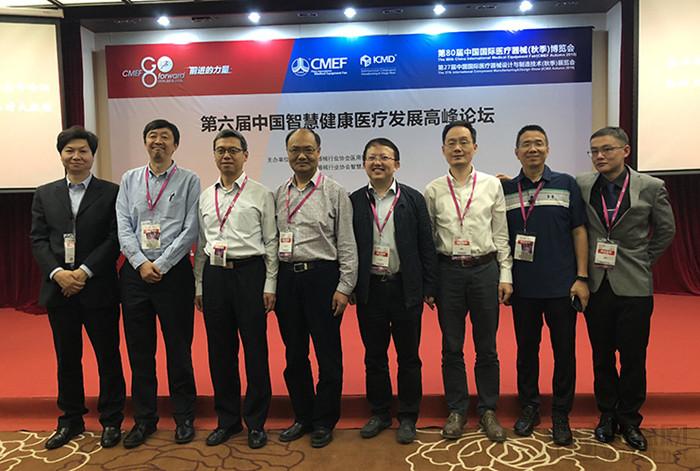
This forum brought together more than 300 experts in medical information standardization from across China, as well as entrepreneurs and investors in the medical informatics industry. Centered on the theme of “openEHR Standards and Medical Big Data,” participants discussed and shared insights on current hot topics in the field of medical information standardization from various levels and perspectives.
So, what is openEHR? Professor Lu Xudong from Zhejiang University, serving as the moderator and opening speaker of this forum, provided a detailed introduction to the specifics of openEHR and its application and development in China, including the openEHR Standard Technology Special Committee, modeling efforts across various subdomains, and case studies.
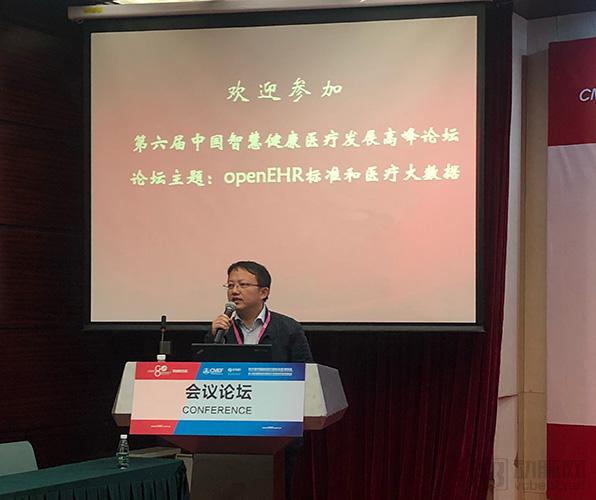
Professor Lü Xudong, Zhejiang University
The openEHR specification is an open electronic health record standard developed by the openEHR Foundation. Its core principle lies in separating medical domain knowledge from specific clinical information, establishing a two-layer model comprising a Reference Model and an Archetype Model. Through this two-layer modeling approach, openEHR enables domain experts to participate in the design and implementation of information systems by defining domain models, thereby achieving the goal of “putting domain experts in the driver’s seat.” This effectively reduces the dependence of information systems on domain knowledge, allowing systems built on openEHR to adapt to changes in domain knowledge while offering features such as reusability, scalability, and ease of maintenance.
openEHR has been widely adopted in Europe, Australia, Japan, and other countries and regions. It was accepted by the International Organization for Standardization in 2008 and developed into the ISO 13606-2 standard. To date, national electronic health record data centers in many European countries have adopted this standard, and Japan’s newly launched national electronic health record data center project in 2015 also plans to adopt it.
Although openEHR, as an international standard, has been extensively researched and applied worldwide, accumulating a certain number of archetypes and templates, these archetypes and templates cannot be directly applied to clinical practice in China. There is an urgent need to extend and localize them according to China’s clinical requirements.
Professor Lu Xudong stated that a platform for open, multi-institutional collaborative participation in standards development, tailored to the local Chinese context, has been put into use. Currently in China, an increasing number of healthcare IT vendors and some institutions are beginning to understand and adopt this standard.
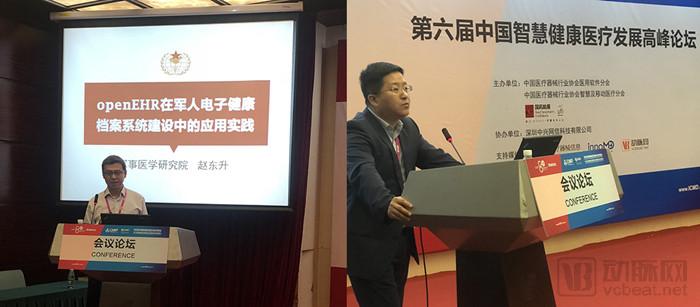
Zhao Dongsheng (left), Researcher at the Academy of Military Medical Sciences, and Zhang Siyu (right), General Manager of the Medical Product Line at ZTE Netcom
Zhao Dongsheng, Researcher at the Academy of Military Medical Sciences, and Zhang Siyu, General Manager of the Healthcare Product Line at ZTE Netcom Technology Co., Ltd., along with other distinguished guests and experts, delivered insightful keynote speeches on openEHR and the application of healthcare big data.
General Manager Zhang Siyu analyzed the usage requirements for the openEHR-based population health information platform from three levels: healthcare institutions, health and family planning administrative departments, and public service platforms for residents. He also introduced the role of openEHR within the system. The core database built on openEHR includes a population information repository, electronic medical record (EMR) data, personal health records, and a business intelligence (BI) data warehouse. Based on this core database, a rich array of application services has been developed, such as basic public health services, two-way referral systems, and health supervision. Currently, this health information platform has been officially deployed and put into use in multiple healthcare institutions both domestically and internationally.
Wang Ping, General Manager of Infinitus Software (Shanghai) Co., Ltd., analyzed and pointed out that big data is currently transforming traditional healthcare models, bringing about significant changes in the medical field. Meanwhile, the difficulty in obtaining high-quality healthcare data has become the biggest bottleneck hindering the development of the healthcare industry. He stated that there are two ways to provide efficient data support for clinical medical research: First, by leveraging artificial intelligence (AI)-assisted medical application scenarios, such as medical imaging, disease risk prediction, and new drug development. Currently, AI-assisted diagnostic products have achieved breakthroughs in lesion recognition and annotation in medical images. Second, by building openEHR-based clinical specialty data and support systems. By constructing specialized clinical models and establishing specialty data centers, upper-layer applications for diagnosis, treatment, scientific research, and management can be developed rapidly and efficiently through data engine processing. At present, Infinitus Software is establishing research data platforms, including an openEHR-based dental clinical research database and a structured ultrasound clinical database for liver transplantation.
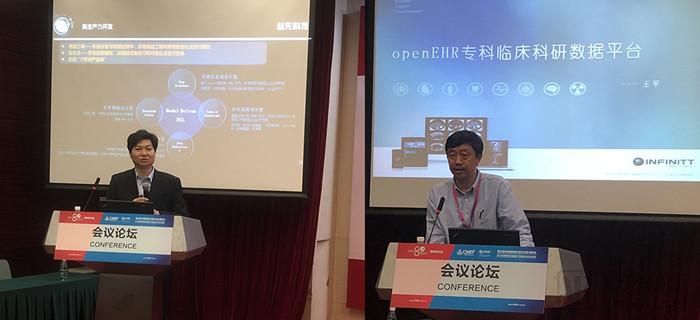
Liu Baogang, Co-founder and CEO of Yixian Technology (left),Wang Ping, General Manager of Infinitas Software (right)
Liu Baogang, Co-founder and CEO of Yixian Technology (Beijing) Co., Ltd., analyzed the pain points existing in the current enterprise software business chain. For medical software companies, these include long R&D cycles and persistently high R&D costs; for hospital users, they include insufficient software integration and flexibility, as well as poor usability. In response, Yixian Technology leveraged the flexible advantages of openEHR’s dual-layer modeling to develop a high-productivity application development and integration platform based on openEHR, effectively addressing the aforementioned issues. The platform can significantly reduce the overall IT costs for enterprises involved in healthcare services, enhance business agility, and comply with both international and domestic standards as well as medico-legal requirements.
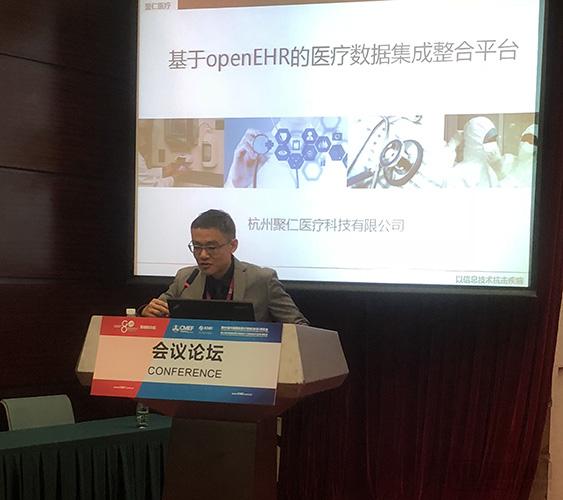
Fu Bin, Technical Director of Juren Medical
Fu Bin, Technical Director of Hangzhou Juren Medical Technology Co., Ltd., fromNational Health CommissionAnalysis of the Entry Points for the Graded Evaluation of Functional Application Levels in Electronic Medical Record Systems, Pointing Out2018New Assessment Dimension for Annual Ratings: Data Quality Scoring and Requirements; Currently, Existing Healthcare Institutions Still Lack a Technical Framework for the Effective Utilization of Medical Data.
The solution he proposed is based onopenEHR-based Medical Data Integration Platform: Empowering Those Who Truly Need Data with Access Rights, Leveraging openEHR’s Dual-Layer Standardized Information Modeling to Address the Complexity and Dynamism of Healthcare Data. It resolves the diversity of data applications and users through comprehensive, multi-channel data access based on openEHR. High-quality medical data is generated through controlled data entry, automatic index matching, automated terminology conversion, natural language information extraction, medical image annotation, and medical image feature extraction.