

Where Is the Tide Heading in the 2018 Top 100? Medical and Health Industry Raises Over RMB 8.5 Billion, with 28 of 2017’s Top 100 Securing New Funding
Stefan Zweig said that all pivotal moments in history require the workings of time, and every significant event undergoes a process of development. In the long river of history, before a brilliant star flashes, humanity must endure lengthy years.
The healthcare sector is undergoing a process of re-domain evolution. Each December, as we look back on the year, we recall many stirring moments, along with sighs and regrets, akin to the waxing and waning of starlight. From here, we observe and document those meteors that pierce the night sky—the brightest stars, and those poised to shine brilliantly.
In 2016, VCBeat released its inaugural “Top 100 Future Healthcare Companies of 2016” list for the healthcare industry. We quantified our observations, insights, and understanding of innovation and entrepreneurship in the healthcare sector over the past three years to identify the industry’s leading enterprises.
In 2017, we collected hundreds of corporate registration entries, obtained dozens of full-year investment datasets for 2017 from industrial investment institutions, and integrated over 5,000 records of the latest funding rounds from the VCBeat database, ultimately compiling the “2017 Future Healthcare 100 China List.”
By 2018, we launched the third edition of the Top 100 List in the Healthcare Sector, titled “2018 Future Healthcare 100.” It remains the mission of the “Future Healthcare 100” to identify Chinese innovative healthcare companies that truly represent the future of medicine within the healthcare industry and to uncover the core forces driving China’s future healthcare sector.
The 2017 list had a total valuation exceeding RMB 320 billion. Where will the growth drivers lie in 2018? How can we identify the Future Healthcare 100 Companies of 2018?

Statistical analysis reveals that the total valuation of companies listed on the “2017 Future Healthcare 100 China List” exceeded RMB 320 billion, representing a nearly 30% increase from the total valuation of the 2016 Top 100 list.
The valuation threshold for companies on the list reached RMB 800 million, an increase of RMB 360 million compared to 2016. The total valuation of the top 10 companies on the list amounted to RMB 129.963 billion, representing an increase of RMB 19.563 billion from 2016.
As can be seen, the prestige of the 2017 Top 100 list has increased significantly. So, what kind of growth will the 2018 list see?
According to incomplete statistics from the VCBeat database, as of November 15, a total of 1,113 financing deals occurred in the healthcare industry in 2018, with 539 taking place in China, amounting to over RMB 8.58 billion.
It is worth noting that 28 of the top 100 companies listed last year successfully secured financing this year.
Image Keyword 1: In 2017, half of the listed companies were from Beijing, while Shanghai, Guangzhou, and Zhejiang each had their own distinctive advantages.
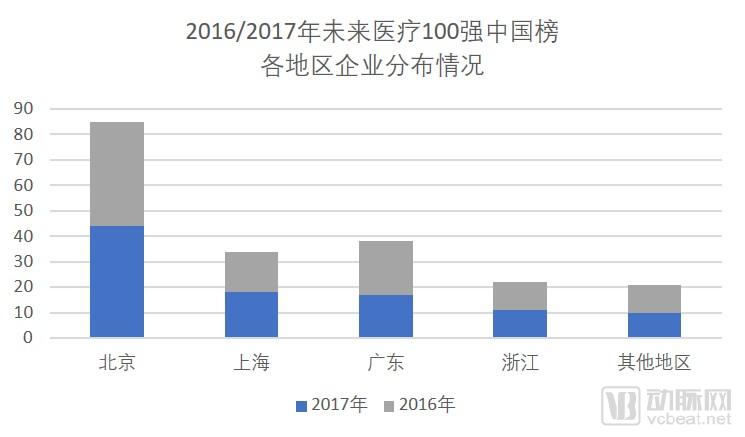
Beijing is the primary hub for listed companies, accounting for nearly half of the total with 44 enterprises. Among Beijing-based companies in the 2016 Top 100 list, service-driven firms predominated, including eight companies focused on online medical consultation and appointment services. In contrast, the 2017 list shows a marked increase in technology-driven enterprises, with a significant emergence of genetic testing companies and those specializing in artificial intelligence in healthcare.
Shanghai, Guangdong, and Zhejiang exhibit a relatively balanced distribution in the number of listed companies. Among the 18 companies from Shanghai on the list, biotech and genetic firms account for a significant proportion, which is attributable to the region’s abundant pool of specialized talent. As a frontier province for the internet industry with geographical proximity to Shanghai, Zhejiang is dominated primarily by internet healthcare and biotech/genetic enterprises. Guangdong, as a hub for high-tech industries, is mainly home to technology-driven companies.
Image Keyword 2: In 2017, 64 companies listed in the A/B funding rounds had a total valuation of RMB 97.143 billion, accounting for 30% of the total valuation of the top 100 companies.
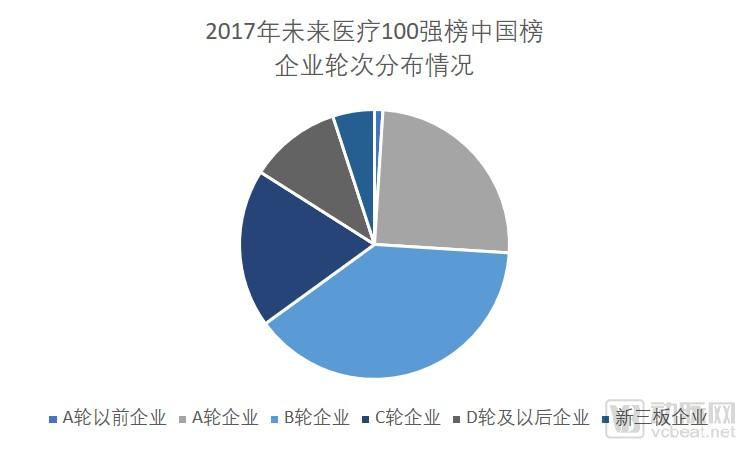
In the 2017 Top 100 Future Healthcare Companies list, companies at Series A and B funding rounds dominated, accounting for a total of 64 firms.
There are 25 Series A companies. As Series A companies are still in the early stages of development, their inclusion on the list indicates that they have identified a viable business model and secured substantial investment.
Notably, United Imaging Healthcare, which ranked first on the list, was also at its Series A stage. In September 2017, the company secured RMB 3.333 billion in Series A financing, marking the largest single private equity investment in China’s medical device industry and making it the biggest dark horse on last year’s list. This year, United Imaging launched 13 AI-powered products and expanded into the U.S. market. It remains to be seen whether it can retain its top position this year.
There are 39 companies at the Series B stage on the list, accounting for the largest proportion. By the Series B stage, a company’s business model has been preliminarily validated, and its operational capabilities have basically stabilized. Valuations of companies at this stage typically experience exponential growth.
Companies at Series C and later stages undoubtedly constitute the group with the highest share of valuation on the list, with a total valuation exceeding RMB 120 billion and accounting for five of the top 10 spots.
At this stage, companies are primarily targeting an initial public offering (IPO). Most have been established for over five years, with many exceeding ten years. Relatively speaking, their core businesses are not in emerging sectors; instead, they feature mature business models that have generated substantial revenue or even achieved break-even. Companies such as healthcare IT firms and comprehensive platforms that originated from online medical consultation services dominate the landscape.
Image Keyword 3: A Growing Number of Technology-Driven Companies; Artificial Intelligence and Genomics Draw Significant Attention
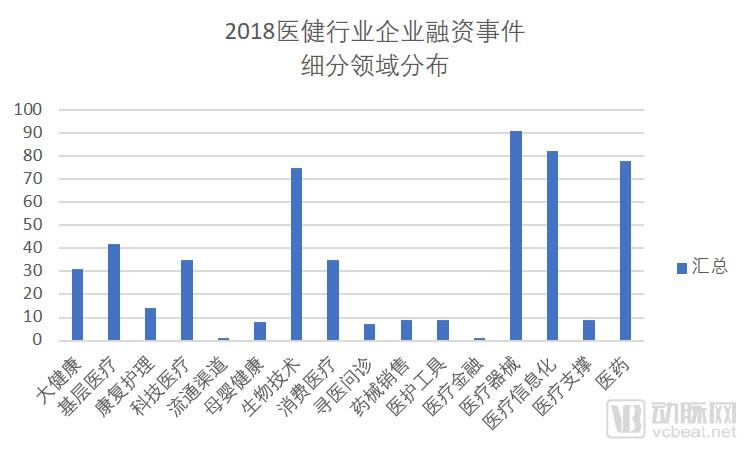
Based on financing events in the healthcare industry in 2018, three distinct tiers have clearly emerged. Tier 1: Medical devices, healthcare informatics, pharmaceuticals, and biotechnology; Tier 2: Primary care, digital health, consumer healthcare, and general wellness; Tier 3: Rehabilitation and nursing, maternal and infant health, medical tools, and healthcare support services.
Medical devices, healthcare informatization, and traditional pharmaceuticals rank as the top three sectors.
Mindray Medical was listed on the ChiNext board in October, with a market capitalization of RMB 85.327 billion, making it the largest IPO in the history of the ChiNext board. United Imaging, the biggest dark horse on last year’s Top 100 list, launched 13 AI-powered products this year and expanded into the U.S. market.Medical DevicesReshuffling ushers in the era of outsourcing; intelligence enters version 2.0.
New Policy on Electronic Medical Records Released, Drawing Attention from Hospitals at All Levels and Set to ActivateMedical InformaticsA market worth tens of billions of yuan.
Policy liberalization and the explosive growth of the multi-billion-yuan internet economy have created a prescription outflow market worth tens of billions of yuan. Technological innovations, such as artificial intelligence, are empowering pharmaceutical companies. Under the dual influence of policy and technology,PharmaceuticalsThe field is also ushering in great prospects.
Of course, in addition to the above fields,Biotechnology,Primary Healthcare,TechMedIt remains highly anticipated this year.
In 2017, AI and big data companies made remarkable strides on the list, with eight companies featured and a combined valuation exceeding RMB 20.6 billion.
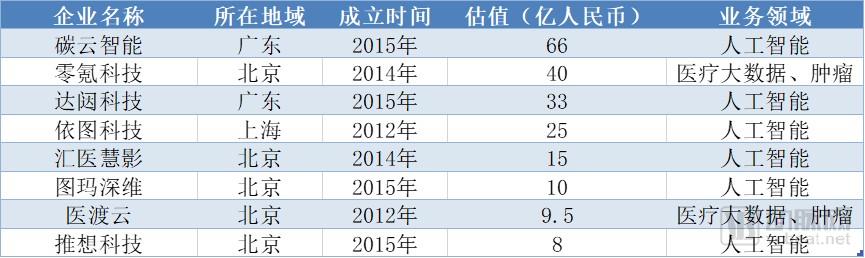
The listed companies are all star players in the field of medical artificial intelligence, having secured substantial financing. Notably, half of them continued to raise over RMB 100 million in 2018, demonstrating strong performance.
ZeroKrypton Tech, as the “Enterprise with Most Potential of the Year” in VCBeat’s 2016 Future Healthcare Top 100, it became the “Innovative Enterprise of the Year” in 2017, and this year secured RMB 1 billion in Series D financing, growing at a breakneck pace. We believe that, having ranked 51st in 2016 and 23rd in 2017, LinkDoc should achieve an even higher ranking this year.
Yitu Technology, not only securing $200 million in Series C financing this year, but also partnering with West China Hospital to co-establish an intelligent clinical research disease registry for lung cancer and launching the world’s first multidisciplinary intelligent diagnostic system for lung cancer. Its AI products have proven their efficacy in nearly 100 Grade A tertiary hospitals across China.
Infervision, Last year, as a capital hotspot in the niche field of medical imaging AI, it secured RMB 300 million in financing this year and continued to emphasize clinical implementation, having diagnosed over 450,000 patients and covered 85 Grade A tertiary hospitals.
Huiyi Huiying, “AORTIST 2.0 Aortic Artificial Intelligence Cloud Platform” achieves full-cycle coverage in the diagnosis and treatment of aortic diseases, from tear identification to stent selection and follow-up prognosis; another platform, the “Breast Cancer Artificial Intelligence Full-Cycle Health Management Platform,”
It is worth mentioning that those not on the list last yearXtalPi, having completed two rounds of financing this year and raising a cumulative total of over US$66 million, it has become one of the best-funded companies globally in the field of AI-driven drug discovery. In May of this year, it also announced a strategic R&D collaboration with Pfizer’s U.S. R&D center to develop a drug molecule simulation platform. Will it secure a spot on this year’s Top 100 list?
Genetics FieldAmong these, companies in Series B financing demonstrated the strongest performance, with nine genetic firms currently at this stage. Novogene and Mingma Bio ranked among the top 10, with valuations of RMB 10 billion and RMB 8 billion, respectively.
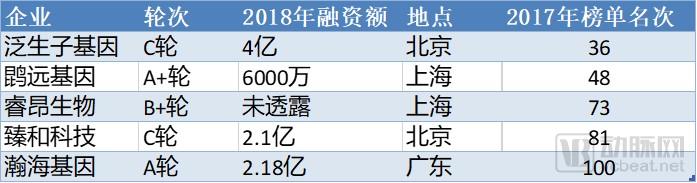
Among the 20 genomics companies listed in 2017, Genetron Health, Raybiotech, Kangpu Biopharmaceuticals, Hanhai Gene, and Geneseeq have each secured over RMB 100 million in financing this year. Meanwhile, Annuoda, BGI-Shenzhen (Mingma Bio), and 3D Medicines—top-ranked firms on the 2017 list—have not announced any new funding rounds recently, but they continue to actively explore market opportunities.
BGI Genomics, ranked among the top ten genetic companies in the 2017 Top 100 List, has partnered with the Children's Hospital of Fudan University this year to launch "Xinma," a neonatal genetic screening product, thereby expanding into the tertiary prevention market.
Annuoda and Pacific Biosciences will engage in deep collaboration on the application of SMRT single-molecule sequencing technology in fields such as basic research in plant and animal genomics, basic medical research, and translational medicine, thereby continuing to drive the in-depth adoption of PacBio sequencing technology.
In addition, consumer-grade genetic testing companies 23Mofang and WeGene have also drawn attention, successfully securing financing as the industry enters the “200 million yuan” era.
Certainly. In 2018, many sectors and enterprises held great promise: internet hospitals experienced a surge, ushering in a new boom; the tumor detection sector was poised for rapid growth; new pharmaceutical retail channels were capturing the hundred-billion-yuan market driven by outpatient prescription outflow; and commercial health insurance was becoming organically integrated with health management services.……
Leading enterprises in these fields are poised to become the core force behind the “2018 Future Healthcare 100 List.”
Seeking the “2018 Top 100 Future Healthcare Companies”—The Core Forces Driving Innovation in the Healthcare Industry
Our list is currently in intensive preparation and production. We welcome self-nominations.
Meanwhile, we will also launch the application process for the “Top 100 Future Healthcare Awards.” These awards will be presented to enterprises, institutions, or individuals that have made outstanding contributions to innovative healthcare this year. The winners will be jointly selected by the VCBeat Content Center, VBInsight, and industry judges. The final awards will comprise seven categories across three major themes—“Innovative Enterprises,” “Investment,” and “Industry Chain”—including “Innovative Enterprise of the Year,” “Promising Enterprise of the Year,” “Investor of the Year,” “Investment Firm of the Year,” “Innovative Hospital President of the Year,” “Innovative Department Director of the Year,” and “Innovative Listed Company of the Year.”
Rankings & Awards Application Link:http://qr32.cn/ETGtWf

(Scan the QR code to apply for rankings & awards)
In the 2018 Future Healthcare 100 ranking, which companies in which sectors will make the list, and which will fall short?
The total valuation of companies on the 2017 list reached RMB 321 billion, an increase of RMB 72.6 billion from 2016. So, what will be the total valuation of this year’s list?
In 2018, what breakthroughs will technology-driven enterprises, represented by innovative medical devices, genomics, and artificial intelligence, achieve?
Compared with 2017, what development trends will the entire healthcare industry exhibit in 2018? Will these trends benefit or hinder enterprises across various sectors?
To determine the rankings, check the leaderboard!
Want to know the rankings? Unveiled on the forum!
2018 Future Healthcare 100 Forum: Inviting Visionaries from All Walks of Life to Discuss the Turbulent Landscape of the Medical and Health Industry
Forum Registration Link:http://qr32.cn/BbS9x4

(Scan the QR code to register for the conference)
Ranking Inquiry:
Mr. Wang
Mobile Number: 17623133499
Email:wang.gl@vcbeat.top
Mr. Li
Mobile Number: 15723315597
Email:li.f@vcbeat.top