

Tencent Co-Founded the AI in Gastrointestinal Endoscopy Committee to Advance Standardization of Medical AI
According to VCBeat (WeChat ID: vcbeat), on November 17, at the 2018 Chinese Endoscopist Conference held in Hangzhou, the Chinese Medical Doctor Association’s Branch of Endoscopists established the Professional Committee on Artificial Intelligence in Digestive Endoscopy. This marks the first professional committee in China’s digestive disease field dedicated to artificial intelligence. Yang Min, Executive Vice President and Secretary-General of the Chinese Medical Doctor Association, pointed out that artificial intelligence has emerged in response to the times, and the establishment of the Professional Committee on Artificial Intelligence in Digestive Endoscopy is timely.
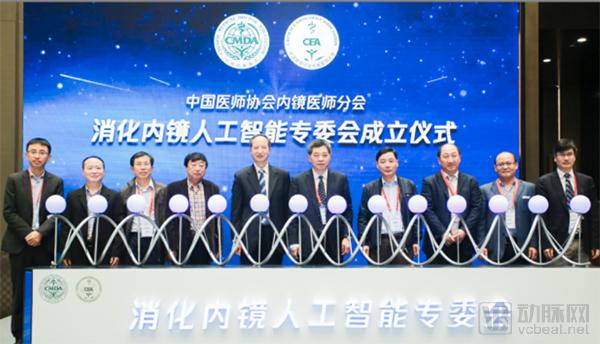
Chinese Medical Doctor Association Endoscopy Branch Establishes the Professional Committee on Artificial Intelligence in Digestive Endoscopy
Li Zhaoshen, an academician of the Chinese Academy of Engineering, Director of the Department of Gastroenterology at Changhai Hospital affiliated with Naval Medical University, Director of the National Clinical Research Center for Digestive Diseases, and President of the Endoscopist Branch of the Chinese Medical Doctor Association, was elected as the Chairman of this special committee. Academician Li Zhaoshen stated that the establishment of the Special Committee on Artificial Intelligence in Digestive Endoscopy aims to engage more experts in joint research and discussion on the application of artificial intelligence in digestive endoscopy, standardize the development of medical AI, promote healthy industry growth, and enable AI to better assist both physicians and patients.
As the builder of the National New Generation Artificial Intelligence Innovation Open Platform for Medical Imaging, Tencent has also participated in the establishment of the Professional Committee on Artificial Intelligence in Digestive Endoscopy and launched a special research fund for medical AI to support academic research and paper publications. Chen Guangyu, Vice President of Tencent, stated that he looks forward to the establishment of the Professional Committee on Artificial Intelligence in Digestive Endoscopy opening up broader innovation spaces for the technology and medical sectors, attracting more AI and medical experts to join, systematically exploring application scenarios of artificial intelligence in the field of digestive diseases, and validating the true clinical value of medical AI.
In recent years, medicine has become a vibrant field for the research and application of artificial intelligence technologies, with medical AI continuously achieving technological breakthroughs and application innovations in areas such as medical image analysis and AI-assisted diagnosis.
Academician Li Zhaoshen pointed out, “The integration of artificial intelligence and medicine has brought us opportunities and pleasant surprises. However, we must also recognize that the application of AI in the healthcare sector has not yet fully realized its potential; regulatory frameworks urgently need to be established, and its application potential remains to be further explored.”
Chen Guangyu pointed out that while artificial intelligence can easily defeat the world’s best chess players, it has not been rapidly adopted in the medical field. This is because medicine is far more complex than other domains. “The prospects for AI in medicine depend entirely on the openness of the medical community to cultivate valuable AI solutions. We hope Tencent can learn alongside experts to make AI a reliable assistant for physicians.”
According to reports, following the establishment of the Professional Committee on Artificial Intelligence in Digestive Endoscopy, it will organize experts to draft industry norms, technical standards, and product standards for AI in digestive endoscopy, thereby regulating the use of AI-enabled digestive endoscopy systems in hospitals. The committee will facilitate academic exchanges among its members through various forums, lectures, and seminars to enhance professional expertise. It will also conduct research and development as well as tackle key technical challenges in AI-based gastrointestinal products, validate their clinical efficacy across hospitals of different tiers, and ultimately promote the integration of AI into clinical practice. Furthermore, supported by the Tencent Academic Research Fund, the committee will carry out academic research and promptly share scientific achievements with peers.
The Significance of Artificial Intelligence in Early Screening for Gastrointestinal CancersCurrently, the incidence of gastrointestinal tumors in China accounts for 43.5% of all cancer cases. If detected at an early stage, the cure rate for these tumors can reach as high as 95%. The emergence of artificial intelligence (AI) technology in digestive endoscopy not only helps primary healthcare institutions improve their diagnostic capabilities but also enables tertiary hospitals to enhance diagnostic efficiency, thereby freeing up more medical resources. Furthermore, this technology makes population-based screening and early detection of gastrointestinal diseases feasible, contributing to a reduction in mortality rates from gastrointestinal malignancies.
At the conference, Yang Wei, Deputy General Manager of Tencent’s AI Medical Center, also presented the technical research and clinical implementation of artificial intelligence in digestive endoscopy. Tencent began its exploration of medical AI in August 2017 with early-stage esophageal cancer screening, followed by the release of an AI-based colorectal tumor screening system in July 2018. Currently, AI screening research for early gastric cancer is underway, with plans to integrate it with early esophageal cancer screening capabilities to form a comprehensive AI-based screening solution for the upper gastrointestinal tract. In addition, AI screening capabilities for the duodenum are actively under development.
In the near future, AI-assisted capabilities will integrate the entire gastrointestinal tract, making AI-powered digestive endoscopy a “standard tool” for gastroenterologists. Chen Guangyu stated, “We expect AI to provide physicians with more comprehensive and professional assistance, while also helping to alleviate patients’ discomfort during examinations and reduce healthcare costs.”