

98% Accuracy! Key Trends Shaping the Healthcare Industry in 2019: Voice Technology, Blockchain ROI, and AI Breakthroughs
At the turn of the year, many institutions begin to release their forecasts for industry development trends in the coming year, which has become a major tradition within the sector.
Recently, the renowned consulting firm Frost & Sullivan also released its forecast on industry trends, marking the 11th consecutive year that the company has published such reports. Forbes republished this report on its official website, which not only expanded the report’s reach but also served as a form of credibility “endorsement.” Reportedly, the firm’s predictions achieved an accuracy rate of 98% in 2018!
Frost & Sullivan, founded in New York in 1961, is headquartered in San Jose, the heart of Silicon Valley, California. Its core business activities include market research, publishing, and training. Currently, the company operates in nearly 50 countries worldwide, with a workforce of approximately 1,000 employees, primarily serving large multinational corporations and pre-IPO companies.
Healthcare is a key focus area for Frost & Sullivan, which boasts a large team of consultants and researchers with specialized professional backgrounds. The industry research and reports produced by the firm have earned a strong reputation in the market.
This article was authored by Ms. Reenita Das, Partner and Senior Vice President of Healthcare and Life Sciences at Frost & Sullivan, who brings over 25 years of healthcare consulting experience across numerous countries in the Asia-Pacific, Latin America, and Eastern Europe regions.
In its 2019 forecasts, Frost & Sullivan’s core insights included: Asia becoming the innovation hub for global contract manufacturing of pharmaceuticals and medical devices; broader adoption of voice technology in the healthcare industry; blockchain transitioning from hype to genuine commercial infrastructure and generating return on investment; lifestyle- and health-data-driven personalized health insurance reshaping the health insurance industry; the value of medical artificial intelligence (AI) exceeding $1.7 billion by 2019; and digital health applications outside hospitals growing by 30%, with a market size surpassing $25 billion.
VCBeat has translated the full report, reviewed Frost & Sullivan’s reports from previous years, and integrated these insights with the development of China’s domestic industry to analyze the trends that have emerged and are currently unfolding in China’s healthcare sector.
The structure of the full text is as follows:
I. Frost & Sullivan’s 2019 Outlook on Healthcare Industry Trends;
II. Review of Frost & Sullivan’s Forecasts from Previous Years;
III. Review and Outlook of Recent Trends in China’s Healthcare Industry
The following is the main text.
Globally, 2019 will mark a pivotal year for value-based healthcare, as the industry’s focus on “outcomes-based care” becomes increasingly globalized. This shift will foster more mature risk-sharing arrangements among healthcare providers, pharmaceutical R&D institutions, and original equipment manufacturers (OEMs), thereby delivering commercial value to providers. Furthermore, access to affordable, high-quality care will emerge as a key political agenda item in the upcoming 2019 elections across emerging markets, including Asia, Africa, and Central and Eastern Europe.
As the boundaries between the retail, IT, and healthcare industries become increasingly blurred, Google, Apple, Facebook, and Amazon (GAFA) in the West, and Baidu, Ali Health, and Tencent (BAT) in the East, will begin to dominate the personal care market in 2019.
Non-traditional digital market providers, such as Alibaba Health, Tencent, Amazon, Google, Apple, Microsoft, and IBM, will dominate the home health sector, providing the necessary impetus to public health systems to ensure the accessibility and affordability of care. Frost & Sullivan also predicts that future R&D investments in pharmaceuticals and medical devices will be more targeted toward meeting the unique needs of emerging Asian markets.
Finally, Frost & Sullivan predicted that 2019 would test the implementation capabilities of the two most popular healthcare technologies of the decade—artificial intelligence (AI) and blockchain.
Meanwhile, approximately 80% of healthcare professionals believe that four technologies—artificial intelligence, big data, digital health, and wearable devices—will change the rules of the game in the industry.
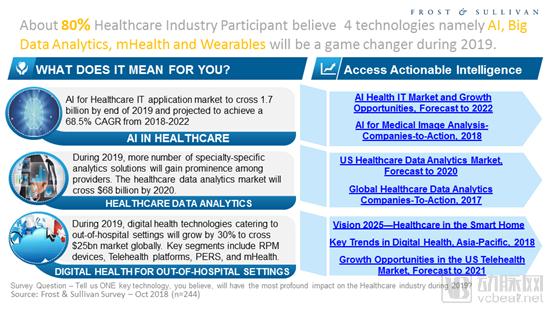
Image source: Frost & Sullivan, VCBeat
Prediction 1: The Value of Medical Artificial Intelligence (AI) Will Exceed $1.7 Billion by 2019
Frost & Sullivan estimates that by the end of 2019, the value of artificial intelligence in the healthcare IT application market will exceed $1.7 billion. Frost & Sullivan further projects that productivity will increase by 10–15% over the next two to three years through the deployment of AI platforms in selected healthcare workflows. However, pricing remains a critical factor for AI solutions, as users are often reluctant to allocate additional budgets for such IT capabilities. Adopting cost-effective approaches and clearly demonstrating the potential return on investment for both parties is an effective strategy to sustain market growth.
Throughout 2019, the development of artificial intelligence and machine learning will focus on human-machine interaction. More specifically, AI will begin to yield tangible results and returns, particularly in applications such as imaging diagnostics, drug discovery, and risk analysis.
Prediction 2: Asia Becomes the Innovation Hub for Global Contract Manufacturing of Pharmaceuticals and Medical Devices
Historically, most channels for medical innovation have flowed from the West to the East. Now, as emerging markets capture 20–30% of the pharmaceutical industry’s value with double-digit growth rates (10–15%), a range of global contract manufacturers of drugs and medical devices are seeking to accelerate this trend by developing new products tailored to Asian healthcare institutions and Asian populations. Frost & Sullivan predicts that by 2019, up to 10% of healthcare R&D will be dedicated to innovation in emerging Asian markets. For instance, in terms of growth, the Asia-Pacific region is the strongest market, with more than 30% of global late-stage cell therapy trials being conducted there.
Furthermore, Frost & Sullivan believes that the Asia-Pacific region will witness a genomics revolution in the coming years. In particular, China is poised to play a leading role in the field of genomics in Asia. This evolving pattern of product development and geographic expansion leads Frost & Sullivan to believe that the number of “unicorn startups” (valued at over $1 billion) and foreign direct investment will increase alongside rising demand for healthcare services, population aging, and income growth.
Prediction 3: Voice Technology Will Be More Widely Adopted in the Healthcare Industry
Healthcare is at a tipping point, with specialized voice technology providers such as Nuance and Orbita, along with leading tech companies like Amazon, Apple, Google, and Microsoft, adopting voice technologies tailored to healthcare industry use cases.
Frost & Sullivan predicts that, prior to 2019, HIPAA-compliant healthcare voice and chatbot applications will gain prominence driven by the active participation of tech giants in the competition for voice solutions. However, the current state of voice technology limits its applicability to narrow use cases, such as rapid retrieval of medical information and voice-guided transcription interactions, making it unsuitable for conveying lengthy information. In the future, applying voice technology to vetted clinical use cases—such as elderly care, chronic disease management, and physician assistant services—will create growth opportunities.
Prediction 4: Blockchain Transitions from Hype to Genuine Business Infrastructure, Delivering Return on Investment
In 2019, blockchain technology will shift from hype to early commercial deployment, generating a certain return on investment in enterprise B2B operations. Frost & Sullivan predicts that by the end of 2019, 5%–10% of healthcare-focused enterprise blockchain applications will transition from the pilot phase to partial or limited commercial availability.
Companies such as Change Healthcare, Hashed Health, and Guardtime will continue to expand their already commercialized applications. Furthermore, initial coin offerings (ICOs) by healthcare enterprises and proof-of-concept projects by startups will identify viable pathways for commercialization. This will attract early adopters—who are awaiting the right opportunities—to create much-needed network effects in the healthcare sector and explore where and how blockchain technology can be utilized within healthcare.
Prediction 5: Lifestyle- and Health Data-Driven Personalized Health Insurance Will Reshape the Health Insurance Industry
Undoubtedly, today’s health insurance policies have become outdated and fail to meet individuals’ personalized needs. Consequently, Frost & Sullivan projects that the growth rate of the health insurance industry in 2018 will be below 1.5%. To ensure future growth in global insurance revenues, many insurers have begun providing data- and digital-driven healthcare services to their policyholders, thereby reducing potential claims costs.
Frost & Sullivan believes that by the end of 2019, 5–10% of health insurance plans will be linked in some form to interactive policies driven by lifestyle and health data. Research by Frost & Sullivan indicates that interactive policies will continue to gain popularity globally, as they enable insurers to leverage individual data to offer personalized premiums, discounts, and rewards.
Prediction 6: Digital health applications outside hospitals will grow by 30%, with a market size exceeding $25 billion
In 2019, the application of digital health will continue to extend far beyond traditional healthcare systems, empowering individuals to manage their own health conditions. According to Frost & Sullivan estimates, by the end of 2019, out-of-hospital digital health applications will grow by 30%, with the global market size exceeding USD 25 billion.
Chronic diseases that increase cost burdens and population aging will become the main drivers of digital health solutions, such as RPM devices (Remote Patient Monitoring), telemedicine platforms, PERS (Personal Emergency Response Systems), and mHealth applications.
Furthermore, favorable reimbursement policies for clinically relevant digital health applications will continue to expand healthcare service models beyond physical medicine and rehabilitation, including behavioral health, digital therapeutics, dentistry, nutrition, and prescription management.
Prediction 7: From Big Data to Meaningful Small Data, Data Applications Will Shine in Niche Fields
As the healthcare industry becomes more familiar with data management workflows, Frost & Sullivan expects that a large number of specialized analytical solutions will play a prominent role in these niche areas: investigating drug utilization rates, treatment variability, enhancing clinical trial eligibility, reducing billing discrepancies, and self-care programs targeting major chronic diseases. Frost & Sullivan predicts that by the end of 2019, 50% of healthcare companies will have repositories dedicated to accessing, sharing, and analyzing real-world data for use within their organizations.
Looking ahead, the primary objectives for healthcare payers and providers in leveraging analytics capabilities will include: population health management (identifying at-risk individuals), identifying optimal care pathways (lowest cost, best outcomes), and automating operations for patients, payers, physicians, and procedures. Furthermore, the convergence of artificial intelligence and analytics will drive augmented analytics into mainstream adoption within the next two to three years.
Prediction 8: 15% of global healthcare spending will be linked to value-based models
In 2019, the healthcare industry will continue its shift toward a value-based model. Frost & Sullivan projects that by the end of 2019, up to 15% of global healthcare spending will be linked in some form to the concept of value- or outcomes-based care. This transition is particularly urgent for countries where healthcare expenditure accounts for nearly 10% or more of their gross domestic product (GDP), such as the United States, the Netherlands, Sweden, France, Germany, Canada, and Japan.
In 2019, Value-Based Care (VBC) initiatives will continue to shift from purely economic models or cost-effectiveness measures toward a greater focus on health outcomes and treatment efficacy, leveraging data-driven risk-sharing frameworks and sustainable reimbursement models to benefit both providers and payers.
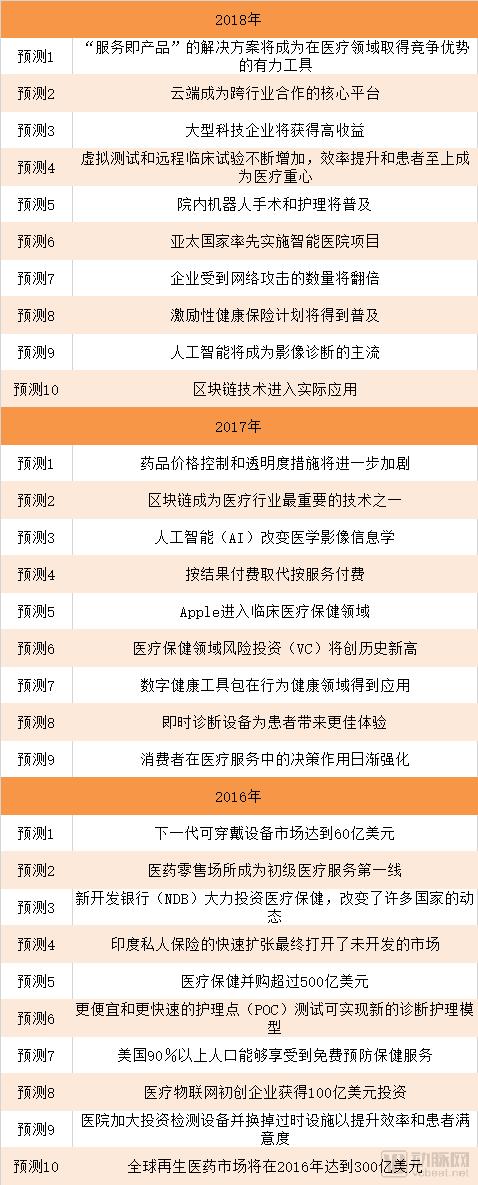
At the beginning of the report, Reenita Das wrote that over the past decade, Frost & Sullivan has annually compiled forecasts on development trends in the healthcare industry, with its predictions becoming increasingly accurate each year. The 2018 forecast, released in December 2017, achieved an accuracy rate of nearly 98%, with every item being validated in the following year.
Below are Frost & Sullivan’s forecasts from the past few years
Source: Frost & Sullivan, VCBeat
In terms of predictive accuracy, many of Frost & Sullivan’s forecasts are trend-oriented and lack quantifiable metrics. Nevertheless, from the perspective of industrial development, FS has correctly anticipated numerous trends, such as the application of artificial intelligence in medical imaging and the practical implementation of blockchain technology in specific scenarios. Of course, these trends typically persist for several years.
Compared with the TMT sector, the healthcare industry evolves at a slower pace. Due to its high level of industrial maturity, both regulators and established interest groups tend to be conservative toward new developments, meaning that new business models will not be widely adopted in the short term.
Changes in the healthcare industry are often driven by innovation, which can be categorized into two directions: technological innovation and business model innovation. These two types of innovation interact with each other; technological innovation gives rise to new business models, while new business models drive technological iteration.
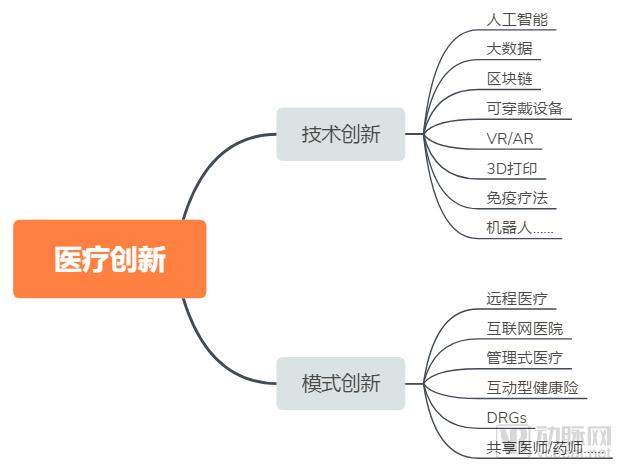
Whether through technological or business model innovation, the ultimate goals remain threefold: cost, quality, and accessibility. For instance, artificial intelligence, as a productivity tool, can reduce costs and enhance efficiency; wearable devices and portable diagnostic equipment improve user experience; and internet-based healthcare and telemedicine enable patients in remote areas to access high-quality medical services without leaving their homes.
Beyond innovation, policy and capital are often key drivers of change in the healthcare industry. In a heavily regulated sector, administrative directives can readily spur or dismantle specific subsectors. Capital, meanwhile, can facilitate consolidation of existing assets and achieve short-term breakthroughs, as seen in mergers and acquisitions among pharmaceutical companies, the integration of retail pharmacy chains, and the surge of innovative biopharma firms fueled by investment.
Predicting the changes that will occur in China’s future healthcare industry is a complex issue. A viable framework for analysis is as follows: Identify current problems and pain points → Determine the solutions → Assess who has the capability to provide these solutions → Evaluate the value returns that solution providers will receive (as solutions without visible value returns are often unsustainable) → Examine the resulting changes for surrounding companies and industries.
Apply this framework to analyze currently trending topics in healthcare, such as artificial intelligence (AI). The goal of AI is to enable machines to “mimic” humans, possessing the ability to think through problems and solve complex issues like humans do. These capabilities can be further broken down into image recognition, speech recognition, natural language processing, data processing, data mining, and cognitive reasoning. Corresponding application scenarios include lesion identification, electronic medical record (EMR) entry, data structuring, drug discovery, and Clinical Decision Support Systems (CDSS), among others.
Medical artificial intelligence, particularly in imaging, has partially replaced the tedious and repetitive tasks previously performed by physicians, addressing their key “pain points.” Consequently, the factor that will influence its future development is the realization of commercial value—namely, the issues of pricing and payment responsibility. Currently, most medical AI products enter hospitals through research collaborations, with very few achieving true monetization.
AI tools have significantly improved doctors' work efficiency. Doctors or hospitals, rather than patients, should bear the cost of AI products, as AI helps save time, allowing them to spread the costs by serving more patients. As these products mature, more hospitals and doctors will be willing to pay for AI, which represents the primary trend in the development of AI within hospitals.
Another example is the application of AI in drug R&D, which can reduce the time required for molecular discovery, target validation, and crystal form design, while improving the efficiency of subject recruitment through precise trial design, thereby accelerating the drug’s market launch. For blockbuster drugs, each day earlier to market can generate millions or even hundreds of millions in revenue, which is certainly why companies are willing to pay for such solutions.
A review of the changes in China's healthcare industry over the recent period is summarized below, though not exhaustively:
1. The rapid development of internet healthcare has expanded from appointment registration and basic consultations to remote diagnosis and treatment, as well as hospital information system construction;
2. Independent practice by physicians is highly advocated, with physician groups and private healthcare sectors experiencing rapid growth;
3. AI products are flooding hospitals, ranging from electronic medical record entry and big data to medical imaging and assisted diagnosis;
4. The number of innovative pharmaceutical companies has surged, with R&D strategies primarily focused on fast-follow approaches; securitization remains a key means of continuous financing;
5. Accelerated M&A among retail pharmacies and distribution enterprises, with consolidation of existing assets driving increased operational concentration;
6. Reforms to medical insurance payment methods continue to advance, with expanded pilots for capitation, diagnosis-related group (DRG) payment, and centralized volume-based procurement;
7. Commercial health insurance is expanding rapidly, with group medical insurance and critical illness insurance experiencing the fastest growth, demonstrating significant synergy with medical services and health management;
In summary, it is evident that technological advancements in China’s healthcare industry are largely synchronized with global trends, whereas changes in policy and business models are more deeply rooted in national conditions. To identify opportunities amidst these shifts, one must first remain attuned to cutting-edge technologies and secondly be capable of delivering solutions tailored to practical realities. Most importantly, however, it is essential to establish a business model that ensures sustainable value returns.
[References]