

Tencent Leads National Key R&D Project on AI-Powered Clinical Decision Support Technology
VCBeat (WeChat ID: vcbeat) has learned that on November 18, the “Future-Oriented, AI-Initiated” Tencent Medical Artificial Intelligence and Medical Technology Development Forum, concurrently serving as the kick-off meeting for a key project under the National Key R&D Program, was held in Shenzhen. The event was guided by the Guangdong Provincial Department of Science and Technology and hosted by Tencent. At the forum, Tencent, as the lead undertaking entity, together with the Institute of Automation of the Chinese Academy of Sciences, the Chinese PLA General Hospital, Xiangya Hospital of Central South University, Peking University People’s Hospital, Shenzhen People’s Hospital, and other institutions, officially launched the project titled “Research on AI-Based Clinical Decision Support Systems (CDSS) Technologies and Their Service Model Solutions.” This project falls under the “Special Project on R&D of Digital Diagnostic and Therapeutic Equipment” within the 2018 National Key R&D Program. It aims to explore artificial intelligence-based clinical decision support technologies (AI+CDSS) and develop innovative healthcare service model solutions covering the entire patient journey, thereby enhancing the accessibility, consistency, precision, and standardization of medical services.
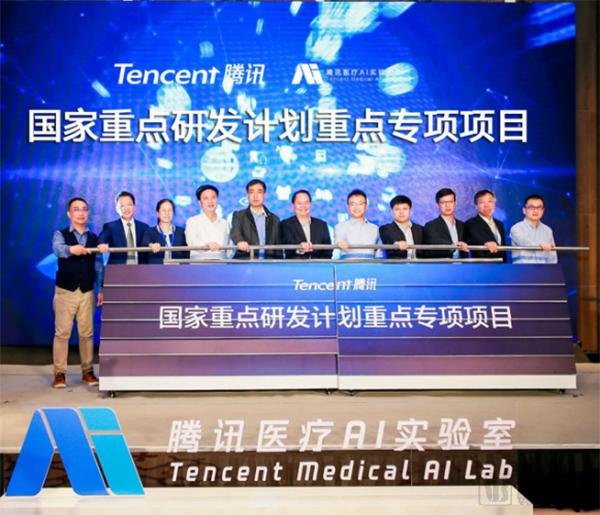
Tencent Leads the 2018 National Key R&D Program
“AI-Assisted Diagnosis Project under the Special Program for R&D of Digital Diagnostic and Therapeutic Equipment” Launched
According to reports, the AI-assisted diagnosis project under the “Special Project for Research and Development of Digital Diagnostic and Therapeutic Equipment,” led by Tencent, aims to study artificial intelligence-based clinical decision support technologies and their service model solutions. Participating collaborative institutions include the Institute of Automation, Chinese Academy of Sciences; the Chinese People’s Liberation Army General Hospital; Xiangya Hospital of Central South University; Peking University People’s Hospital; Shenzhen People’s Hospital; Ruijin Hospital, Shanghai Jiao Tong University School of Medicine; Guang’anmen Hospital, China Academy of Chinese Medical Sciences; Guangzhou Huyun Hospital Management Co., Ltd.; and Feijiu Medical Technology (Beijing) Co., Ltd., among others.
“Based on the new development trends, and closely focusing on major needs such as alleviating the scarcity of medical resources, improving the technical level of medical services, and enhancing the synergy of the healthcare system, the Ministry of Science and Technology (MOST) has strengthened its strategic layout in key application areas of medical artificial intelligence,” said Zhang Zhaofeng, Director of the Biotechnology and Medicine Division at the Department of Social Development under MOST, during the conference. “We are delighted to see that, building upon the first batch of next-generation AI open innovation platforms announced by MOST—specifically, the Next-Generation AI Open Innovation Platform for Medical Imaging undertaken by Tencent—the key R&D project on medical AI digital diagnostic and therapeutic equipment, led by Tencent, is officially launched today. We hope that Tencent will strengthen its strategic planning, achieve new breakthroughs in medical AI, and establish itself as a powerful force driving critical advancements in medical AI, as well as a globally leading team.”
Ding Ke, Senior Vice President of Tencent, stated, “This marks another significant step forward in Tencent’s efforts to drive the digital transformation of the healthcare sector. Medical artificial intelligence is a field with immense development potential and broad scope for innovation. Tencent has successfully explored practical pathways from research to application and is continuously accelerating this process to ensure that technology is effectively implemented, tangibly assisting doctors and patients while enhancing the quality of medical services.”
Fan Wei, Project Leader and Director of Tencent’s Medical AI Laboratory, introduced that during the project period, Tencent will collaborate with partners to deeply explore artificial intelligence-based clinical decision support systems (AI+CDSS), build a self-evolving medical knowledge base, develop AI-driven decision support systems for consultation, triage, diagnosis, and treatment, create a new model of medical cloud services, and provide solutions covering the entire patient journey from pre-consultation to intra-consultation and post-consultation stages.
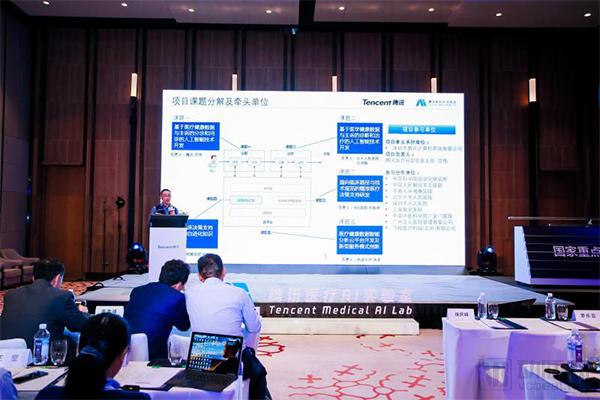
Fan Wei, Head of Tencent Medical AI Lab, Introduces Key Project Content
Fan Wei introduced a new AI-assisted disease service model, focusing on dermatology as a key specialty. Using psoriasis as an example, the model operates across three stages. In the pre-consultation stage, patients engage in human-computer interaction by uploading images for preliminary assessment and simple triage questions. Integrated with internet hospital platforms, this enables intelligent triage, patient guidance, and referral. During the consultation stage, the system assists physicians in initial disease assessment and provides personalized treatment recommendations, while doctors can make final diagnostic decisions through online consultations. In the post-consultation stage, the system predicts recurrence probabilities through prognostic evaluation, intelligently tracks patient conditions, and delivers personalized medication guidance based on monitoring of therapeutic effects.
“Tencent possesses advanced core competencies in medical big data and cutting-edge artificial intelligence technologies. By undertaking this national scientific research mandate, Tencent will mobilize top-tier AI research resources to address critical challenges in healthcare, integrate the collaborative ecosystem spanning industry, academia, research, and clinical practice, deliver tangible value, and benefit more physicians and patients.”
From research to application, Tencent has achieved significant practical outcomes. In 2017, Tencent launched its first product to apply artificial intelligence technology in the medical field, “Tencent Miying,” which assists doctors in screening for diseases such as esophageal cancer, pulmonary nodules, diabetic retinopathy, colorectal tumors, and breast cancer. It has established collaborations with more than 100 Grade A tertiary hospitals across China, cumulatively assisting doctors in interpreting over 100 million medical images and serving more than one million patients.
Established in late 2017, Tencent’s Medical AI Laboratory is dedicated to exploring the deep integration of healthcare and artificial intelligence. It conducts in-depth research on foundational technologies such as natural language understanding, medical knowledge graphs, deep learning, video analysis, and multimodal analysis, while building intelligent AI engines including a medical knowledge engine, a medical reasoning engine, a clinical decision support engine, and a consultation dialogue engine.
In the field of cardiovascular and cerebrovascular diseases, Tencent Medical AI Lab has launched an intelligent ECG analysis system, which can be applied to the entire medical process of cardiovascular disease prevention, diagnosis, and monitoring in the future. In addition, the lab conducts targeted technology research and development for various specialties, such as using AI video analysis technology for intelligent assessment of motor function in Parkinson's disease and other movement disorders; and developing rapid organ localization technology to meet the needs of head and neck radiotherapy, achieving the goal of precision radiotherapy.