

China's Top 100 Hospitals Ranked, Yet 65% Still Lag in Digital Maturity
Top-tier martial arts masters excel not only in hand-to-hand combat but also demonstrate considerable proficiency with various weapons, including swords, spears, and staffs. Hospital development follows the same principle: both specialty reputation and scientific research must be prioritized, with neither being dispensable.
Recently, the Hospital Management Institute of Fudan University officially released the China Hospital Rankings. The number of experts in the panel has grown from an initial 1,624 to over 4,000, rising from 4,175 last year to 4,630 this year, representing a 10.9% increase. The number of valid responses from experts also reached a record high, increasing from 2,657 last year to 2,964 this year, with the effective response rate rising from 44.24% in the first year to 64.1%.
Overall, this ranking does not cover hospitals’ health IT capabilities. To further identify which of the top 100 hospitals is the most well-rounded “model student” with no significant disciplinary weaknesses, VCBeat has integrated discipline development and health IT considerations into this ranking by drawing on the National Health and Medical Information Interoperability Standardization Maturity Assessment organized by the National Health Statistical Information Center, the “Graded Evaluation Standards for Electronic Medical Record System Application” issued by the Hospital Management Institute, and the HIMSSEM RAM ratings.
In addition to compiling a detailed ranking (with data for the Top 100 list provided by Health界), VCBeat has also drawn the following conclusions from its analysis:
1. The development of comprehensive disciplinary capabilities and health information technology infrastructure is uneven across most top-tier hospitals in China.
2. Hospitals in East China (including Shandong Province, Jiangsu Province, Shanghai, Zhejiang Province, etc.) demonstrate the highest alignment between disciplinary comprehensiveness and informatization capabilities, with the most balanced development.
3. Ruijin Hospital, Shanghai Jiao Tong University School of Medicine, is the leading hospital in China in terms of comprehensive capabilities in clinical disciplines and health informatics.
4. Hospitals in Northwest China need comprehensive “remedial improvements.”
Below is the consolidated ranking compiled by VCBeat:
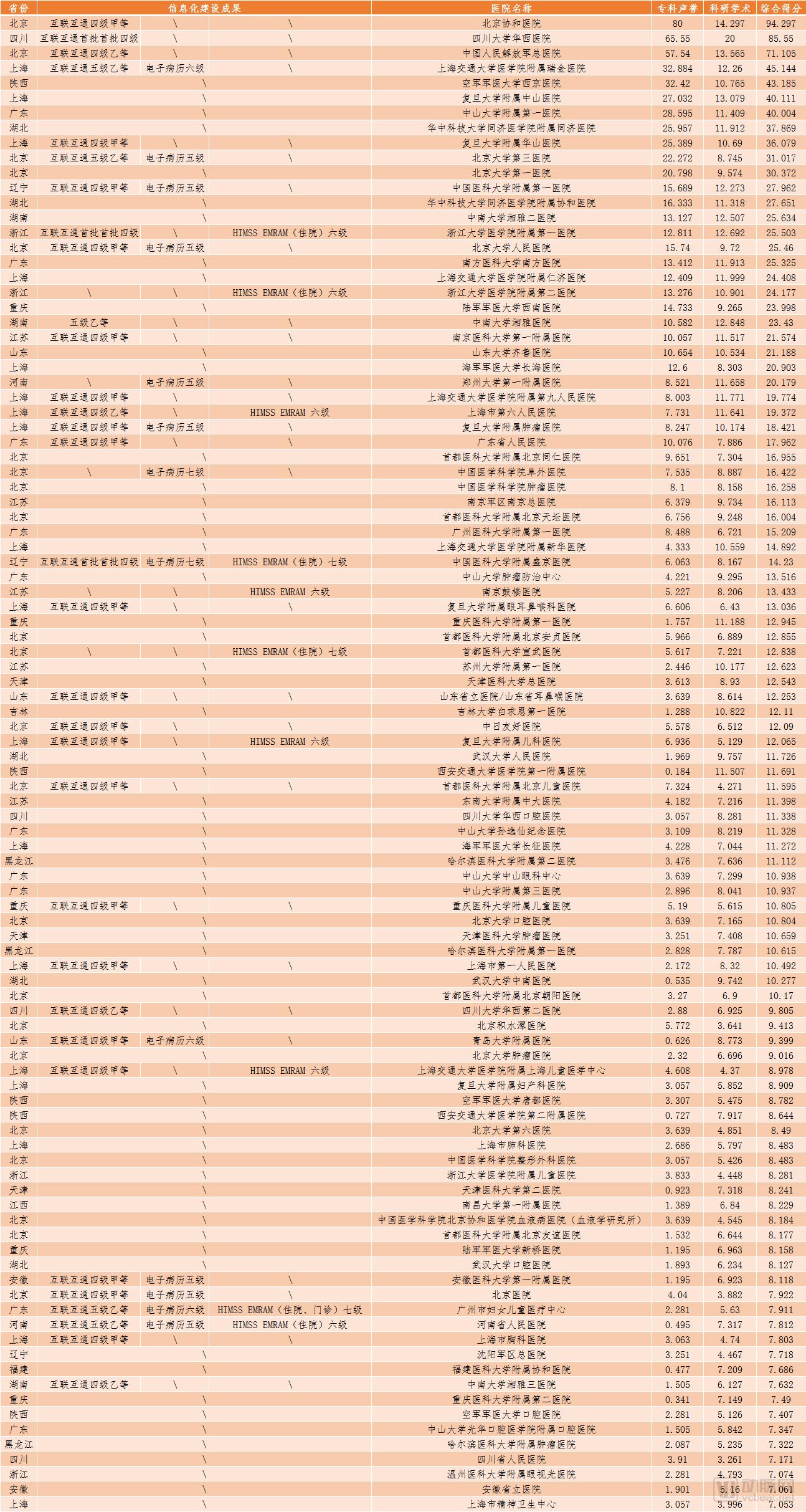
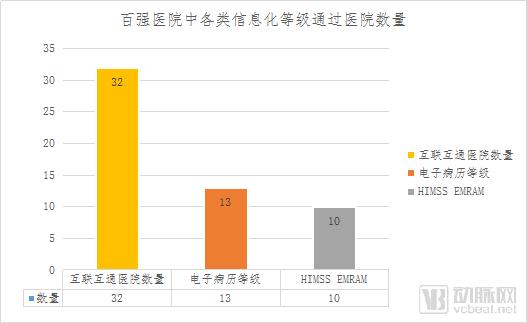
As shown in the table, 32 hospitals have passed the Interconnectivity Standardization Maturity Assessment, 13 hospitals have passed the Graded Evaluation of Electronic Medical Record (EMR) System Application Level, and 10 hospitals have achieved HIMSSEM RAM ratings. It can be inferred that top-tier hospitals in China are currently more inclined to participate in the Interconnectivity Standardization Maturity Assessment. (Note: Subjective evaluations such as “high” or “low” mentioned below are relative only to this Top 100 ranking.)
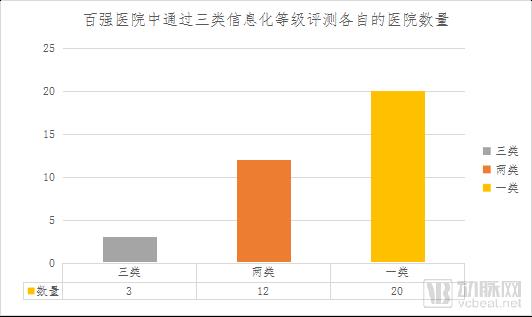
Given that some hospitals have passed more than one category of accreditation, VCBeat compiled statistics on the number of accreditation categories passed by the top 100 hospitals and found that a total of35 HospitalsPassed at least one of the three categories of evaluations. In other words,65%None of the top 100 hospitals passed any level of accreditation.
Among them, only three hospitals passed the three types of evaluations, namelyShengjing Hospital of China Medical University、Guangzhou Women and Children's Medical CenterandHenan Provincial People's Hospital.It is worth mentioning Shengjing Hospital of China Medical University, which is not only among the first batch of hospitals in China to achieve Level 4 Interconnectivity, but has also attained the highest levels in both the Electronic Medical Record (EMR) System Functional Application Level Evaluation (Level 7) and the HIMSS EMRAM (Inpatient) Stage 7. In essence, this hospital represents the highest standard of healthcare informatization development in China.。
However, an analysis of their comprehensive scores in disciplinary reputation and scientific research capabilities reveals that none of these three hospitals rank among the top tier within the Top 100 Hospitals. Shengjing Hospital of China Medical University is ranked 37th, Guangzhou Women and Children’s Medical Center is ranked 87th, and Henan Provincial People’s Hospital is ranked 88th.
In terms of disciplinary reputation and comprehensive research and academic capabilitiesTop 20of hospitals, onlyRuijin Hospital, Shanghai Jiao Tong University School of Medicine、Peking University Third Hospital、The First Hospital of China Medical University、The First Affiliated Hospital, Zhejiang University School of MedicineandPeking University People's HospitalTotalFive Hospitals, passed two categories of grade evaluations (excluding Category III).
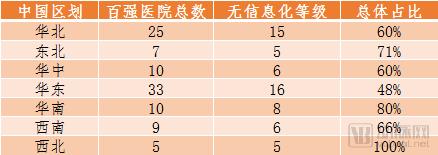
From the perspective of national geographic divisions, hospitals in East China (including Shandong Province, Jiangsu Province, Shanghai, Zhejiang Province, etc.) have better overall infrastructure. Not only are there more hospitals on the top 100 list, but the proportion of hospitals without an informatization rating (48%) is also the lowest. The most representative among them areRuijin Hospital, Shanghai Jiao Tong University School of Medicine, ranking 4th in the Top 100 for disciplinary reputation and comprehensive scientific research capabilities, it has also achieved Level 5 Grade B—the highest level—of Interconnectivity Standardization Maturity, as well as Level 6 for Electronic Medical Records, making it a model hospital in East China.
The proportion of hospitals without information system grading in North China (Beijing, Tianjin, etc.) is 60%, among which the most representative arePeking University Third Hospital. This hospitalIn addition to achieving Level 5 Grade B in the Interconnectivity Standardization Maturity Assessment, it has also attained Level 5 in the Electronic Medical Record (EMR) System Functional Application Level Evaluation. Furthermore, Peking University Third Hospital ranked 10th nationwide in terms of disciplinary reputation and comprehensive research and academic capabilities.
The proportion of hospitals without information technology ratings in Central China (Henan, Hubei, and Hunan) is the same as that in North China, both at 60%. Representative examples includeHenan Provincial People's Hospital, having passed three major accreditation assessments, including Level 5 Class B for Interconnectivity, Level 5 for Electronic Medical Records (EMR), and Level 6 of the HIMSS EMRAM (Inpatient). However, in terms of disciplinary reputation and comprehensive research and academic capabilities, the hospital ranks only 88th on the Top 100 list, which is relatively low.
The Southwest region (including Sichuan, Chongqing, etc.) lacks representative strength in hospital informatization, with only those having passed the first batch of Level 4 Interconnectivity assessments.West China Hospital, Sichuan University, and has passed the Level 4 Grade A certification for interconnectivityChildren's Hospital of Chongqing Medical UniversityBarely considered “competent.”
The undisputed leader in comprehensive strength in Northeast China (Liaoning, Jilin, Heilongjiang, etc.) isShengjing Hospital of China Medical UniversityandThe First Hospital of China Medical UniversityShengjing Hospital’s informatics capabilities are unquestionably second to none, as previously introduced and thus not reiterated here. Meanwhile, the First Affiliated Hospital of China Medical University has achieved Level 4 Grade A certification for Interconnectivity Standardization Maturity and Level 5 for Electronic Medical Records. Coupled with its 12th-place ranking in disciplinary reputation and comprehensive research and academic capabilities, its overall strength is truly top-tier.
Hospitals in South China (Guangdong) are somewhat surprising, as the proportion of hospitals without an informationization rating among the Top 100 is as high as 80%, but fortunately there are stillGuangzhou Women and Children's Medical CenterTo salvage some prestige, the hospital passed three major assessments: Level 5 Class B for Interconnectivity, Level 6 for Electronic Medical Records, and Level 7 of the HIMSS EMRAM (for both inpatient and outpatient services).
Northwest Region (Shaanxi, Gansu, Ningxia, etc.): Proportion of Hospitals Without Informationization Grading in the Top 100 Ranking100%……
Who is the most “Subject Imbalance” of the Top 100 Hospitals?
It is evident that there are two such hospitals: one possesses strong informatics capabilities but ranks low in the top 100 list for disciplinary reputation and comprehensive scientific research and academic strength, while the other exhibits the opposite profile. As shown in the table,Air Force Medical University Xijing Hospital and Guangzhou Women and Children's Medical CenterRanked 5th in comprehensive capabilities with no information technology rating, and ranked 87th with all three major ratings fully assessed, both were successfully selected.
Based on the above information, VCBeat has drawn the following four conclusions:
1. The development of comprehensive disciplinary capabilities and informatization is uneven across most top-tier hospitals in China.
2. Hospitals in East China (including Shandong Province, Jiangsu Province, Shanghai, Zhejiang Province, etc.) demonstrate the highest alignment between disciplinary comprehensiveness and informatization capabilities, with the most balanced development.
3. Ruijin Hospital, Shanghai Jiao Tong University School of Medicine, is the leading hospital in China in terms of comprehensive capabilities in clinical disciplines and health informatics.
4. Hospitals in Northwest China Need Comprehensive “Remedial Measures.”