

From 25 to 120: The Turbulent Three-Year Journey of Internet Hospitals in China
Internet hospitals were clearly defined in 2016 and have since experienced rapid development. In 2017, they saw a collective surge in Yinchuan, reaching a peak of public attention. Subsequently, due to policy headwinds, the sector cooled off before making a comprehensive recovery in 2018, ushering in an era of explosive industry growth. What stages has the internet hospital industry undergone over these three years? How exactly has it evolved? Perhaps the three reports on digital healthcare published by VCBeat’s VBInsight can help map out the developmental trajectory of the industry over this period.
(Students who have claimed three Internet Hospital reports and forum coupons may skip directly to the end of the article to participate in the survey.)
Back in 2016, after three years of rapid development, light consultation had become the niche sector spawning the most mobile health giants, yet it was also one of the most fiercely competitive arenas. With small-scale paid consultations and low conversion rates for alternative revenue models such as value-added services, the inability to form a complete commercial loop meant that light consultation platforms could not rely solely on online models to sustain long-term growth, making it urgent to identify a new extension model.
In October, the government launched the “Healthy China 2030” initiative. Against the backdrop of vigorous governmental promotion of “Internet Plus Healthcare” and the inability of traditional medical resources to meet public demand for healthcare services, “internet hospitals” emerged. By the end of 2016, the number of internet hospitals across China had grown to 36, covering 17 provinces.
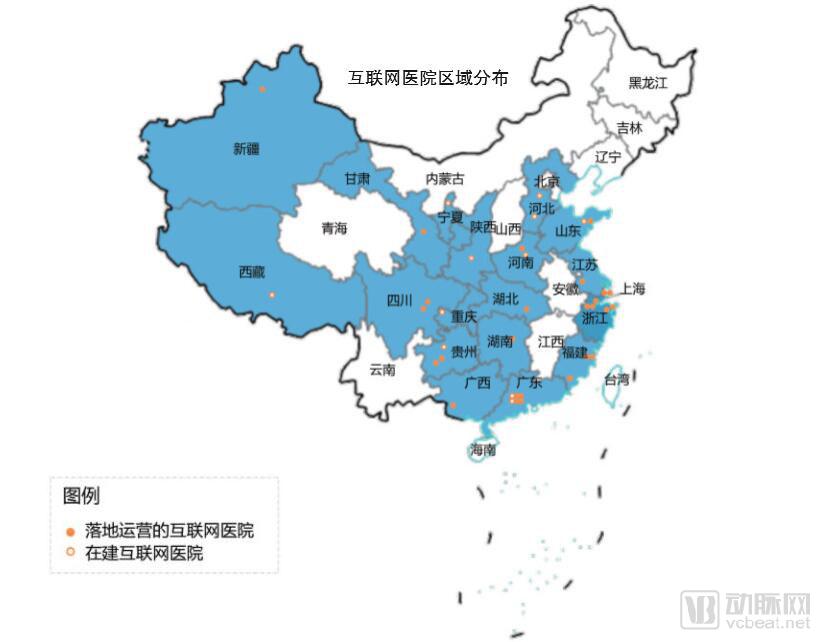
At that time, the mainstream model featured internet healthcare companies such as WeDoctor and AliHealth partnering with medical institutions and local governments as co-initiators. Meanwhile, other participants included IT service providers represented by Neusoft Xikang and Zhiye Interconnect, as well as medical institutions that proactively and deeply implemented the “Internet + Healthcare” model, exemplified by the First Affiliated Hospital of Zhejiang University School of Medicine Internet Hospital.
In November 2016, the “2016 White Paper on China’s Internet Hospitals” was released.。
This report, jointly produced by VCBeat·VBInsight and Tencent Research Institute, provides the first panoramic scan of China’s internet hospitals. It establishes a clear definition for internet hospitals and introduces the industry’s gold standard for evaluation—the “Internet Hospital Maturity Assessment.” Furthermore, it assesses the maturity of 25 operational internet hospitals based on five key indicators: medical services, medical qualifications, breadth of connectivity, depth of connectivity, and dimensions of connectivity.
The “2016 White Paper on Internet Hospitals in China” categorized the 25 internet hospitals that had been launched and were in operation into three tiers based on their maturity. At that time, those truly deserving of the title “Internet Hospital” were those in the first tier: Wuzhen Internet Hospital, Sichuan WeDoctor Internet Hospital, Gansu Internet Hospital, Guangxi Internet Hospital, and Shanghai Children’s Internet Hospital. In terms of connectivity breadth and medical services, these internet hospitals had already established connections at the regional level and even across regions nationwide, and were capable of providing integrated online-to-offline closed-loop medical services.
On March 19, 2017, the Yinchuan Municipal People’s Government and 15 healthcare enterprises held a centralized signing ceremony for a new batch of internet hospitals in Yinchuan.With the addition of Haodf Online and WeDoctor Group, which had previously established operations in the city, the number of internet hospitals in Yinchuan reached 17. This news sparked intense discussion across the industry for several consecutive days. At a time when internet hospitals are still grappling with unclear business models and ambiguous regulatory frameworks, the Yinchuan Municipal Government’s initiative has effectively ushered in a new era for internet hospitals from a policy perspective.
At this point, the number of internet hospitals in China had increased to 79, with 48 operating online and covering 25 provinces. In a short period, internet hospitals experienced explosive growth. The industry is widely pondering whether the surge in internet hospitals represents a new monetization model for digital healthcare. Moreover, amid ongoing debates over whether internet hospitals require licensing, it is urgent to explore what characteristics they should possess, what risks they entail, and which prospects are viewed favorably.
In March 2017, VCBeat Research Institute released the industry report “Analysis of Industrial Models for Internet Hospitals.”, based on the differences in medical service pathways among internet hospitals in the market at that time, internet hospitals are categorized into two mainstream models: B2C and B2B2C.
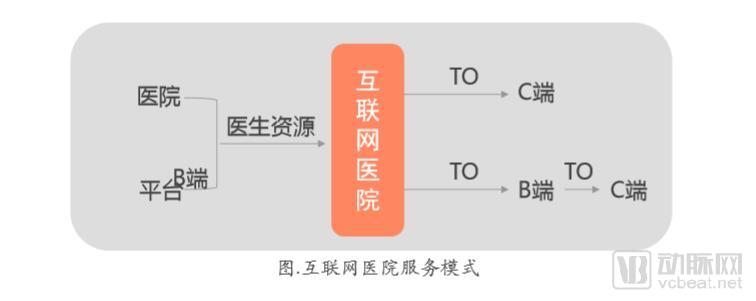
The B2C model involves consultations conducted by hospital-based physicians and doctors from regional or even national platforms for patients, primarily covering initial and follow-up visits. Although this model enables online diagnosis and treatment without geographical or spatial constraints, it suffers from low and unstable prescription rates.
B2B2C Model, typically manifested in the form of medical consortia, establishes “online diagnosis and treatment departments” within hospitals. This model facilitates coordination between physicians at different hierarchical levels. Service access points include primary care institutions such as clinics, pharmacies, community health service centers, and village hospitals. In this setup, physicians interact with other physicians, while patients from the surrounding community are present locally. Primary care physicians provide patient medical histories, laboratory reports, and other relevant data to senior specialists, generally via video consultations. The specialists at tertiary hospitals then proceed with diagnosis and prescription.
At that time, following the introduction of the “One Measure and Two Systems” in December of the previous year, Yinchuan rolled out three additional detailed implementation rules. This established China’s first relatively comprehensive systemic regulatory framework for internet hospital management, as well as the policy support system with the greatest degree of innovation and the strongest level of backing. These policy innovations have significantly advanced the institutionalization of internet hospital management.

However, shortly after the implementation of these detailed rules, internet hospitals were sidelined by the widespread online circulation of the “Measures for the Administration of Internet-Based Diagnosis and Treatment (Trial) (Draft for Comments)” and the “Opinions on Promoting the Development of Internet Medical Services” (Draft for Comments).
A turning point emerged in March 2018, when Premier Li Keqiang, while participating in the deliberation of the government work report with the Ningxia delegation, instructed relevant authorities to accelerate the development of “Internet + Healthcare.” The Premier’s remarks brought “Internet + Healthcare,” which had previously lost momentum, back into the spotlight of public discourse.
On April 28, the General Office of the State Council issued the “Opinions on Promoting the Development of ‘Internet + Healthcare’.”, allowing the development of internet hospitals based on medical institutions. On the basis of physical hospitals, safe and appropriate medical services are provided using internet technology, allowing online follow-up consultations for some common diseases and chronic diseases. After physicians have mastered the patient's medical record data, they are allowed to issue prescriptions for some common diseases and chronic diseases online.
Furthermore, tertiary medical institutions within medical consortiums are encouraged to leverage artificial intelligence and other technological means to provide remote consultation, remote electrocardiogram (ECG) diagnosis, and remote imaging diagnosis services to primary care facilities, thereby facilitating real-time access, mutual recognition, and sharing of examination and test results among member institutions.
Nowadays, "Internet + Healthcare" has become a key national strategy in China. With clear regulatory policies for internet hospitals, local governments are beginning to embrace this model. The concept of internet hospitals is no longer limited to clinical consultations; modules such as diagnosis, physician education, family doctor services, and post-discharge follow-up are being integrated into the internet hospital system in practice.
VCBeat·VBInsight believes that internet hospitals have entered a brand-new stage, breaking through the limitation of only involving in diagnosis and treatment. They are gradually building a closed-loop medical service process that includes "health management - consultation - in-hospital care - rehabilitation," collaborating with medical consortia, family doctors, and pharmaceutical channels to achieve true vertical circulation of medical resources.
We aim to address the key concerns of various stakeholders regarding internet hospitals:
For hospitals: Who are the partners? Who are the existing players?
For Internet Companies: How to Launch a New Internet Hospital?
For Internet Hospitals: How to Implement Performance Management and Cooperation Models?
For Pharmaceutical Companies: How to Collaborate and Capture the Outflow Prescription Market?
For Physicians: Where to Earn, How Much to Earn, and How to Do It?
......
Therefore,Produced by VCBeat“China Internet Hospital Report 3.0,” released on December 18In“2018 Top 100 Future Healthcare Forum”Published on, through in-depth interviews with Yinchuan Smart Internet Hospital, Wuzhen Internet Hospital, 39 Internet Hospital, and the First Affiliated Hospital of Zhejiang University School of Medicine Internet Hospital, as well as survey-based analysis of physicians on internet hospital platforms, aims to clarify regulatory policies, stakeholder attitudes, and key considerations for practical implementation, while summarizing operational achievements and best practices, thereby providing readers with aPractical Guide to Internet Hospitals。

“China Internet Hospital Report 3.0” will be released at the “2018 Future Healthcare 100 Forum.”
Meanwhile, the forum also established 14 thematic forums, including “Internet+ Smart Hospital.”
Forum Date: December 18-19, 2018
Forum Venue: Renaissance Beijing Chaoyang Hotel
Registration Link:https://vcbeat.top/Forum/vb100
(Registrants for the forum will receive a free electronic copy of the "Internet Hospital Report 3.0")
Research Report: Receive 3 Complimentary Reports + a ¥100 Forum Coupon
“China Internet Hospital Report 3.0” is now calling for project submissions from hospitals, enterprises, and institutions related to internet hospitals within the industry! To participate in the survey, please scan the QR code or click the link below.

Call for Submissions Link:http://vcbeat2018.mikecrm.com/2UZay4e
Students who participate in our questionnaire survey will receive three reports on internet hospitals from VCBeat·VCBeat Research Institute: "2016 China Internet Hospital White Paper," "Analysis of Industrial Models for Internet Hospitals," and "China Internet Hospital Report 3.0" (among which, "China Internet Hospital Report 3.0" will be released at “2018 Future Healthcare Top 100 Forum”on-site release and collection), as well as a 100-yuan discount coupon for the “2018 Top 100 Future Healthcare” Forum.
1. "2016 White Paper on Internet Hospitals in China"
In 2016, VCBeat·VBInsight, in collaboration with Tencent Research Institute, produced and released the “2016 White Paper on Internet Hospitals in China,” conducting the first comprehensive overview of internet hospitals in the country. The report provided a clear definition of internet hospitals and introduced the industry’s gold standard for evaluation—the “Internet Hospital Maturity Assessment”—while also assessing the maturity levels of 25 implemented internet hospitals.
2. “Analysis of the Industrial Model of Internet Hospitals”
In 2017, prior to the industry’s explosive growth, VCBeat Research published “Analysis of Business Models in Internet Hospitals.” Building on its ongoing attention to and understanding of internet hospitals, four analysts from VCBeat Research spent an additional month conducting an in-depth examination of the operational, pricing, and profitability models of 79 internet hospitals, thereby identifying shifts in their business models.
3. “China Internet Hospital Report 3.0”
In 2018, internet hospitals entered their true “Year One” of development. At the “2018 Top 100 Future Healthcare Forum,” VCBeat will release the “China Internet Hospital Report 3.0.” By conducting comprehensive visits to internet hospital enterprises and interviewing physicians on internet hospital platforms, we aim to present a holistic industry perspective on the current state of internet hospital development in China. This report clarifies regulatory policies, stakeholder attitudes, and key considerations for practical implementation, while summarizing operational achievements and best practices to provide readers with a practical guide to operating internet hospitals.
*Excerpted from the "2016 White Paper on Internet Hospitals in China" and "Analysis of Industrial Models for Internet Hospitals."