

WISH Summit in Doha Highlights Global Health Innovation Amid IPO Filing
When Qatar is mentioned, people’s minds typically turn first to oil, natural gas, and the FIFA World Cup; few associate it with the healthcare industry. This is understandable: with a population of just over two million, Qatar lacks the market foundation necessary to nurture large-scale pharmaceutical enterprises. Moreover, its economy, heavily reliant on oil and natural gas extraction, does not provide the conditions conducive to generating cutting-edge medical technologies.
However, this does not mean that Qatar is excluded from global healthcare innovation. On the contrary, leveraging its economic and geographical advantages, Qatar has organized or hosted numerous global conferences in the healthcare sector and supported many medical innovations and social welfare projects, making significant contributions to global medical progress and equity.
Recently, VCBeat (WeChat: vcbeat) was invited to attend the WISH Healthcare Innovation Conference held in Doha, the capital of Qatar. The event provided not only an opportunity to learn about the local customs and culture of this Middle Eastern oil-rich nation but also enabled participation in discussions on healthcare innovation led by top global speakers.
The full name of the WISH Conference is the World Innovation Summit for Health, sponsored by the Qatar Foundation. WISH has a sister conference, WISE (World Innovation Summit for Education). The two conferences are held alternately, with one theme each year, to discuss the problems and solutions facing global healthcare and education.
Customs and Traditions: A Beautiful and Resource-Rich Peninsular Nation
Qatar is a peninsular country located in the central part of the western coast of the Arabian Gulf (Persian Gulf). It is bordered by sea on its eastern, northern, and western sides, with a coastline totaling 563 kilometers; to the south, it shares a land border of approximately 60 kilometers with Saudi Arabia.
Qatar’s primary natural resources are oil and natural gas. Its proven oil reserves (including condensate) amount to 2.8 billion metric tons, equivalent to 26.2 billion barrels, ranking 12th worldwide. Its natural gas reserves stand at approximately 25.8 trillion cubic meters, equivalent to 164 billion barrels of oil equivalent, accounting for 15.3% of the world’s total natural gas reserves. This places Qatar third globally, after Russia and Iran.
In 2014, Qatar’s population was 2.12 million, with Qatari citizens accounting for approximately 15% and expatriates for about 85%. The expatriate population primarily originated from India, Nepal, the Philippines, and other Arab countries. Approximately 83% of Qatar’s population was concentrated in the capital city, Doha.
Arabic is the official language, while English is widely spoken. Islam is the state religion; the majority of residents are Muslims, most of whom belong to the Wahhabi sect of Sunni Islam. Shi’a Muslims constitute approximately 16% of the national population.
Qatar is a mono-petroleum economy, with its pillar industries being oil and natural gas and the associated petrochemical sector, which has long accounted for more than 60% of Qatar’s GDP. In 2014, Qatar’s nominal GDP was preliminarily estimated at USD 211.8 billion, representing a year-on-year increase of 6.2%. However, as Qatar vigorously developed its non-oil-and-gas economy and pursued an economic diversification strategy, the output value of its non-oil-and-gas sectors surpassed that of the oil-and-gas sectors for the first time by the end of 2014, accounting for 50.7% of GDP.
From our on-the-ground observations, Qatar is a beautiful and affluent peninsular nation. Its capital, Doha, is dominated by skyscrapers, a testament to its rapidly growing economy. Construction sites are ubiquitous, with high-rises rising steadily across the cityscape. A stroll along the Corniche offers a pleasant and relaxing experience.
WISH Conference: Focusing on Global Healthcare Innovation
This year’s WISH Conference marks its fourth edition, aiming to provide an open international platform for the global healthcare sector to promote and showcase innovative medical applications and achievements, thereby fostering global health exchange and cooperation.
This year, the summit convened 2,000 leading scholars, business leaders, public policymakers, and innovation practitioners from over 100 countries to jointly discuss, connect, share, and explore innovative solutions addressing the world’s most pressing health issues and challenges.
In terms of agenda setting, WISH primarily features a main forum, sub-forums, and an innovation exhibition. The first two are initiated by relevant experts who propose topics and invite guests to participate in discussions, while the latter provides a venue for young global entrepreneurs to showcase their projects.
Speakers at the forum included Lord Darzi of Denham (Executive Chairman of WISH and Chair of the Paul Hamlyn Centre at Imperial College London), Mary Robinson (former President of Ireland and former United Nations High Commissioner for Human Rights), and David Miliband (President and CEO of the International Rescue Committee and former UK Foreign Secretary). Additionally, speakers from the cultural and sports sectors attended, such as Michael Phelps, the renowned swimmer who won eight gold medals at the Beijing Olympics.
Lord Darzi of Denham, the Executive Chair of the Conference, delivered the opening address. He stated that WISH is not merely about ideas and innovation, but rather a platform that provides industry leaders, policymakers, government agencies, and academic institutions with opportunities to share insights and address the challenges facing the world today.
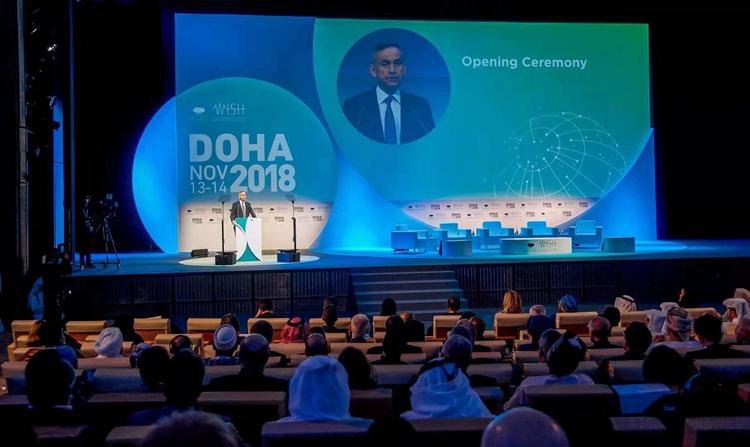
Conference Executive Chairman Lord Darzi of Denham Delivers Opening Keynote. Image courtesy of WISH.
Healthcare is a global issue. People in remote, conflict-ridden, and economically underdeveloped regions often struggle to access quality medical services. In areas with abundant medical resources, needs such as vaccination may seem trivial, yet they can easily prove fatal for patients in remote areas. We should not only focus on cutting-edge innovations in global medical technology and service delivery models but also prioritize equity and equal access to healthcare services. This is both a key topic of the current WISH Conference and a critical challenge that healthcare professionals must address through concrete action.