

Yinzhan Medical Group: Pioneering Remote Imaging Diagnostics in Yinchuan to Address Grassroots Radiology Challenges
Since the emergence of “Internet + Healthcare” in 2014, it has traversed a long and tortuous path. Amidst the uncertainty, Yinchuan, a northwestern city, became one of the first pilot sites for “Internet + Healthcare.” After three years of persistent efforts, it was designated by the National Health and Family Planning Commission as the only national demonstration zone for “Internet + Healthcare” in China.
Within the comprehensive “Internet+ Healthcare” ecosystem built in Yinchuan, which encompasses end-to-end medical services, laboratory testing, remote consultations, and artificial intelligence applications, medical imaging holds a pivotal position. As a discipline that provides scientific and intuitive evidence for disease diagnosis, it is also one of the fields experiencing the most rapid technological innovation.
Ma Xiaofei, Director of the Yinchuan Municipal Health and Family Planning Commission and President of Yinchuan First People’s Hospital, emphasized at the “2018 Ningxia Internet Plus Medical Imaging Summit Forum and Consensus Workshop on the Preliminary Draft of Internet Plus Medical Imaging Standards”: “Imaging examinations are the most commonly used and most important diagnostic method in clinical diagnosis. With advances in software technology and the widespread adoption of digital radiography (DR) equipment at the primary care level, medical imaging occupies a critically important position within the ‘Internet Plus Healthcare’ ecosystem.”
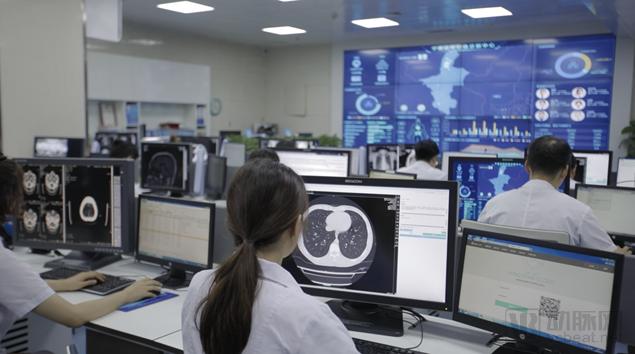
So, what sparks will fly from the integration of the internet and medical imaging? At the Remote Imaging Diagnosis Center of Yinchuan First People’s Hospital, with technical support provided by Wingspan Medical Group, VCBeat observed the real-world working conditions of radiologists in an environment combining “Internet Plus” and medical imaging.
“Equipment Without Operators”: The Advantages and Inevitability of Integrating Grassroots Radiology Departments with the Internet
Throughout the entire patient care journey, imaging findings play a pivotal role in disease assessment, characterization of lesions, formulation of surgical plans, and evaluation of treatment outcomes. According to Ma Xiaofei, the remote imaging diagnosis center project in Yinchuan originated from field research conducted at grassroots healthcare facilities.
During the research, he discovered that primary healthcare institutions faced the issue of underutilized equipment. Although government funding had equipped township health centers with digital radiography (DR) systems, it proved far easier to procure machines than to staff them adequately. There was significant regional disparity in the competency of radiologists, a shortage of radiologists at the grassroots level, and high rates of misdiagnosis and missed diagnoses in overall imaging interpretation, making it difficult to meet clinical requirements for diagnostic accuracy.
According to data from VCBeat’s Eggshell Research Institute, the annual growth rate of medical imaging data in China is currently approximately 30%, while the annual growth rate of radiologists is only about 4.1%. This represents a gap of 25.9 percentage points, indicating that the increase in the number of radiologists falls far short of the surge in imaging data.
Shortages of personnel, lengthy physician training cycles, and underutilized equipment plague primary healthcare institutions that already suffer from scarce resources.
“If imaging services are unavailable at primary care facilities, patients will inevitably flock to large hospitals. Only by addressing the challenges of auxiliary diagnosis can we retain patients at the primary care level,” emphasized Ma Xiaofei.
In contrast to internet hospitals, which did not experience favorable policy conditions until 2018, the General Office of the State Council had already issued the Guiding Opinions on Advancing the Construction of a Tiered Diagnosis and Treatment System in September 2015. The opinions pointed out that regional medical resources should be integrated by establishing third-party independent clinical laboratories, medical imaging centers, blood purification centers, and other institutions to compensate for the scarcity of resources in primary healthcare facilities, and to promote mutual recognition of test results among healthcare institutions at the same level as well as between healthcare institutions and independent testing organizations.
Encourage secondary and tertiary hospitals to provide services such as remote consultations, remote pathology diagnosis, remote imaging diagnosis, remote electrocardiogram (ECG) diagnosis, and remote training to primary healthcare institutions. Encourage regions with the necessary conditions to explore effective models of “primary-level examination and higher-level diagnosis.”
The rapid advancement of tiered diagnosis and treatment, coupled with continued support for privately funded healthcare institutions, will directly elevate the level of medical imaging diagnostics in primary care and private hospitals, thereby unlocking greater growth potential in the primary care medical imaging market.
In August 2017, Ningxia’s first remote imaging diagnosis center was established at Yinchuan First People’s Hospital. Regarding this initiative, Ma Xiaofei believes that this innovation is driven by three needs and two key elements:
First, to meet the public’s demand for managing minor illnesses at the primary care level without needing to visit higher-level hospitals, thereby accessing quality medical care at a lower cost;
Second, the National Health Commission’s drive to promote tiered diagnosis and treatment;
Third, the long-term benefit needs of primary healthcare institutions to retain patients at the grassroots level;
One of the key factors is the role of tertiary hospitals. These institutions should provide cloud-based support while leveraging remote diagnostics to prevent their inpatient beds from being occupied by common conditions. This approach enables tertiary hospitals to focus on complex and critical cases, curbs overmedicalization, and truly realizes a tiered diagnosis and treatment system.
Ma Xiaofei stated, “To advance tiered diagnosis and treatment, patients who previously needed to seek medical care in Beijing should be retained in Yinchuan, and those who previously needed to go to Yinchuan should be retained at the township level.”
Another key factor is third-party platforms, where the involvement of private capital serves as a beneficial supplement to the overall healthcare system; meanwhile, hospitals create a profitable business model for these platforms, allowing each party to leverage its respective strengths.
Leveraging external forces to build external resources and engaging outside experts to rapidly enhance the service standards of local medical institutions and their capacity to serve the local population is key to the development of “Internet Plus” healthcare.
Radiologists “Grab Orders” to Interpret Scans, Completing 52,000 Imaging Diagnoses in One Year
According to Chen Tong, Director of the Radiology Department at Yinchuan First People’s Hospital, the department has a total of 19 radiologists. Among them, 76% hold senior professional titles (associate chief physician or above). This inverted pyramid staffing structure indicates that the training of junior physicians has not kept pace; however, such a structure is more conducive to conducting remote consultations and providing technical support to primary healthcare institutions.
Through the remote imaging diagnosis system of Yinchuan First People's Hospital, primary healthcare institutions can upload medical images to the Wingspan Cloud Imaging Diagnosis Platform by connecting to the external internet via a compact Wingspan Box. Upon receiving the images, the remote diagnosis center enables radiologists to promptly complete the diagnosis and draft the report, which is then transmitted back to the referring hospital.
On average, it takes about 30 minutes for the primary healthcare center to receive the diagnostic report, enabling further diagnosis and treatment for the corresponding patients. This service fundamentally addresses the shortage of radiologists or the insufficient expertise among physicians in primary medical institutions.
In addition, Wingspan Medical Group has equipped the remote imaging diagnosis center with a real-time monitoring dashboard that displays report transmission times and conducts secondary analysis of all information flows, thereby enhancing support from tertiary hospitals to primary healthcare institutions and improving problem-solving capabilities.
According to Chen Tong, the radiology department at this hospital handles 400–500 in-house diagnostic cases and 200 remote diagnostic cases daily. Therefore, innovative concepts are indispensable in optimizing workflows. The goal is to transform work methods and models, better leverage existing operational frameworks, and generate incremental service value. Currently, the Radiology Department of Yinchuan First People’s Hospital employs three operational models—task-grabbing, task-assignment, and fallback coverage—to enhance physicians’ efficiency and benefits.
Currently, the center is connected to 62 institutions, including secondary hospitals, township health centers, and community health service centers. The maximum daily diagnostic volume has reached 1,400 cases, with a total of 52,000 remote diagnoses completed over the past year.
According to Gao Yunlong, Partner and CMO of Wingspan Medical Group: “With the Wingspan Box, grassroots medical institutions can be rapidly connected and deployed. Provided that the network conditions at a grassroots medical institution are adequate, it takes only two hours to set up the image upload tool, transfer all imaging data to the cloud platform, and then reorganize the workflow.” This represents an innovation in work methods and operational models.
The architecture of the remote imaging diagnosis center, supported by Wingspan Medical Group, connects top-tier cities like Beijing and Shanghai at the upper end with counties and townships at the lower end. Upward, a cloud-based platform leverages a large pool of top-tier domestic experts to ensure quality control; once patients enter this system, even complex and difficult cases can be effectively addressed. Downward, the network encompasses various equipment types—from DR and MRI to CT—and covers all primary healthcare institutions across three districts, two counties, and one city, providing them with uninterrupted 24/7, 365-day-a-year service. This achieves comprehensive coverage in terms of geography, time, and services.
Meanwhile, this model creates a win-win-win scenario for all three parties. Radiologists can increase their income through remote diagnostics; primary healthcare institutions can retain patients at the grassroots level, thereby achieving long-term benefits; and patients can enjoy superior services from tertiary hospitals without incurring additional costs, truly realizing the goal of “fewer trips, more information.” For enterprises, a revenue-sharing model allows them to collect certain information maintenance fees, thereby creating a new business model.
Innovators in Healthcare Services: Leveraging Wingspan’s Strengths in Grassroots Care
Ma Xiaofei stated that there were three reasons for initially choosing to collaborate with Wingspan Medical Group:
First, Wingspan’s service-oriented business philosophy aligns closely with Yinchuan’s “Internet + Healthcare” system;
Second, through nine years of exploration in the field of medical imaging, Wingspan has connected a wealth of expert resources within its cloud platform;
Third, the technical architecture is sound. The Wingspan Box offers a low entry barrier for primary healthcare institutions and features strong connectivity with medical devices.
Founded in 2009, Wingspan Medical Group initially entered the healthcare sector through software assistance and informatics solutions for medical imaging, providing services such as PACS and hospital information systems. The company subsequently established the “Wingspan Cloud Imaging” cloud-based diagnostic platform, launched the “Yingling” app, and formed a physician group. Leveraging its technological advantages, Wingspan then expanded into medical AI, initiated offline operations, and began establishing third-party medical imaging centers to serve primary healthcare institutions.
Notably, in 2011, Wingspan became the only private enterprise involved in drafting the “Connectivity Standards for Medical Diagnostic X-ray Imaging Equipment.” Currently, Wingspan holds 157 copyrights, and its core products have obtained CE certification from the European Union, FDA clearance from the United States, and CFDA approval from China.
After nine years of exploration, Wingspan Medical Group has emerged as a trailblazer in the fields of medical imaging and artificial intelligence. Currently, Wingspan has deployed its cloud platform across China, with nearly 2,000 hospitals connected to this diagnostic platform.
At the recently concluded CCR Congress, Wingspan Medical Group unveiled its AI-powered product, W-insight, which enables automated generation of chest images from digital radiography (DR), along with classification and imaging findings reports for 17 thoracic and pulmonary conditions. This solution achieves a complete diagnostic workflow encompassing image interpretation, diagnosis, and report generation. It can be widely applied to patient health screenings and related services, significantly reducing operational costs for screening institutions and further supporting the enhancement of primary healthcare services.
According to Gao Yunlong, the advantages of the new product lie in:
1. The new product offers extensive applicability and widespread adoption at the primary care level. Digital Radiography (DR) is a medical imaging tool widely deployed on a large scale in primary healthcare institutions. W-insight leverages industry-leading machine learning technology to automatically generate diagnostic reports from DR images, thereby facilitating its broad application in screening and health check-ups.
2. New products can improve doctors' work efficiency, reduce costs and increase speed. DR images automatically generate reports, which can reduce the time doctors spend on input. At the same time, they can refer to the machine-generated report and make modifications based on the doctor's judgment. According to calculations, W-insight can significantly reduce the diagnostic input time for doctors.
The Medical Imaging Diagnostic Center is the most critical component of Wingspan’s entire healthcare ecosystem. Remote imaging addresses the current imbalance in the distribution of medical resources while continuously empowering Wingspan’s healthcare ecosystem.
Leveraging its comprehensive ecosystem, Wingspan not only supports every medical imaging diagnostic center but also enhances its AI capabilities with standardized data acquired from these centers. This continuous improvement in diagnostic performance and accuracy creates a complete service loop.
As early as 2017, Ni Meng, founder of Wingspan Medical Group, defined himself as a “healthcare service provider” rather than a “medical software vendor” in an interview with VCBeat. To better serve patients and physicians, Wingspan will leverage its continuous exploration in the field of medical imaging to further provide innovative service models for “Internet + Medical Imaging.”