

China Smart Elderly Care Industry Development Report (2018): Four Standardization Challenges Identified, Market to Mature by 2020
VCBeat (WeChat ID: vcbeat) has learnedOn November 24, the “2018 China Hualing Forum – The 6th National Strategic Symposium on Smart Elderly Care and the China Railway Renzhi Health and Elderly Care Industry Forum” was held in Chongqing. At the event, the Hualing Smart Elderly Care Industry Development Center and the Social Sciences Academic Press jointly released the Blue Book titled “Report on the Development of China’s Smart Elderly Care Industry (2018)” (hereinafter referred to as the “Blue Book”).
The Blue Book points out that China’s smart elderly care industry, which started in 2012, went through stages of advocacy and pilot programs, and entered a nationwide promotion phase in 2017. In February 2017, three national ministries and commissions jointly issued the Action Plan for the Development of the Smart Health and Elderly Care Industry (2017–2020), marking the introduction of the first national-level plan for the smart elderly care industry and ushering in a golden period of development for China’s smart elderly care sector.
I. Six Current Development Trends in China’s Smart Elderly Care Industry
The Blue Book highlights six key aspects of the current development of China’s smart elderly care industry: sustained growth in demand for smart elderly care services, increasing government support and policy incentives, the basic formation of an industrial support system, a market landscape characterized by proactive strategic positioning, continuous innovation in service models and business formats, and accelerated innovation in key technologies and smart products.
II. The Development of Smart Health and Elderly Care Communities Has Become a Major Direction
Communities serve as the basic units for social management by grassroots government authorities and as fundamental platforms for integrating governmental and market resources. The essential attributes of elderly care services and communities determine the foundational role of communities in smart elderly care. In the future, the development of smart health and elderly care communities will become a primary direction. With sub-district (township) communities as the basic units, and relying on comprehensive community public service information platforms, we can precisely match elderly individuals’ service needs with available resources, facilitating service providers in delivering precise, personalized, and professional services to the elderly. By leveraging technologies such as the internet, mobile internet, and the Internet of Things (IoT), we will develop intelligent home- and community-based elderly care services, promoting the integrated development of elderly care, health preservation, and medical services.
III. During the 13th Five-Year Plan period, China's smart elderly care industry system will exhibit new trends characterized by "innovation, integration, application, and sharing."
By the end of the 13th Five-Year Plan period, the population aged 60 and above in China is projected to reach approximately 255 million, accounting for about 17.8% of the total population, with the elderly dependency ratio rising to around 28%. The demand for elderly care services is showing a trend of simultaneous growth in both volume and quality. China’s first peak in elderly population growth (with an annual increase of 8.4 million) is expected to end around 2018, while a second peak (with an annual increase of 11 million) will emerge after 2022. The 13th Five-Year Plan period coincides with the trough between these two peaks, presenting a favorable window for strategic preparations to actively respond to population aging, as well as for building a modern elderly care service system and developing the elderly care service industry. During this period, China will establish an intelligent elderly care industrial system with distinct characteristics of the new era, exhibiting new trends of “innovation, integration, application, and sharing.”
IV. Major Achievements in the Development of China’s Elderly Care Service Industry
The Blue Book points out that China’s elderly care service industry has achieved significant historic milestones. First, a preliminary framework of laws and regulations has been established, with the cumulative effect of policies gradually becoming evident. Second, government investment has grown rapidly, increasingly leveraging social capital. Third, an elderly care service system has been initially established, significantly enhancing supply capacity. Fourth, the informatization, standardization, and specialization of elderly care services have been actively promoted, leading to a progressively optimized development environment.
V. The primary form of future smart elderly care will be the widespread application of smart home technology
The primary form of future smart elderly care will be the widespread adoption of smart home systems, which integrate next-generation information technologies—such as the Internet of Things (IoT), cloud computing, big data, and artificial intelligence—into the homes of older adults to provide safe, convenient, and comfortable services. This represents an innovative model and format within the elderly care service industry.
VI. The smart elderly care service industry will enter its maturity phase in 2020
Based on the current technological and economic conditions, the period from approximately 2015 to 2017 is identified as the incubation phase for the smart elderly care services industry. During this period, regulations, policies, standards, innovation systems, and trusted transaction environments adapted to the elderly care services industry will be gradually established, and numerous smart elderly care service enterprises will continuously introduce new offerings. The period from approximately 2018 to 2020 will mark the growth phase of the smart elderly care services industry.
During this period, various enterprises adapting to the smart elderly care service industry were basically established, innovative service models continued to emerge, and the investment and financing market was very active. An important turning point in the development of the smart elderly care service industry occurred around 2020. After 2020, the scale of the online intangible market is expected to gradually approach that of the traditional tangible market, with the smart elderly care service industry projected to enter its maturity stage at that time.
VII. Information Technology Enterprises Are the Main Force in China’s Smart Health and Elderly Care Sector
In 2017, among the 53 smart health and elderly care demonstration enterprises announced by three national ministries and commissions, there were 20 information technology companies and 12 medical technology companies, collectively accounting for nearly half of the market. This is because information technology enterprises possess the following advantages: (1) strong independent research and development capabilities, providing robust momentum for sustainable corporate innovation; (2) abundant information resource advantages, delivering professional and high-quality intelligent services to the elderly care industry; (3) mature elderly care products, services, and systems capable of market-oriented promotion and operation; and (4) clear operational and profitability models, basically achieving sustainable development.
VIII. Four Major Issues in the Standardization of Smart Elderly Care in China
Overall, there are four main issues with the standardization of smart elderly care in China.
(1) The standard system for smart elderly care is inadequate, and the supply of smart elderly care products falls short of demand;
(2) There are connectivity barriers between smart elderly care products and smart elderly care systems;
(3) Insufficient sharing of public health and medical data;
(4) The level of informatization management and supervision in smart elderly care is struggling to keep pace with market development. Therefore, it is necessary to support the establishment of professional industry associations, authoritative social organizations, and research institutions within the smart elderly care sector. In accordance with market-oriented principles, technical management standards should be coordinated and planned, while efforts should be made at multiple levels to encourage and support relevant stakeholders in promoting the interoperability and shared application of public data, thereby effectively delivering elderly care services that meet the actual needs of older adults.
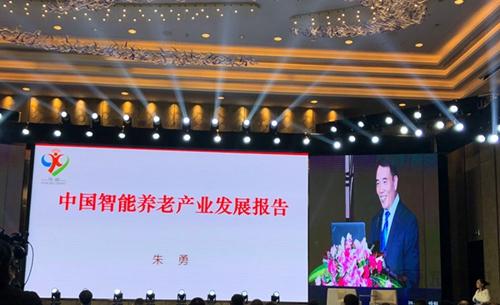
At the conference, Zhu Yong, former Deputy Director of the National Working Commission on Aging and Chairman of the Hualing Intelligent Elderly Care Industry Development Center, stated that in recent years, support from the State Council and relevant departments—including the Ministry of Civil Affairs, the National Health Commission, and the Ministry of Industry and Information Technology—has continuously increased. The integration of smart elderly care products and services has significantly improved, innovation in service models and business formats has steadily advanced, and the development of smart health and elderly care communities has shown a positive trend. A market structure dominated by the government has taken shape in the intelligent elderly care industry. Zhu Yong also pointed out that China’s intelligent elderly care industry faces challenges such as inadequate implementation of policies, an unsound industrial financial support system and standards framework, unclear understanding of the attributes of the health and elderly care industry, and unbalanced development.
Zhu Yong believes that the main situation facing China's smart elderly care industry is: the problem of population aging is becoming increasingly apparent, the trend of economic and social adaptation to aging is obvious, the industrial development environment is further optimized, and the demand for health and wellness services is growing rapidly. Currently, the average retirement age in China is 53.3 years, which is 12 years lower than that of developed countries; the average life expectancy of China's population is 76.7 years, close to the level of developed countries, but the average healthy life expectancy is only 66 years, 9 years lower than that of developed countries; by 2020, the number of elderly people aged 80 and above in China will reach 30 million, the number of disabled elderly will be 42 million, the number of elderly living alone or in empty nests will be 118 million, the number of disabled elderly will be close to 10 million, the number of elderly people suffering from chronic diseases will be 150 million, the number of medical visits will reach 1.86 billion, and the number of hospitalization cases throughout the year will be nearly 35 million. While the problem of population aging is becoming more prominent, the demand for health and wellness is growing rapidly. As one of the pillar industries supporting China's future economic development, the status of the health and wellness service industry will be further clarified, and the business environment will also be further improved.
During the conference, the China Railway Renzhi Health and Elderly Care Industry Forum was also held, and attendees conducted on-site visits to the “China Railway Renzhi Health City.” Developed by Chongqing China Railway Renzhi Elderly Care Industry Co., Ltd., one of the first batch of smart health and elderly care demonstration enterprises in China, the Health City has been included in the National Catalogue for the Promotion of Smart Health and Elderly Care Products and Services. With its innovative design concepts, comprehensive architectural facilities, advanced intelligent systems, excellent ecological environment, and mature service framework, it represents the development direction of age-friendly community construction in China. The project received high acclaim and recognition from attendees and was designated as an “International Hualing Age-Friendly Community” by the International Federation on Ageing and the Hualing Smart Elderly Care Industry Development Center.
Wu Yushao, Member of the Party Leadership Group and Deputy Director of the Office of the National Working Commission on Aging; Li Xuemin, General Manager of China Railway No.10 Engineering Group Co., Ltd.; Zhu Yong, Former Deputy Director of the Office of the National Working Commission on Aging and Chairman of the Hualing Smart Elderly Care Industry Development Center; Nie Meisheng, Founding President of the Real Estate Chamber of Commerce of the All-China Federation of Industry and Commerce; Chen Dapeng, Director of the Internet of Things Research and Development Center of the Chinese Academy of Sciences; Wu Liuxin, Dean of the Zhongguancun New Zhiyuan Health Management Research Institute; Wang Zhiliang, Chief Professor at the University of Science and Technology Beijing; Yu Dongsong, Chairman of Chongqing China Railway Renzhi Elderly Care Industry Co., Ltd.; Yu Yaping, Vice Chairman; Li Nengpeng, General Manager; Yang Bin, Executive Deputy General Manager; as well as outstanding representatives from smart health and elderly care enterprises in the industry, attended this conference.
The conference was jointly hosted by the Hualing Intelligent Elderly Care Industry Development Center, the International Federation on Ageing, China Railway No. 10 Engineering Group Co., Ltd., Zhongguancun New Wisdom Source Health Management Research Institute, the Third Research Institute of China Electronics Technology Group Corporation, and Hualing Kangyang Group, with Chongqing China Railway Renzhi Elderly Care Industry Co., Ltd. serving as the organizer. More than 400 attendees participated in the conference, including experts and scholars from relevant fields, officials in charge of aging affairs offices from selected provinces, autonomous regions, municipalities directly under the Central Government, and cities with independent planning status, as well as representatives from various sectors of society.