

Medtronic Bets Big on Diabetes Management, Taking on Google and Apple in Digital Health Race
A few days ago, Medtronic acquired its long-time partner, Nutrino, an AI-assisted nutrition management platform.This is not the first time Medtronic has introduced AI into diabetes management; through this small ripple, one can discern the undercurrents of Medtronic’s strategic layout.Previously, Medtronic also collaborated with IBM Watson to launch Sugar.IQ, an intelligent diabetes lifestyle management software.
In addition, Medtronic’s competitor Dexcom recently acquired TypeZero Technologies, a diabetes management platform renowned for its excellence in insulin delivery algorithms.
Their identical moves are no coincidence. In the arena of diabetes management, VCBeat (WeChat ID: vcbeat) has observed that both pharmaceutical companies and internet giants such as Google, Apple, and Tencent are placing substantial bets.
In this article, VCBeat seeks to reveal:
1. What strategic logic did Medtronic adopt in its diabetes management portfolio?
2. How giants such as Google and Apple choose their entry “anchor points”;
3. What is the development environment of the health management market in the United States;
4. The state of the domestic market and where the opportunities lie.
In the public perception, Medtronic is a major professional player in the medical device industry. However, as shown in the figure below, Medtronic has achieved comprehensive coverage in the field of diabetes, with corresponding products available across all stages, including prevention, treatment, and prognosis.
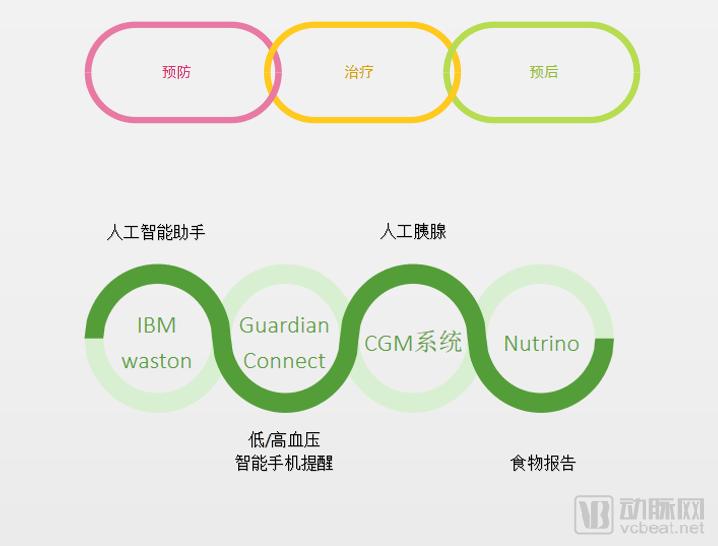
Medtronic Diabetes Digital Health Solution — Graphic by VCBeat
“Medtronic maintains its leadership position in most of the fastest-growing medical technology markets today, and we will invest more capital in faster-growing markets and new opportunities,” said Medtronic President Omar Ishrak. “We are seeking to go beyond simply improving and innovating existing products and therapies; our goal is to disrupt the market.”
This passage clearly reveals Medtronic’s mindset: to genuinely address medical challenges, rather than merely serving as a supplementary player or supporting actor.
In this regard, Medtronic has delivered commendable performance. Medtronic’s MiniMed system was the first continuous glucose monitoring system approved by the U.S. Food and Drug Administration (FDA), commonly referred to as an “artificial pancreas.” By enabling direct communication between the Continuous Glucose Monitoring System (CGMS) and the insulin pump, MiniMed administers appropriate doses of insulin to patients in a timely manner under algorithmic guidance. This system achieves closed-loop insulin delivery, significantly improving glycemic control, enhancing patients’ quality of life, reducing complications, and lowering healthcare costs.
The FDA also sees promise in this “artificial pancreas,” announcing an expansion at the end of June this year.Approval of the MiniMed 670G’s indications for use has expanded its application to children aged 7 years and older.
“The Artificial Pancreas” is more of a technological breakthrough. Let us now examine Medtronic’s strategic initiatives surrounding the “Artificial Pancreas.”This reveals Medtronic’s ambition to fully control the health management rhythm of diabetes patients, rather than merely playing a supporting role as a device provider.
Subsequently, Medtronic developed the Guardian Connect system, which links smartphones with continuous glucose monitors (CGMs) and has also received FDA approval. The Guardian Connect system consists of a Guardian sensor and a paired transmitter, which sends continuously collected data via Bluetooth to the Guardian Connect app on the user’s smartphone. This app can alert patients up to 60 minutes before hyperglycemic or hypoglycemic events occur.
Medtronic’s acquisition of the AI-powered nutrition management platform Nutrino is also aimed at integrating Nutrino’s predictive glycemic response algorithms into its technology stack. As early as June this year, Medtronic had already reached an agreement with Nutrino to incorporate Nutrino’s FoodPrint reporting technology into the Medtronic iPro2 myLog application, enabling users to directly visualize how consumed foods will impact their blood glucose levels.
Medtronic is by no means content with superficial efforts in this regard,but rather to thoroughly bridge the last mile of data analytics, ultimately delivering professional, intelligent analysis directly to users.
Previously, Medtronic and IBM Watson collaborated to launch a diabetes health management software called Sugar.IQ. Currently, the application can be used in conjunction with the Medtronic Guardian Connect system to form a continuous glucose monitoring system. Sugar.IQ is available for iOS-based mobile phones in the United States.
Sugar.IQ is akin to applying Alexa and Siri to the health management of patients with diabetes. Huzefa Neemuchwala, Head of Global Digital Health Solutions and Artificial Intelligence at Medtronic, stated, “It is an intelligent assistant that tracks all your data and intelligently aggregates it. Then, leveraging Watson technology, we can provide insightful recommendations to help you better manage your diabetes.”
Notably, the collaboration between Medtronic and IBM Watson Health has also received FDA approval; the FDA has authorized the use of IBM Watson Health’s artificial intelligence analytics to inform users with data-derived recommendations.
Why is it necessary to gather such extensive data? Huzefa Neemuchwala, Senior Director of Data and Information Innovation at Medtronic, explained: “Patients with diabetes want a direct answer to the question, ‘How much insulin do I need right now?’ However, this is not a question the FDA can directly address, as the answer depends on numerous factors. Did you sleep well last night? Are you ill? Are you under stress this morning? What is your current blood glucose level? What is your historical blood glucose profile? Many variables influence the amount of insulin you should take at any given moment. But by integrating an increasing number of these data streams, we can provide an answer by stating, ‘In similar situations in the past, you took this amount of insulin,’ thereby offering a personalized recommendation.”Data can bring us closer to the optimal answer.
Moreover, medical device companies are becoming more consumer-friendly. Philips, for instance, operates both B2B and B2C businesses. The company has already integrated its medical business with its personal health business, beginning to consolidate into a single health technology company.
Medtronic’s approach is to build on its core products and integrate comprehensive solutions.This logic is easy to understand. Just as basic mobile phones were originally designed for calling and social interaction, smartphones integrate multiple functions—such as photography, communication, entertainment, and life management—ultimately guiding users on what to do. Medtronic’s “artificial pancreas” is akin to a device with superior communication capabilities, whereas the company is building a “smartphone” for diabetes management. It is also actively recruiting talent to develop its proprietary “apps.”
In a 2015 interview with MobiHealthNews, Medtronic CEO Omar Ishrak stated that the company would focus on smaller-scale acquisitions and the development of its diabetes business. In 2014, Medtronic acquired Corventis, a company specializing in wearable patch-based cardiac monitoring. Corventis’s peel-and-stick PiiX sensor received FDA approval in 2009. The PiiX device can measure a range of vital signs, including fluid status, heart rate, heart rate variability (HRV), respiratory rate, activity levels, and posture.
VCBeat has found that collecting user data for effective diabetes management is a long-term strategic focus for IT giants like Google and Apple, as well as multinational pharmaceutical companies such as Sanofi. Google’s approach involves collaborating with professional pharmaceutical companies or device manufacturers, while Apple is making its moves behind the scenes.
Dexcom, a competitor of Medtronic mentioned at the beginning of this article, jointly developed a bandage-sized glucose monitor with Google in 2015. While many digital health projects have yet to deliver prominent returns, the collaboration between Dexcom and Google has demonstrated promising results.
On November 20, Dexcom announced its willingness to continue funding the renewal. It entered into an amended collaborative license agreement with Verily, the life sciences division of Alphabet, to accelerate Dexcom’s research and development efforts in type 2 diabetes monitoring. Under the amended agreement, Dexcom is required to make a $250 million upfront payment to Verily, followed by $280 million in milestone payments.
Previously, Verily partnered with Sanofi to establish the joint venture Onduo, with both Google’s Verily and Sanofi jointly investing $500 million. Together, they designed a comprehensive virtual diabetes clinic under Onduo.
Regarding Apple, foreign media reported in 2017 that the company had a secret team of biomedical engineers tasked with developing sensors to monitor blood glucose levels. This ambitious initiative was reportedly one of Steve Jobs’ last wishes. If successful, devices such as the Apple Watch would become essential for patients with diabetes.
According to three people familiar with the matter, they are part of Apple’s top-secret initiative to develop sensors for non-invasive continuous glucose monitors.
According to CNBC, such a breakthrough would become the “holy grail” of life sciences. Many life sciences companies have attempted this and failed, as accurately tracking glucose levels without piercing the skin is highly challenging. There are also reports that Apple has been conducting feasibility trials at its clinical facility in the Bay Area and has hired consultants to help identify regulatory pathways.
A source familiar with the matter stated that, as of a year ago, the organization had approximately 30 employees. However, speculation has mounted since the company poached around 12 biomedical experts from firms such as Vital Connect (a wearable vital signs monitoring company), Masimo (non-invasive blood oxygen monitoring), Sano (blood glucose monitoring), Medtronic, and C8 Medisensors (optical continuous glucose monitoring). According to the source, some of these hires joined a secret blood glucose monitoring team, while others were assigned to the Apple Watch group.
In 2015, China’s diabetes sector witnessed a surge of diabetes management apps, often referred to as the “Hundred Sugar Wars,” yet only a few companies survived. Currently, the predominant business models of active diabetes apps include: pharmaceutical e-commerce; collaborations with pharmaceutical and medical device manufacturers; exploration of the overseas HMO (Health Maintenance Organization) model, which integrates insurance, healthcare, and data; comprehensive online-to-offline patient management; charging patients membership fees; and receiving payments from corporate B-side partners.
Tencent launched its own smart glucometer, “Teng Ai Tang Daifu,” in 2015. In early 2017, Tencent partnered with Eli Lilly and DXY.cn to launch the diabetes care and support initiative, the “Eli Lilly Diabetes Youxing Care Project.”
Pharmaceutical companies are the most active players in diabetes management in China,VCBeat Previously Compiled a List of 18 Pharmaceutical Companies That Leveraged Chronic Disease Management for Channel TransformationIt was found that more than half of pharmaceutical companies provide services through collaborations with e-commerce platforms, internet healthcare providers, and chronic disease management apps. “Internet platforms, smart hardware, and offline services” rank as the top three forms of chronic disease management services offered by pharmaceutical companies.
In China, health management is generally a new concept with low entry barriers and no clear restrictive regulations at present. However, abroad, products seeking market recognition must pass FDA approval. Fortunately, the FDA has generally been giving the green light, maintaining an open attitude and continuously improving its regulations.
About a year ago, the FDA announced its Pre-Cert Pilot Program, which shifts the regulatory focus from individual products to the companies and developers behind them. The rationale is that if the FDA is confident in a company’s commitment to responsibility and safety throughout its research and development processes, it need not regulate every single product.
In late June, the FDA released the second draft of its pre-certification framework, which outlines 12 categories that the agency may reference when evaluating an organization. These categories include leadership, transparency, personnel, and risk management.
In April this year, a 17-page preliminary draft was released. The first draft outlined the pre-certification details for two tiers of Software as a Medical Device (SaMD): one tier designed for companies with prior experience in developing SaMD, and the other for enterprises developing SaMD for the first time. This quarter alone, the FDA cleared 14 products, reflecting the agency’s stance. Listed below are the products cleared by the FDA this quarter:
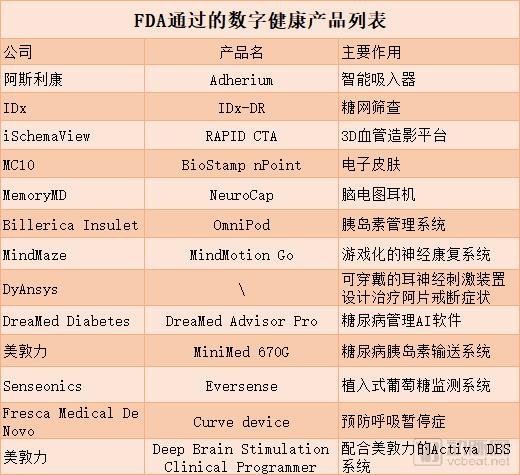
References:
Medical Device Industry: 2030 Outlook — KPMG
““Will There Still Be a Unicorn Winner After the ‘Hundred Glucose Meters War’?”
https://www.cnbc.com/2017/04/12/apple-working-on-glucose-sensors-diabetes-treatment.html
https://www.mobihealthnews.com/content/fda-green-lights-14-digital-health-products-continues-evolve-regulations
https://www.mobihealthnews.com/content/medtronic-acquires-ai-powered-nutrition-platform-nutrino