

Breaking Through in Elderly Care Models: Smart Elderly Care Returns to Human-Centric Service, Aiming for Shared Value through Integration and Empowerment
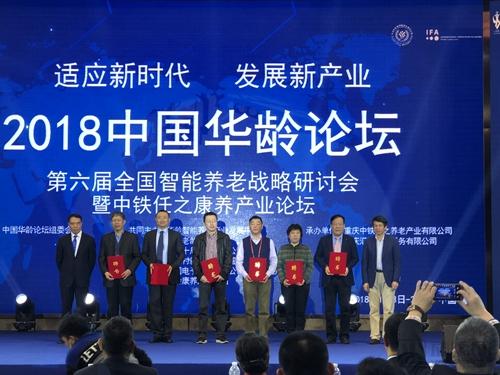
Conference: 2018 China Hualing Forum – The 6th National Smart Elderly Care Strategy Symposium and the China Railway Renzhi Health and Elderly Care Industry Forum
Location: Holiday Inn Chongqing R&F
Speakers: Wu Yushao, Member of the Party Leadership Group and Deputy Director of the Office of the National Working Commission on Aging; Li Xuemin, General Manager of China Railway No.10 Engineering Group Co., Ltd.; Zhu Yong, Former Deputy Director of the Office of the National Working Commission on Aging and Chairman of the Council of Hualing Intelligent Elderly Care Industry Development Center; Nie Meisheng, Founding President of the Real Estate Chamber of Commerce of the All-China Federation of Industry and Commerce; Chen Dapeng, Director of the Internet of Things Research and Development Center at the Chinese Academy of Sciences; Wu Liuxin, Dean of Zhongguancun New Zhiyuan Health Management Research Institute; Wang Zhiliang, Chief Professor at the University of Science and Technology Beijing; Yu Dongsong, Chairman, Yu Yaping, Vice Chairman, Li Nengpeng, General Manager, and Yang Bin, Executive Deputy General Manager of Chongqing China Railway Renzhi Elderly Care Industry Co., Ltd.; as well as distinguished representatives from leading smart health and elderly care enterprises.
Every family has elderly members, and everyone will grow old. The concept of “smart elderly care” is widely recognized; it was first proposed in 2012 by the National Working Commission on Aging. After years of trial and error, smart elderly care is now experiencing a new wave of rapid growth, with various industries actively exploring and developing “Smart Elderly Care Plus” models. At the 2018 China Hualing Forum, leading figures in the elderly care sector provided detailed insights into the prevalent challenges facing China’s smart elderly care industry, current focal points of attention, and further strategies to break through existing bottlenecks.
Below is a compilation of the speaker’s insightful views by VCBeat (WeChat ID: vcbeat), primarily covering three key perspectives:
I. Hotspots, Challenges, and Pain Points of Smart Elderly Care
II. Elderly Care Models Require Further Breakthroughs
III. Integrated Empowerment and Sharing-Led Innovation in Development Models
Hotspots, Challenges, and Pain Points of Smart Elderly Care
According to Wu Yushao, Deputy Director of the National Office on Aging, smart elderly care is of great significance and has been developing rapidly, yet it faces numerous challenges. Director Wu conducted an analysis from three perspectives: conceptual understanding of smart elderly care, integrated development of smart elderly care, and human-centric services in smart elderly care.
I. Conceptual Understanding of Smart Elderly Care
Director Wu stated that smart elderly care should encompass smart concepts, smart technologies, and smart approaches. It is not solely about technology, which is merely one component; rather, technology should be guided by underlying principles. These guiding principles should be rooted in the concepts of active aging and healthy aging. The concept of active aging primarily encourages older adults to be proactive, independent, self-reliant, and engaged, as opposed to being passive, dependent, or inactive. We must ensure that smart elderly care does not foster new forms of dependency among older adults.
Another point concerns the three principles of age-friendly living stipulated in the Elderly Rights Law: safety, convenience, and comfort. Director Wu placed particular emphasis on safety, stating that it encompasses not only the functional safety of equipment and facilities but also information security, including privacy protection.
II. Integrated Development Is the Soul of Smart Elderly Care
Director Wu stated that smart technology and elderly care require a high degree of integration. A major reason why smart elderly care is currently unpopular among seniors is that the use of new devices has become a burden for them—having to wear various devices at home and when going out disrupts their normal daily lives.
Furthermore, smart elderly care should be organically integrated with traditional models of home-based, community-based, and institutional care. In particular, regarding health management in the home-based sector, traditional approaches have been challenging to implement due to the lack of internet connectivity, big data, and artificial intelligence. However, smart elderly care provides new opportunities and possibilities for modern health management.
It is worth emphasizing that many current products have implemented monitoring for the elderly, tested numerous indicators, and generated vast amounts of data. ButThe most critical factor is not the volume of data, but its effectiveness., it is not that the more and bigger the data, the better; rather, the more precise and effective, the better.
III. Human-Centric Services in Smart Elderly Care
Elderly care should be“Technological Subtraction + Service Addition”, and smart elderly care should be“Technical Precision + Humanistic Warmth”, in a sense, the warmth of humanistic care may be even more important than the precision of technology.
“Providing elderly care is fundamentally about delivering services.” Elderly care services are primarily hands-on, interpersonal services; at their core, they are service-oriented. However, elderly care has unique characteristics that demand humanized, personalized, and family-like approaches. In the realm of smart elderly care, many regions have developed informatization platforms. Yet, due to constraints imposed by regional administrative systems, these initiatives remain limited in scale and tend to prioritize online over offline operations, and call-center functionalities over effective engagement and service delivery to end-users. As a result, such smart elderly care solutions are merely superficial and fail to constitute genuine service provision.
Elderly Care Models Need Further Breakthroughs
According to Nie Meisheng, the founding president of the Real Estate Chamber of Commerce under the All-China Federation of Industry and Commerce, China’s current elderly care model needs a breakthrough, transitioning from a phase of high-speed growth to one of high-quality growth.
First, fromManagement ModelUpgrading from a model where development, construction, and operations are handled by the same entityOne-Stop Management, involving different entities for development, construction, and operationTwo-Station Management, where the local government, investors, constructors, operators, asset holders, and exit acquirers are all distinct entities, in this form ofMulti-Station Managementtransformation. This creates an entire industry chain, where each entity has different financing models and shareholders, thereby making it possible to form an asset package.
Secondly, fromProfit ModelUpgrade from the traditional model of selling housesReal Estate Model, with the separation of the insurance platform for customer acquisition, the insurance platform, and the asset holding and operation platformInsurance Model, extending to institutions primarily in the financial sector, with financial products as the core thread to establish capital entry and exit mechanisms embedded throughout development and construction, operational management, and asset holding, until exiting after reaching a certain valuation, such as through REITs.Institutional Investment Modelof transformation.
The ultimate and genuine blue-ocean opportunity for breakthrough lies inC-End EmpowermentWhether in real estate insurance or among institutions, all are facing immense challenges from the new wave of internet technologies, big data, and high-tech innovations. The key to breaking through lies in generating incremental growth on top of existing stock; such growth must be driven by technological support. Those who can embed greater value-added increments into their current platforms will emerge victorious.
The entire service process requires upgrading. The underlying logic is to adopt a people-centric approach, refocus on the consumer end (C-end), transition from project-based models to platform-based ecosystems, shift from bounded to unbounded operations, and move from an investment-return mindset to a service-consumption orientation. Once service consumption is optimized, returns will inevitably improve.
Second, revitalizing the nation through science and technology ultimately aims to create a better quality of life. This involves shifting from a real estate mindset to an internet mindset, transitioning from merely applying internet technologies to fully embracing them, and upgrading from standalone product devices (Device A) to AI-enabled solutions for homes, communities, and industries. By integrating life sciences with the internet, we can maximize improvements in human health, longevity, and well-being.
Innovation in the Integration-, Empowerment-, Sharing-, and Leadership-Driven Development Model
In the view of Wu Liuxin, Dean of the Zhongguancun New Zhiyuan Health Management Research Institute, integration is the foundation of empowerment. It involves integrating platform systems and technological products to build a unified platform for resources and services. By consolidating high-quality medical and health service resources as well as elderly care resources, it enhances the capacity and efficiency of health and wellness services. Furthermore, by aligning the forces of government, market, society, and families, it creates a synergistic effect that boosts overall capability and effectiveness.
Empowerment is the prerequisite for sharing. Empowering communities involves age-friendly renovations, coordinated planning for the construction of smart health and elderly care communities, and the establishment of a framework comprising one platform, two centers, and N service points to create smart, livable communities for older adults. Empowering families entails implementing age-friendly modifications, deploying smart terminal devices, and providing training for family members to enhance their capacity for home-based health and elderly care services. Empowering services involves leveraging intelligent technological products to improve service delivery capabilities.
Sharing is the objective of empowerment, with the key lying in the establishment of scientific and efficient sharing mechanisms. Benefit-sharing mechanisms include partnerships, equity ownership, crowdfunding, and point-based systems. Establishing a sharing platform: In the enterprise-plus-organization platform model, health and elderly care are primarily matters of public welfare that require government attention. Meanwhile, market mechanisms should be leveraged to integrate and allocate resources, addressing demand from the supply side. The enterprise-plus-platform approach offers numerous advantages during project implementation. Establishing a consultation mechanism to safeguard stakeholders’ rights to information, expression, and participation; establishing a supervision mechanism involving government, organizations, and stakeholders for evaluation, management, and oversight.
Investors focusing on the elderly care sector are welcome to connect with our reporter for discussions (WeChat: Shirley_CaiAx).