

Global Outcry Over World’s First Gene-Edited Babies: Ethical and Scientific Backlash Intensifies
2018of the year11Month26Recently, the medical community, academia, and social circles have sparked an intense debate on ethics and philosophy.
The incident was triggered by an announcement released that morning: He Jiankui, a scientist from Shenzhen, China, declared on the eve of the Second International Summit on Human Genome Editing that a pair of gene-edited twin girls, named Lulu and Nana, had been born healthy in China in November.
One gene in these twins was modified, enabling them to be naturally resistant to HIV from birth. This marks the world’s first case of gene-edited babies with immunity to HIV.
As soon as the news broke, it immediately sparked widespread attention across China, rapidly dominating WeChat Moments feeds and generating countless posts with over 100,000 views. Hospitals, schools, regulatory authorities, and other stakeholders swiftly responded and issued statements. The dramatic and intense nature of these developments is surely familiar to all.
Meanwhile, the news quickly caused a stir in the international community and “blew up” social media feeds:
Dr. Kiran Musunuru, a gene-editing expert at the University of Pennsylvania and an editor for a genetics journal, stated, “This is unreasonable... unacceptable from the standpoint of human morality and ethics.”
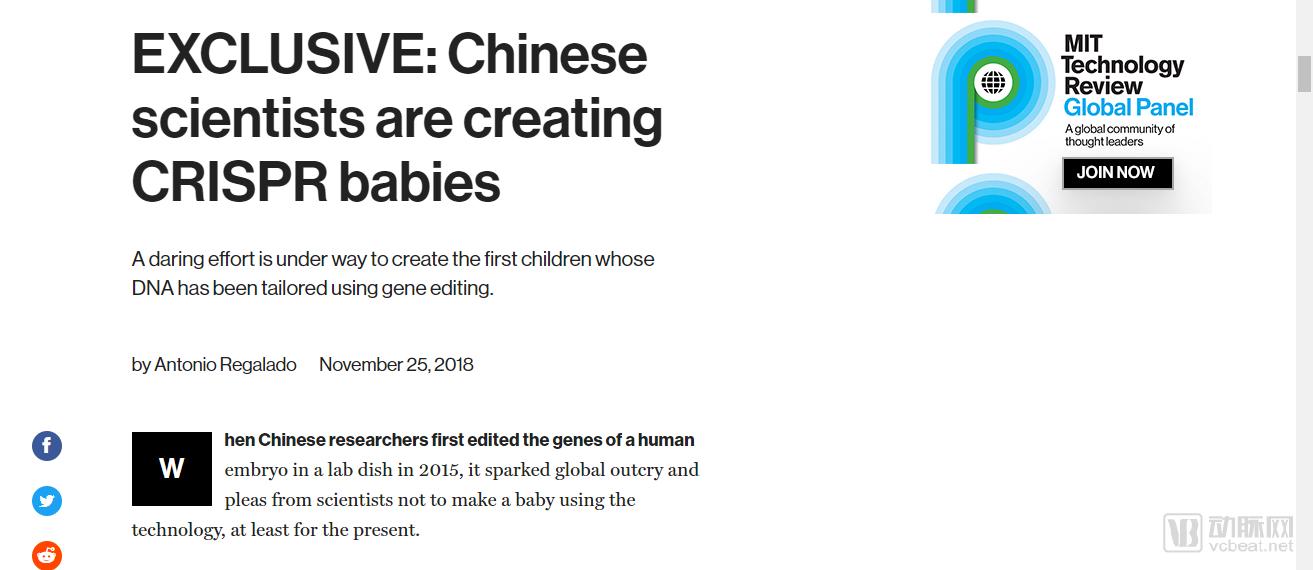
MIT Review wrote: “It has sparked intense global protests and a boycott by scientists, as the time is not yet right.”
“It’s too early,” said Dr. Eric Topol, Director of the Scripps Research Translational Institute in California. “At present, understanding even a single gene remains a major challenge.”
“If true, this experiment is terrifying,” said Julian Savulescu, Professor of Practical Ethics at the University of Oxford. “The embryos themselves were healthy, with no known diseases. Gene editing itself is experimental. If off-target effects occur, genetic problems—including cancer—could arise at any time, either in early life or later on.”
“There are now many effective methods for the prevention and treatment of HIV. This experiment may expose healthy children to genetic risks caused by gene editing, which is unnecessary. In many parts of the world, it is illegal.”
Dr. Sarah Chan, a bioethicist at the University of Edinburgh, stated that if true, the experiment faces serious ethical issues. “Regardless of whether the reports are accurate, deliberately causing an uproar in the academic community and seeking attention through such claims is irresponsible and unethical.” “This will polarize public opinion and deepen misunderstandings among those who already question and worry about science.”
Joyce Harper, a specialist in women’s reproductive health at University College London, believes that it is still too early to use gene editing on human embryos to prevent HIV, describing such an approach as dangerous and irresponsible. She stated that years of research are needed to demonstrate that intervening in the embryonic genome will not cause adverse effects. Before gene editing can be applied in the context of embryo transfer, legislation and public discussion are required.
Tetsuya Ishii, a bioethicist at Hokkaido University, also argues that using gene editing on embryos to reduce HIV infection is unjustified. Even if the mother is HIV-positive, transmission during childbirth can be prevented through cesarean section.
Now, let us take another look at the thrilling 12 hours that unfolded in China after the message was released.
The announcement sparked intense debate within the academic and medical communities:
“Is this playing with fire?”
“Mad Scientist!”
“Would directly removing a gene lead to uncontrollable consequences? Moreover, there are already effective prevention and treatment strategies for the disease.”
“Will another child who did not respond successfully to the treatment be affected?”
“Gene editing for the treatment of severe genetic diseases is understandable; it is a measure of last resort.”
More scrutiny has been directed at the hospital’s ethics committee: How did it pass ethical review?
Around 2:00 p.m., a reporter from The Beijing News contacted staff at Southern University of Science and Technology (SUSTech): He Jiankui was attending a conference in Hong Kong and was temporarily unavailable to respond to the online controversy.
In an article published by The Intellectual, Liu Ying, a researcher at the Institute of Molecular Medicine, Peking University, noted that the ethics application mentioned prior experiments conducted in model organisms such as monkeys, but merely described the procedures without providing any detailed results or follow-up observations of the animals involved.
“This ethics application is extremely sloppy; based on the dates provided, the trial had already been underway for a considerable period before ethical approval was granted. Ethical review is conducted in accordance with ‘research projects’“...was implemented according to the standard, but the standard itself is flawed,” he commented.
What happened next was unexpected by many.
At 15:19, the Medical Ethics Expert Committee of the Shenzhen Municipal Health Commission stated via The Beijing News: “The First Gene-Edited Babies Immune to HIV”The trial was not reported to the department prior to its initiation., currently holding a meeting to discuss this matter.
15:59, Southern Metropolis Daily continued to follow up on the incident:The relevant hospital stated that it had not received any related applications.
“I have no idea how this happened.”Qin Suji, former Director of the Medical Affairs Department at Shenzhen HeMei Women’s and Children’s Hospital, stated that according to the date indicated on the application form, he was still employed by the hospital and served as a member of the Ethics Committee at that time. However, he had no recollection of the hospital convening such a meeting, nor did he sign the application form.
He specifically reached out to former colleagues whose signatures appeared on the document to verify the situation. Several of them stated that they had never signed the application form and had no recollection of any meetings held regarding this project, suggesting that the signatures might be forged.
Cheng Zhen, General Manager of Shenzhen Hemme Women’s and Children’s Hospital, stated that the experiment was not conducted at the hospital, nor was the child born there. Regarding the application form circulating online, the hospital has no knowledge of the matter and is currently investigating and verifying the situation.
Not only the relevant hospitals, but also Southern University of Science and Technology, where He Jiankui was employed, stated that they were unaware of the matter.
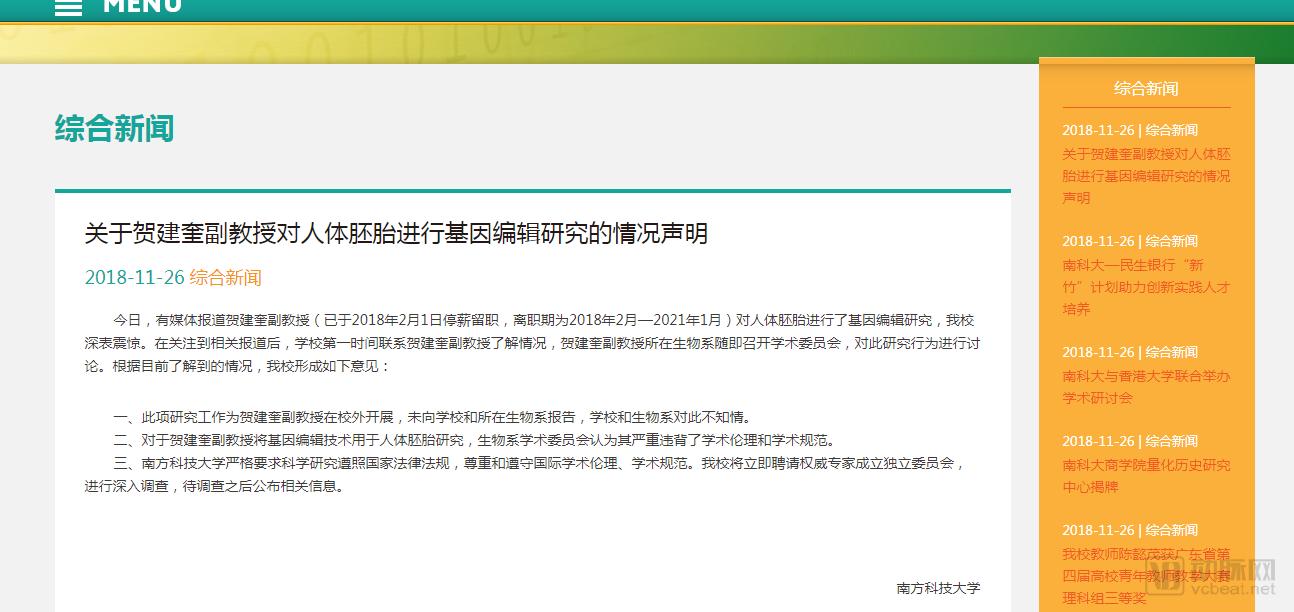
At around 6:00 p.m., Southern University of Science and Technology issued a statement expressing shock over the incident. It announced that the associate professor in question had been on unpaid leave since February 1, 2018, and that the university would immediately engage authoritative experts to establish an independent committee for an in-depth investigation.
Subsequently, Company E issued a statement reporting that its journalist visited the Department of Biology building at Southern University of Science and Technology (SUSTech) and located the office of Associate Professor He Jiankui. The office is situated within the research building, and posters highlighting technologies from Hanhai Genomics (of which He Jiankui serves as the legal representative) being featured in Nature subsidiary journals were displayed on the door. Adjacent to the office are the department’s laboratories. When questioned by the journalist, laboratory staff indicated that He Jiankui had not been present recently, noting that he seldom conducts experiments there and likely maintains his own external laboratory.
At 14:50, Sai Xiansheng, affiliated with The Intellectuals, published an article titled “Fierce Backlash: Gene-Edited Babies Draw Widespread Criticism from the Biomedical Community,” further intensifying the controversy.
In the article, Professor Zhang Linqi of Tsinghua University School of Medicine pointed out: CCR5 is important for the function of human immune cells.
“Editing CCR5 in healthy embryos is irrational and unethical.”We have not yet identified any Chinese individuals with a complete CCR5 deficiency.“He criticized,”CCR5 editing must not be used in humans until it can be guaranteed to be 100% error-free.”
In addition to ethics, safety is also a major focus of public concern.
In her article “Fierce Backlash: Gene-Edited Babies Draw Widespread Criticism from the Biomedical Community,” Liu Ying pointed out, “This experiment carries substantial potential risks at the scientific level. As test subjects, the two children will face these unknown risks throughout their growth.”
“Gene editing for the treatment of severe genetic diseases is understandable, as it is a measure of last resort.“An entrepreneur in the medical field stated, ‘But would directly removing a gene lead to uncontrollable consequences? Moreover, there are already effective prevention and treatment options available for this disease.’”
“An HIV-positive father and a healthy mother can 100% have a healthy and adorable child. There is absolutely no need for CCR5 editing,” Zhang Linqi pointed out in the article.
Gene editing should be targeted at monogenic diseases, but as is well known, HIV is an infectious disease that can be mitigated through prevention. Moreover, the difficulty in treating HIV is only a challenge at the current stage. Over a century ago, humanity had limited knowledge of tuberculosis, which was also once considered incurable.
Gilead pioneered the launch of zidovudine (AZT), the world’s first approved antiretroviral drug for HIV/AIDS, in 1987, followed by lamivudine. GSK subsequently developed various combination antiretroviral therapies (“cocktail therapies”), including Combivir (lamivudine/zidovudine), Trizivir (abacavir/lamivudine/zidovudine), and Epzicom (abacavir/lamivudine), at one point surpassing Gilead to become the dominant leader in the HIV/AIDS field. Currently, these two companies together have more than ten marketed products, some of which enable patients to remain asymptomatic and non-infectious while living with the virus for life.
This is not the first time that gene-editing technology has been mired in a public opinion storm.
In the early years, a research team in Oregon successfully modified the DNA of human embryos and was once condemned by public opinion. In 2016, a trial approved in the UK to edit human embryo genes using CRISPR was also once criticized.
The most contentious issue in public discourse stems from ethical considerations. Yet, also based on gene-editing technology, why is gene therapy viewed favorably by the public, with the FDA even approving related products for market release?
Gene therapy refers to the introduction of exogenous normal genes into target cells to correct or compensate for diseases caused by defective or abnormal genes. Simply put, gene therapy involves inserting exogenous genes into appropriate recipient cells in patients. Currently, the only permitted recipient cells are somatic cells.
However, the modifications made in this trial were performed on human embryos, which can be understood as fertilized eggs or germ cells. This type of modification is fundamentally different from the former, as it has the potential to be transmitted to subsequent generations.This is fundamentally different from gene therapy targeting somatic cells.
“Gene editing for the treatment of genetic diseases is understandable and acceptable.” said Li Dali, Director of the Department of Biomedical Sciences at the School of Life Sciences, East China Normal University. “Currently, many studies have begun to explore fetal gene therapy via gene editing using recombinant viruses in animal models.”
In his view, gene editing or gene therapy for diseased fetuses is acceptable, as many fetal cells are in an active phase of division, leading to higher recombination efficiency. However, editing zygotes is entirely different.
Despite the public outcry, perhaps we need to focus more on reflecting on the future. The child has already been born; what is done cannot be undone. The most urgent priority is to enact strict legislation and regulatory controls over such research, enhance scientists’ sense of ethical responsibility, and prevent similar incidents from recurring.
At 5:38 p.m., 122 scientists from universities including the University of Science and Technology of China, Sichuan University, and Fudan University issued a joint statement via The Intellectuals: “We firmly oppose this! We strongly condemn it!”
Meanwhile, this deals a severe blow to the global reputation and development of Chinese science, particularly in the field of biomedical research, and is profoundly unjust to the vast majority of diligent Chinese scholars who are committed to scientific innovation and uphold ethical standards.
They have called on the relevant regulatory authorities and research institutions to promptly enact legislation and enforce strict oversight, conduct a comprehensive investigation and handling of this incident, and timely release follow-up information to the public. The Pandora’s box has been opened; we may still have a slim chance to close it before the situation becomes irreversible.

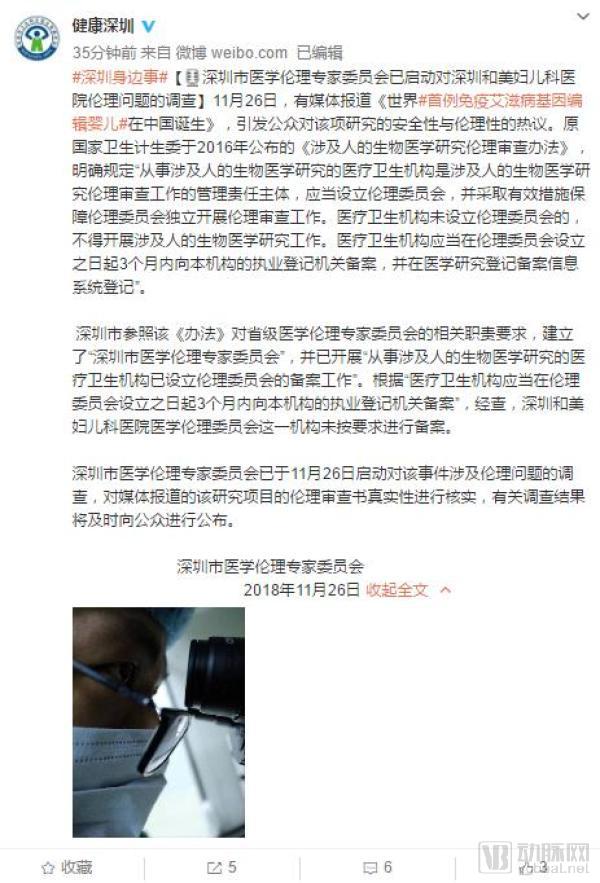
At 18:39, the Shenzhen Municipal Health Commission officially issued a statement announcing the initiation of an investigation into ethical concerns at Hemei Women’s and Children’s Hospital. The Medical Ethics Expert Committee will verify the authenticity of the ethical review documents for the research project reported by the media, and the relevant findings will be promptly disclosed to the public.
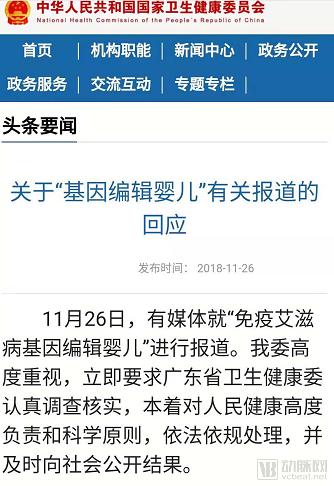
Around 10 p.m., the National Health Commission also responded, requiring the Guangdong Provincial Health Commission to conduct a thorough investigation and verification, and to promptly disclose the results to the public.