

Broad-Spectrum Anticancer Drugs Uncovered: Beyond Bayer, How Are Global Pharma Companies Positioning Themselves?
The recent discussions surrounding the FDA’s approval of a “broad-spectrum anticancer drug” may well become a classic case study in communication science. First, cancer is a topic of universal public interest, readily capturing widespread attention. Second, given the complexity of cancer pathologies and the diversity of treatment modalities, there is a strong public desire for a “clear-cut solution” capable of conquering the disease. Finally, as information dissemination becomes increasingly rapid and direct, with a lack of professional “gatekeepers,” the impact of any single news item can be amplified exponentially.
Following the announcement of a broad-spectrum anticancer drug, VCBeat promptly contacted the relevant manufacturer, Bayer, as well as industry experts to provide insights on the event and the drug itself.
The article is divided into four parts:
1. Expert Q&A: Why “Miracle Drugs” Are Not So Miraculous;
2. Unveiling the True Nature of “Miracle Drugs”: What Are Their Limitations?
3. A Comprehensive Review of Broad-Spectrum Anticancer Drugs: R&D Efforts and Product Pipelines of Major Pharmaceutical Companies in China and Abroad;
4. The Battle Against Cancer Is Still Ongoing.
VCBeat interviewed Mr. He Xiaobing, President and CEO of Chunfeng Health and Mingyan Pharma, who provided his interpretation of the broad-spectrum anticancer drug incident.
VCBeat:Do broad-spectrum anticancer drugs truly possess “miraculous” efficacy, capable of “curing” so many cancers? Some commentators claim high “response rates,” but in terms of real-world effectiveness, how effective is this drug actually?
Answer:First and foremost, it should be clarified that cancer cannot be “cured”; the current treatment goal is to prolong patients’ overall survival. The term “response” can be understood as follows: tumor cells exhibit a reaction to the medication being administered.
So-called broad-spectrum anticancer drugs actually refer to agents that act on multiple tumor targets of different types. Among these targets, some exhibit higher sensitivity to the drug, potentially resulting in more significant therapeutic effects, such as a decrease in tumor markers and tumor shrinkage. Other targets show lower sensitivity, leading to less pronounced effects, which may manifest as disease stabilization (i.e., preventing tumor growth) and absence of disease progression. Clinically, all these outcomes are considered positive, as they extend patient survival time.
On the other hand, when patients undergo genetic testing using tumor tissue, the results will indicate the mutation rate of specific targets. If the targets with high mutation rates happen to be those to which the drug is sensitive, the treatment outcome will be highly effective. Conversely, if the targets with high mutation rates fall outside the scope of the drug’s intended targets, the therapeutic effect will be suboptimal.
Patients undergoing cancer treatment should not place undue faith in broad-spectrum anticancer drugs. Instead, they should select the medication with the highest sensitivity based on their individual condition.
VCBeat:From a horizontal perspective, apart from Bayer, are there any other companies with pipelines in “broad-spectrum” anticancer drugs, including those already approved and those in research and development (clinical) stages?
Answer:From a scientific research perspective, the term “broad-spectrum anticancer drugs” is not entirely rigorous. If drugs applicable to multiple types of cancer are classified as broad-spectrum anticancer agents, there are currently many companies investing in this area. For instance, PD-1 inhibitors, which are already on the market and supported by extensive clinical data demonstrating their efficacy, can be considered “broad-spectrum” anticancer drugs. These include pembrolizumab from MSD and nivolumab from BMS. Although they target only a single molecule, this target is part of the human immune system. By activating the body’s own immune response against tumor tissues, these drugs help eliminate cancer cells. In addition to MSD and BMS, Roche has atezolizumab, while Pfizer and AstraZeneca also have developments in the PD-1 field, though their products have not yet been launched.
VCBeat:“Are ‘broad-spectrum’ anticancer drugs a major breakthrough in medicine and pharmacology? From a longitudinal perspective, what are the other milestones and landmark events in pharmacology over the past 20 years?”
Answer:Broad-spectrum anticancer drugs are, in essence, targeted therapies; they either act on multiple targets or target a single point while being effective against various types of cancer. The emergence of targeted drugs represents a major milestone for both the medical and pharmaceutical communities, enabling more precise cancer treatment. Gleevec, developed by Novartis for leukemia and featured in the film *Dying to Survive*, was the world’s first oncology targeted therapy. Its development journey was highly arduous, spanning several decades before finally gaining approval for market launch. This medication brought five world-class scientists to the United States.
The development of biologics also marked a major milestone, as it significantly expanded the scope of drug discovery into a new domain. Moreover, biologics development has become a highly competitive arena for major pharmaceutical companies, as many challenges encountered in small-molecule chemical drugs may find solutions in large-molecule biologics. For example, Roche’s Herceptin, a targeted therapy for breast cancer, has demonstrably extended patient survival due to its remarkable efficacy.
As tumor-related targets continue to be discovered, pharmaceutical R&D scientists are intensifying their efforts to develop drugs targeting these new molecules, and it is believed that more “miracle drugs” for cancer will emerge in the future.
On November 26, the U.S. FDA announced the approval information for larotrectinib, under the original title “FDA Approves Larotrectinib for the Treatment of NTRK Gene Fusion Solid Tumors.”
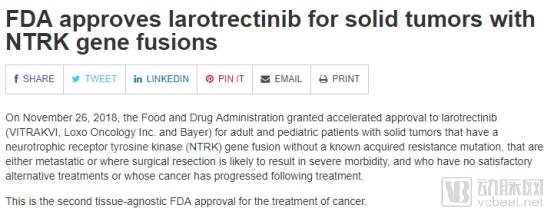
Image source: FDA official website
Larotrectinib is indicated for the treatment of adult and pediatric patients with solid tumors harboring NTRK gene fusions, who have no known resistance mutations, present with widely metastatic disease or locally advanced disease not amenable to curative surgical resection, and whose disease has progressed on prior therapies or who have no satisfactory alternative treatment options.
Data provided by Bayer indicate that NTRK gene fusions are chromosomal alterations that result in the production of constitutively activated abnormal TRK fusion proteins, which act as tumor drivers and promote the proliferation and survival of tumor cells in tumor cell lines.
Larotrectinib, jointly developed by Bayer and Loxo Oncology, is a TRK inhibitor with central nervous system activity that specifically inhibits these proteins. TRK fusions have been found in many types of tumors in both adults and children. In the clinical trials supporting this approval, Larotrectinib demonstrated clinical benefit across a variety of distinct tumor types, including lung cancer, thyroid cancer, melanoma, GIST, colorectal cancer, soft tissue sarcoma, salivary gland tumors, and infantile fibrosarcoma.
Diagnosis of TRK fusion-positive tumors can be achieved through specific detection methods, including the use of next-generation sequencing (NGS) and fluorescence in situ hybridization (FISH) to identify NTRK gene fusions. Patients with tumors harboring NTRK gene fusions are eligible for treatment with larotrectinib.
“The approval of larotrectinib has brought the first therapeutic agent for patients with TRK fusion cancers, a milestone achieved through years of dedicated effort and research by many individuals. Although TRK fusions are rare, they occur across a wide variety of tumor types. In this era of precision medicine, we are fulfilling Bayer’s commitment to delivering value to patients and physicians and shaping the future of cancer care,” said Mr. Robert LaCaze, Member of the Executive Committee of Bayer Pharmaceuticals and Head of the Oncology Strategic Business Unit. “It is highly meaningful to provide a targeted treatment option for patients with advanced solid tumors harboring NTRK gene fusions.”
“NTRK gene fusions are a rare cancer driver, and the FDA’s approval of larotrectinib for the treatment of such tumors marks a significant milestone. I have personally witnessed the therapeutic effects of larotrectinib; it is specifically tailored to this oncogenic driver, regardless of patient age or tumor type,” said Dr. David Hyman, Director of Early Drug Development Services at Memorial Sloan Kettering Cancer Center and Global Study Leader for a clinical trial of larotrectinib. “Now, we have the first approved therapy targeting this genetic alteration that is tumor-agnostic.”
The primary concerns regarding larotrectinib are its indications, cure rate, and price.
First, larotrectinib is indeed applicable to a variety of solid tumors; however, as a targeted therapy, it is effective only when specific gene fusions—namely, NTRK gene fusions—are detected. According to Josh Bilenker, CEO of Loxo Oncology, in an interview with The Washington Post, NTRK fusions occur in less than 1% of most solid tumor types but are common in certain malignancies, such as salivary gland cancers in adults and infantile fibrosarcoma. In the United States, it is estimated that only 2,000 to 3,000 people are diagnosed with NTRK fusion-positive cancers each year.
Secondly, regarding the term "cure rate," the correct terminology should be "response rate." Clinical trial data supporting the approval of larotrectinib, which enrolled 55 patients, demonstrated an overall response rate (ORR) of 75% (95% CI, 61%–85%) across various types of solid tumors in both adults and children, comprising 22% complete responses (CR) and 53% partial responses (PR).
Finally, regarding its pricing, the official wholesale acquisition cost for a 30-day supply of adult capsules is $32,800. The cost of the oral liquid formulation for pediatric patients will be based on body surface area, with a starting price of $11,000 per month. However, it is currently expected that most insurers will set copayments for both the medication and patients at $20 or less per month. Bayer has stated that it will provide payment assistance to patients in need and will refund the drug costs to payers and patients if the medication fails to demonstrate clinical benefit within the first three months.
Overview of Key Information on Larotrectinib
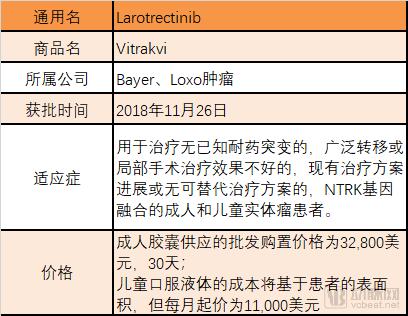
Source: Bayer official website, compiled from public information
Additionally, as with many drugs, long-term use of larotrectinib can lead to drug resistance. Bayer and Loxo Oncology are currently developing second-generation agents targeting emerging mutations.
As previously mentioned, any drug applicable to multiple diseases can be termed “broad-spectrum.” For instance, carmustine, a broad-spectrum anticancer agent that has been used in clinical practice for over 40 years, possesses advantages such as low molecular weight, strong lipophilicity of its β-chloroethyl group, and low plasma protein binding rate. These properties enable it to rapidly cross the blood-brain barrier. Clinically, it is primarily used to treat brain tumors, metastatic brain tumors, and other central nervous system neoplasms, making it the drug of choice for postoperative management of primary brain tumors (such as glioblastoma) and secondary tumors. In recent years, combination therapy regimens involving carmustine have been developed for the treatment of gastric cancer, rectal cancer, bronchial cancer, and other malignancies, sustaining its robust clinical development.
And the renowned paclitaxel, a broad-spectrum, cell cycle-specific antineoplastic agent with a unique mechanism of action. It promotes the assembly of microtubule dimers into microtubules and stabilizes them by preventing depolymerization, thereby blocking mitosis and inhibiting cell proliferation. Additionally, it enhances oxygenation in hypoxic cells, exhibits anti-angiogenic effects, and sensitizes tumor cells to radiation therapy. Its indications include first- and second-line treatment for ovarian cancer, breast cancer, and non-small cell lung cancer (NSCLC), as well as the treatment of head and neck cancers, esophageal cancer, seminoma, and recurrent non-Hodgkin lymphoma.
Calicheamicin, an antibiotic cytotoxin used in antibody-drug conjugates (ADCs), is a class of agents that possess both broad-spectrum antibacterial activity and potent cytotoxicity against various tumor cells. It binds to the minor groove of the DNA double helix and generates a benzene diradical through the Bergman cyclization reaction, thereby cleaving the DNA backbone and killing tumor cells. Drugs developed based on calicheamicin have been applied in the treatment of acute myeloid leukemia and relapsed or refractory B-cell precursor acute lymphoblastic leukemia.
Of course, the “broad-spectrum anticancer drugs” most favored by the industry at present are still PD-1/PD-L1 monoclonal antibodies. Due to their broad-spectrum nature and potential for combination therapy with many other drugs, the market has high expectations for the future prospects of PD-1 monoclonal antibodies. Currently marketed PD-1 monoclonal antibodies include Opdivo (nivolumab), Keytruda (pembrolizumab), and Libtayo (cemiplimab-rwlc) from Regeneron/Sanofi, which was recently launched. Marketed PD-L1 monoclonal antibodies include Roche’s Tecentriq (atezolizumab), AstraZeneca’s Imfinzi (durvalumab), and Pfizer/Merck KGaA’s Bavencio (avelumab).
According to a research report by Shenwan Hongyuan, the PD-1 products of BeiGene, Hengrui Medicine, Innovent Biologics, and Junshi Biosciences in China have all entered clinical stages for multiple indications.
Clinical Progress of Four Domestically Produced PD-1 Inhibitors
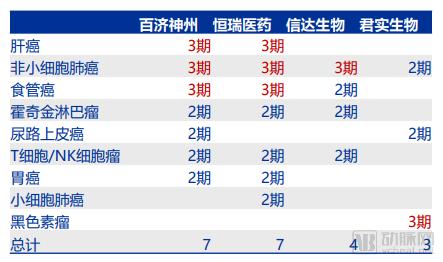
Source: Insight, Shenwan Hongyuan Research
Furthermore, CAR-T therapy can, to some extent, be described as a “broad-spectrum” anti-cancer technology. This approach first involves extracting T cells from the patient, then equipping them with “precision-guided weapons” (i.e., cancer-recognizing targets) via chimeric antigen receptor (CAR) constructs. After substantial expansion ex vivo, the engineered T cells are infused back into the patient, thereby conferring immunity against specific cancers.
Currently, two CAR-T therapies have been approved for market launch: Novartis’s KYMRIAH (indicated for relapsed/refractory acute lymphoblastic leukemia [ALL] in patients up to 25 years of age and for relapsed/refractory diffuse large B-cell lymphoma [DLBCL]) and Kite’s YESCARTA (indicated for relapsed/refractory DLBCL). In addition, numerous CAR-T therapies targeting different antigens are undergoing clinical trials. Notable examples include Juno Therapeutics/Celgene’s JCAR017, Cellectis/Pfizer’s UCART19, Bluebird Bio’s bb2121, and Legend Biotech’s (a subsidiary of GenScript) LCAR-B38M.
Progress of Selected CRT-T Products
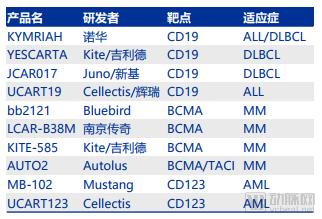
Source: PharmaDJ, FDA, Shenwan Hongyuan Research
However, regardless of the type of “broad-spectrum anticancer drugs,” there are limitations in their indications; targeted therapies are not truly “broad-spectrum,” and those that are “broad-spectrum” lack precision.
Global data indicate that highly competitive multinational pharmaceutical companies also maintain relatively high levels of R&D investment. Data show that in 2017, the ratio of R&D expenditure to sales revenue for the top ten pharmaceutical companies worldwide was generally above 20%, with the highest reaching 45%.
Top 10 Pharmaceutical Companies by Global R&D Investment in 2017
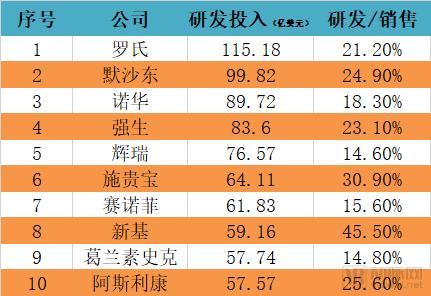
Data source: Company announcements, Menet, compiled by VCBeat
The global competitiveness of multinational pharmaceutical companies is closely tied to their substantial R&D investment. Sustained funding in research and development has driven the creation of high-quality therapeutics, giving rise to “blockbuster” drugs. For some pharmaceutical firms, a single drug can generate over $10 billion in global sales revenue, maintain market leadership for years, and deliver substantial profits to the company.
Whether it was the previously widely discussed film “Dying to Survive” or the recently debated “broad-spectrum anticancer drugs,” these phenomena essentially reflect the public’s earnest hope of overcoming disease and conquering cancer.
The Battle Against Cancer: Still a Work in Progress.