

FDA Encourages Digital Therapeutics Innovation: Unicorns vs. Corporate Alliances – Who Will Emerge Victorious?
Recently, ReSET, a product under Pear Therapeutics, became the first FDA-approved digital prescription therapeutic for the adjunctive treatment of substance use disorders involving stimulants, cannabis, cocaine, or alcohol, helping patients manage drug addiction.
In recent years, with the continuous emergence of digital innovators and regulatory agencies adjusting their review frameworks, digital therapeutics have developed rapidly, becoming an emerging market with huge potential. Pharmaceutical companies' investments in digital health startups have also increased sharply, and software-based digital therapeutic products have appeared in the pipelines of pharmaceutical manufacturers traditionally dominated by conventional drugs.
VCBeat (WeChat ID: vcbeat) has taken stock of the major competitors in this field. This article includes the following content:
1. A Comprehensive Analysis of Digital Therapeutics: The FDA Maintains an Open Stance;
2. Major Competitive Landscape: Unicorns vs. Corporate Alliances;
3. Development Potential: As an adjunctive therapy, it presents opportunities for pharmaceutical companies.
Over the past decade, the digital health sector has experienced rapid development. Researchers have leveraged advanced technologies and devices to enhance clinical treatment, giving rise to two distinct types of digital therapeutics. The first type extends the value of traditional pharmacotherapy; for example, companion software provides medication adherence management and personalized treatment recommendations to help patients manage their conditions, including guidance on medication timing and dosage. The second type serves as a substitute for traditional medications, such as using tablets to deliver sensory stimulation for the treatment of insomnia or depression.
The Digital Therapeutics Alliance, composed of industry stakeholders, defines digital therapeutics (DTx) as:
“Digital therapeutics deliver evidence-based therapeutic interventions to patients, driven by high-quality software programs, for the prevention, management, or treatment of a medical condition. They can be used independently or in conjunction with medications, devices, or other therapies to optimize treatment outcomes and improve patient health.”
Digital therapeutics products integrate advanced technologies related to design, clinical trials, usability, and data security. Regulatory authorities are required to review and approve these products to address product claims concerning risk, efficacy, and intended use.
"Digital therapeutics provide intelligent tools for patients, healthcare providers, and payers to address various aspects of disease through high-quality, safe, and effective data-driven interventions."
It is worth noting that digital therapeutics often target conditions that are not adequately addressed by current healthcare systems, such as chronic diseases or neurological disorders. Furthermore, by reducing the demand for clinicians’ time, this approach is typically more cost-effective than traditional therapies.
Meanwhile, growing evidence highlights their clinical value. For instance, the U.S. Food and Drug Administration (FDA) recently approved a mobile application to aid in the treatment of alcohol, cannabis, and cocaine addiction. Relevant clinical trial results indicated that 40% of patients using the app achieved abstinence from addiction or dependence within three months, compared with only 17.6% of those receiving standard therapy alone.
Currently, hundreds of millions of dollars are being invested in digital health technologies, with more than 318,000 related applications already available on the market. In this process, regulatory agencies play a crucial role by conducting rigorous reviews and evaluations of digital therapeutic products to inform consumers and healthcare professionals about which solutions are safe, effective, and offer therapeutic value and clinical benefits.
As we can see, the FDA maintains an open stance toward digital therapeutics products and encourages innovation. FDA Commissioner Scott Gottlieb once stated, “While safeguarding patients, the FDA is expanding opportunities for the development of digital health technologies and actively developing new regulatory frameworks to review related products using novel approaches.”
For example, its subordinate Center for Devices and Radiological Health established a Digital Health Unit, signaling that the FDA has begun to consider how to evaluate software or applications using criteria distinct from those for traditional drugs and medical devices, so as to accommodate the unique characteristics of digital health technologies and their different cycles of commercial innovation.
Pear Therapeutics’ ReSET became the first prescription digital therapeutic approved by the FDA; the ABILIFY MYCITE system, co-developed by Proteus Digital Health and Otsuka Pharmaceutical, received FDA approval for its New Drug Application (NDA), becoming the first approved drug-sensor combination product; Akili recently completed a multicenter trial and publicly submitted an application for FDA approval. These milestone events demonstrate that digital therapeutics are gradually gaining regulatory recognition and support, emerging as a significant segment within the digital health market.
In addition to recent approvals, the FDA appears to be paving the way for more digital prescription products. The Software Pre-Certification Pilot Program conducted by the FDA allows companies to make minor changes to their devices without having to submit a review application each time. Moreover, the FDA will ensure that other aspects of the regulatory framework, such as new software verification tools, possess sufficient flexibility to align with the unique characteristics of this rapidly evolving field and guarantee that these new technologies meet safety and efficacy standards.
In the U.S. digital therapeutics sector, the primary competitors currently include the unicorn company Proteus Digital Health and members of the Digital Therapeutics Alliance—Pear Therapeutics, Akili Interactive Labs, Propeller Health, WellDoc, Omada Health, and Voluntis.
Selected Digital Therapeutics Companies and Products
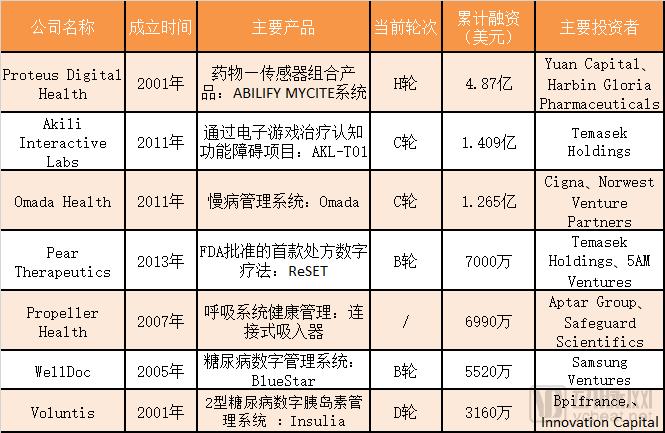
Source: VCBeat
As a unicorn company in the digital health sector, Proteus Digital Health specializes in digital medicine and holds more than 450 patents. Its product portfolio includes: medications that enable communication and connectivity after ingestion; wearable sensors that detect medication intake and capture physiological responses; applications that support patient self-care and clinical decision-making; and data analytics tools serving physicians and health systems.
In November 2017, Proteus’s ABILIFY MYCITE system received FDA approval for its New Drug Application (NDA), becoming the first approved drug-sensor combination product for adults in the United States, capable of tracking medication ingestion for the treatment of conditions such as schizophrenia and major depressive disorder.
In October 2018, Proteus announced a further strengthened collaboration with Otsuka Pharmaceutical in the field of digital therapeutics, aiming to apply its technology to a broader range of mental health treatments and better meet the needs of patients with severe mental illnesses. Otsuka Pharmaceutical paid Proteus $88 million in equity and other considerations, and the two parties signed a five-year agreement to jointly establish teams dedicated to the development and commercialization of the ABILIFY MYCITE system.
The Digital Therapeutics Alliance was established in October 2017, with members including Pear Therapeutics, Akili Interactive Labs, Propeller Health, WellDoc, Omada Health, and Voluntis.
Digital therapeutics company Akili Interactive Labs raised a cumulative $68 million in 2018, bringing its total funding to over $140 million. Investors included CLSA, Omidyar Technology Ventures, Digital Garage Group, and Fearless Ventures. Akili primarily delivers digital therapeutics through video game-based interventions.
For example, AKL-T01 (also known as the “Evo ADHD Treatment Program”) enables users to control an avatar by tilting their device forward and backward, while simultaneously requiring them to tap the screen in response to targets. The associated application tracks user movements, monitors behavior, and rapidly adapts to the player. This sensory stimulation delivered through gameplay can target specific neural circuits, thereby treating cognitive impairments. In December 2017, Akili announced the results of the largest clinical trial of AKL-T01. Currently, these trial data are being used to support the application for FDA approval of this digital therapeutic.
Omada Health, a digital chronic disease management company, primarily provides digital therapeutics for conditions such as type 2 diabetes, heart disease, and obesity. The Omada platform is an open system that allows users to customize it according to their individual health needs by creating modular and personalized workflows within the program to address obesity-related conditions. Specifically, the digital program adjusts its management recommendations based on various variables, including user demographics, comorbidities, self-identified barriers, and medication adherence.
In January this year, Omada announced the launch of the largest clinical trial to date for a digital diabetes prevention program. In May, the program received full recognition from the U.S. Centers for Disease Control and Prevention (CDC). In September, Omada announced an expanded partnership with Cigna; by January 2019, Omada’s technology will be integrated into Cigna’s mobile offerings to deliver digital health services to more patients.
Pear Therapeutics is a digital health technology company dedicated to developing digital therapeutics and combination solutions comprising pharmaceuticals and digital software, with the aim of improving patient outcomes and providing actionable data to guide clinical decision-making. The company’s lead product, ReSET, is the first FDA-approved prescription digital therapeutic designed as an adjunct treatment for substance use disorders involving stimulants, cannabis, cocaine, or alcohol, helping patients regain control over addiction. Other digital therapeutic products include reSET-O for the treatment of opioid use disorder and reVIVE for the treatment of generalized anxiety disorder and panic disorder.
In March this year, Novartis and Pear Therapeutics signed a collaboration agreement to develop digital prescription therapies for patients with schizophrenia and multiple sclerosis (MS). This partnership will combine Novartis’s expertise in neurology, clinical development, and commercialization with Pear Therapeutics’ experience in designing digital prescription therapies.
Propeller Health is a company that provides respiratory health management solutions. It offers a mobile platform comprising sensors, a mobile application, analytics, and services to support respiratory health management, improve patient outcomes, and reduce healthcare costs. Propeller’s smart sensors enable continuous tracking during medication administration, recording the time and location of inhaler use.
In 2017, Propeller partnered with Novartis Pharmaceuticals to develop customized smart sensors for the Breezhaler series of chronic obstructive pulmonary disease (COPD) medications, including Ultibro Breezhaler, Onbrez Breezhaler, and Seebri Breezhaler. This past May, Propeller Health established a partnership with Aptar Pharma to upgrade devices and platforms targeting chronic respiratory diseases. Propeller stated that its products have received FDA 510(k) clearance.
WellDoc’s core business is providing a mobile and cloud-based diabetes management platform, partnering with insurance companies to deliver diabetes management programs for patients. Its flagship product, BlueStar, is an all-in-one digital health solution that helps patients better manage chronic diseases and achieve long-term health by analyzing patient data and sending analytical reports to healthcare teams.
In January this year, WellDoc and Truven Health Analytics released a joint report showing that BlueStar can save an average of more than $250 per patient per month. In July, WellDoc announced that it had expanded its digital diabetes management platform, BlueStar, by adding features such as weight management and hypertension monitoring. Subsequently, the company will also launch a standalone product targeting hypertension.
Insulia, the diabetes management system launched by Voluntis, is a prescription medical device that provides insulin dose reminders and guidance to patients with type 2 diabetes via a smartphone app, based on blood glucose levels and other glucose-related data.
Insulia supports a wide variety of treatment regimen configurations and evidence-based insulin adjustment rules for daily clinical practice. Personalized treatment plans are initially developed by healthcare professionals based on the patient’s individual circumstances, insulin prescriptions, and glycemic targets. The dose adjustment algorithm is embedded within the application and does not require further validation by healthcare professionals after the initial system setup. Patient data is then automatically shared with the medical team, who can remotely monitor the patient’s progress toward achieving their treatment goals, facilitated by customized alerts.
In November 2016, the Insulia app received FDA 510(k) clearance and European CE marking. In November 2017, the solution gained further FDA approval to incorporate two additional basal insulins—Basaglar and Tresiba—into the application. Prior to this, Insulia was already compatible with insulin brands such as Lantus, Levemir, and Toujeo.
Reena Sangar of Ipsos Healthcare stated that when digital therapeutics are explained to physicians, most express interest but primarily view them as adjunctive tools to medication rather than standalone treatments. Specifically, when neurologists were asked about a virtual reality product for chronic disease management, only 7% indicated they would use it as a monotherapy, 39% said they would use VR in conjunction with medication, and 43% stated they would continue with pharmacotherapy alone.
When asked about a digital application for diabetes treatment, 22% of endocrinologists said they would use the digital app, 27% would use an app with an insulin advisor, and 38% would opt for conventional therapy.
Furthermore, the pharmaceutical business model itself poses obstacles to the development of digital therapeutics. In most countries, patents grant pharmaceutical manufacturers 20 years or more of protection, shielding them from competition by generic drugs. However, regulatory agencies cannot provide the same level of protection for devices or medical equipment. Competitors can rapidly enter the market by making incremental changes to the technologies they employ, as long as they avoid infringing on design patents. Coupled with significant differences in production and distribution, the development model for digital therapeutics is fundamentally different from that of pharmaceutical distribution.
However, digital therapeutics may also present significant opportunities for pharmaceutical companies, transforming the way they develop or market their products. For those seeking to bring products to market, demonstrating clinical value and economic benefits has long been a challenge. Digital therapeutics, however, offer a different perspective on medication consumption patterns and provide real-time data on their impact. Companion sensors can inform pharmaceutical companies about patients’ responses to their medications, thereby influencing research and development, or signaling when treatment efficacy is relatively low, thus demonstrating to physicians and payers the need for more effective therapies.
The immense potential of digital therapeutics in the pharmaceutical industry has attracted numerous investors and partners. For instance, Roche recently acquired mySugr, a diabetes management platform. In the long run, it is highly likely that more pharmaceutical companies will develop their own digital therapeutic product lines. However, in the short term, most companies are opting for collaborative approaches, particularly for digital devices that leverage data and patient engagement to assess therapeutic efficacy, serving as adjuncts to existing treatments. For example, pharmaceutical giant GlaxoSmithKline (GSK) partnered with digital therapeutics company Propeller Health to produce a “smart” inhaler for the treatment of asthma and chronic obstructive pulmonary disease (COPD).
Peter Hames, CEO of Big Health, and Jorg Land, CEO of Sonormed, both stated that any evidence-based behavioral or mental health condition is suitable for digital therapeutics, as approximately 80% of healthcare budgets are consumed by chronic diseases, a significant portion of which can be addressed directly or indirectly through cognitive behavioral therapy. For instance, Germany has only 4,500 neurologists, while an aging population is driving an increase in patient numbers. Although some companies focus on early detection, diagnosis is meaningful only when it leads to treatment options; otherwise, patients may experience adverse effects. Consequently, the market is trending toward solutions that offer both therapeutic and preventive value.
Edouard Gasser, CEO of Tilak Healthcare, believes that digital therapeutics can be applied in the fields of ophthalmology, neurology, and psychiatry. For instance, psychiatry is a major discipline where patient monitoring is crucial; since therapists cannot be with patients 24 hours a day, it is much more convenient for individuals with depression to carry a smartphone application with them.
Although there is still a long way to go before digital therapeutics become mainstream treatments and address critical health issues, growing awareness of the need to establish safety and efficacy standards is driving digital innovators to accelerate collaborations with payers, providers, and pharmaceutical companies, while seeking faster regulatory approval.
References:
https://www.mobihealthnews.com/content/depth-defining-burgeoning-field-digital-therapeutics